The US Presidential election day is now less than five weeks away and, while Trump and Clinton are on their corners waiting for the second debate on the 9th of October, the amount of market analysis centered on politics is obviously picking up.
Despite politicians’ impact on markets is nothing new, and generally priced ahead into the markets, this year’s election offers more uncertainty than ever. Trump is an unconventional candidate and his entire campaign has offered an almost complete set of shocking, non-establishment, statements. As example, Trump has defined the North American Free Trade Agreement (NAFTA) the "worst trade deal that the US has ever signed" and declared his intention to build a wall along the Mexican border to limit immigration. In parallel, he showed consideration for Vladimir Putin up to defining him as a “strong leader”.
Logically, markets started to discount the implication of a Trump election, with potential political tensions between the US and Mexico, as well as closer ties with Russia. From a currency perspective, such political scenario is reflected by a clear rising trend in the RUB/MNX pair, now renamed as the “Trump Trade”. Indeed, this pair is very likely to reflect the general consensus about Donald Trump’s chances to become the 45th US President.
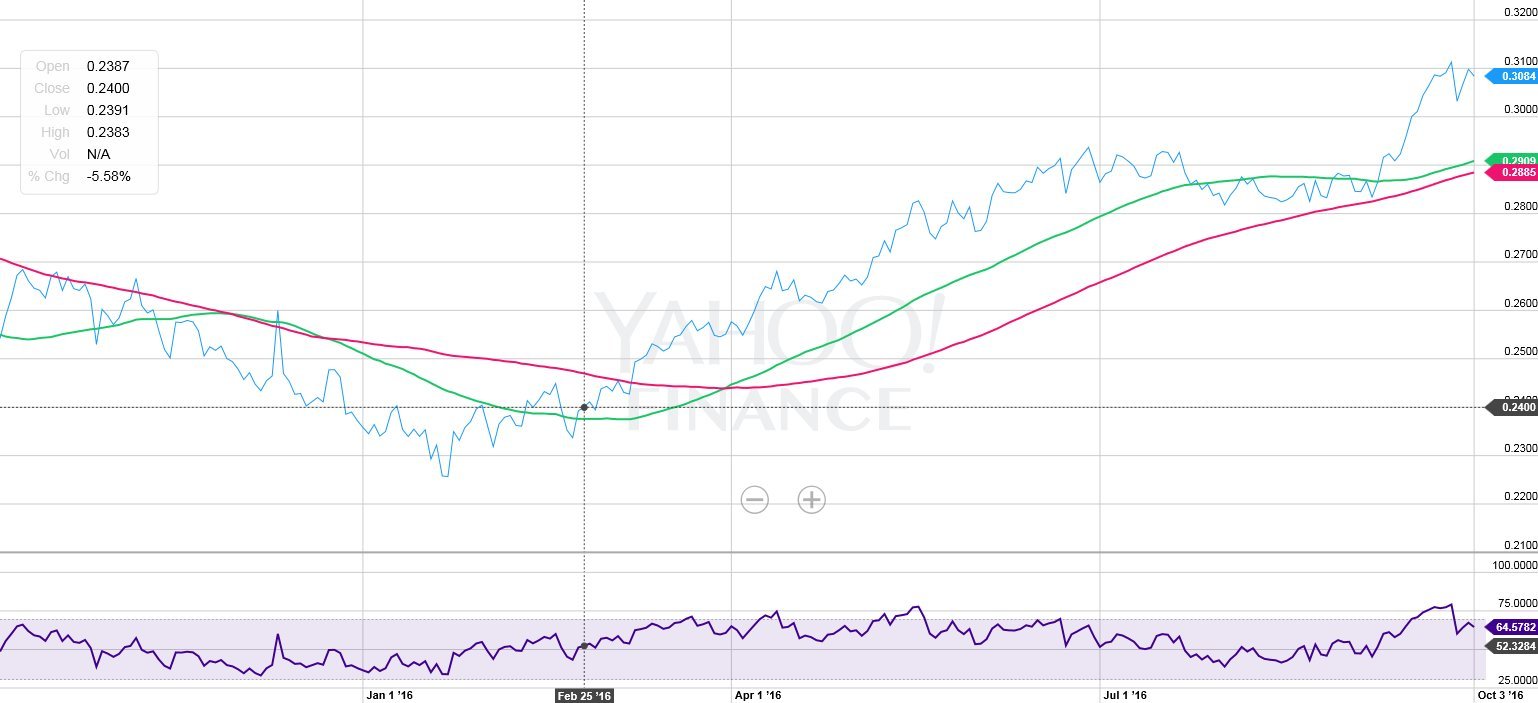
However, few brokers can offer the pair directly, leaving the only solution as to create a synthetic currency pair. Now, let’s dig into the details of it. As explained before, a synthetic currency pair is one that is not listed, or not offered by brokers and liquidity providers. Reasons are generally the limited capital flows between the two economies.
In our case we can create a synthetic pair through two sufficiently liquid pairs such as USD/MXN and USD/RUB. More specifically, we need to sell USD/MXN and buy an equivalent amount of USD/RUB. Once this is done the Dollar positions effectively cancel each other, leaving a long position on the Russian Ruble and a short position on the Mexican Pesos.
There are basically three points to closely watch in a synthetic pair trade:
-
Monitoring: Due to the lack of a direct listing of the pair (in our case, a long RUB/MXN), it becomes necessary to find at least a portal with a clear chart, in order to monitor the trade and analyze it with our own traditional technical analysis tools.
-
Spreads: As with any single currency transaction, there is a spread associated. In a synthetic currency trade we are opening two individual positions, so there will be a spread associated with each transaction. This makes the trade more costly than a liquid one. Therefore, we need to carefully assess how frequently is convenient for us to trade, in order not to push up spreads cost.
-
Interest Rate Differentials: Since there are three countries involved in a synthetic currency transaction, we need to monitor three interest rates as they may negative or positively affect our trade.
Note: All information on this page is subject to change. The use of this website constitutes acceptance of our user agreement. Please read our privacy policy and legal disclaimer. Opinions expressed at FXstreet.com are those of the individual authors and do not necessarily represent the opinion of FXstreet.com or its management. Risk Disclosure: Trading foreign exchange on margin carries a high level of risk, and may not be suitable for all investors. The high degree of leverage can work against you as well as for you. Before deciding to invest in foreign exchange you should carefully consider your investment objectives, level of experience, and risk appetite. The possibility exists that you could sustain a loss of some or all of your initial investment and therefore you should not invest money that you cannot afford to lose. You should be aware of all the risks associated with foreign exchange trading, and seek advice from an independent financial advisor if you have any doubts.
Editors’ Picks
EUR/USD stays bid near 1.1650 ahead of Fed rate decision
EUR/USD keeps the green near the 1.1650 level in the European session on Wednesday. Markets turn cautious and ignore the US Dollar ahead of the US Federal Reserve interest rate decision later on Wednesday, where a 25 bps rate cut is almost fully priced in. Meanwhile, cautious ECB-speak keeps the Euro afloat.
GBP/USD holds gains above 1.3300, eyes on Fed outcome
GBP/USD trades on a firmer note above 1.3300 in Wednesday's European session. The US Dollar weakens against the Pound Sterling as the US Federal Reserve is widely expected to announce another interest rate cut on Wednesday. Next of note will be the UK monthly Gross Domestic Product (GDP) report that will be published on Friday.
Gold struggles around $4,200, looks to Fed for fresh impetus
Gold extends its sideways consolidative price move through the European session and trades around $4,200 this Wednesday. Traders now seem reluctant and opt to wait for the outcome of a two-day FOMC policy meeting later in the day. The key focus will be on updated economic projections and Powell's speech.
Solana price flashes bullish potential on institutional, retail confidence
Solana (SOL) extends its upward trend for the third consecutive day, trading within a consolidation range of $121-$145. Persistent inflows into Solana Exchange Traded Funds (ETFs) over the last four days suggest steady institutional confidence.
BoC expected to hold interest rate, signaling the end of easing cycle
The Bank of Canada is widely expected to maintain its benchmark interest rate at 2.25% at its meeting on Wednesday. That would follow two consecutive quarter-point rate cuts in September and October.
RECOMMENDED LESSONS
Making money in forex is easy if you know how the bankers trade!
I’m often mystified in my educational forex articles why so many traders struggle to make consistent money out of forex trading. The answer has more to do with what they don’t know than what they do know. After working in investment banks for 20 years many of which were as a Chief trader its second knowledge how to extract cash out of the market.
5 Forex News Events You Need To Know
In the fast moving world of currency markets where huge moves can seemingly come from nowhere, it is extremely important for new traders to learn about the various economic indicators and forex news events and releases that shape the markets. Indeed, quickly getting a handle on which data to look out for, what it means, and how to trade it can see new traders quickly become far more profitable and sets up the road to long term success.
Top 10 Chart Patterns Every Trader Should Know
Chart patterns are one of the most effective trading tools for a trader. They are pure price-action, and form on the basis of underlying buying and selling pressure. Chart patterns have a proven track-record, and traders use them to identify continuation or reversal signals, to open positions and identify price targets.
7 Ways to Avoid Forex Scams
The forex industry is recently seeing more and more scams. Here are 7 ways to avoid losing your money in such scams: Forex scams are becoming frequent. Michael Greenberg reports on luxurious expenses, including a submarine bought from the money taken from forex traders. Here’s another report of a forex fraud. So, how can we avoid falling in such forex scams?
What Are the 10 Fatal Mistakes Traders Make
Trading is exciting. Trading is hard. Trading is extremely hard. Some say that it takes more than 10,000 hours to master. Others believe that trading is the way to quick riches. They might be both wrong. What is important to know that no matter how experienced you are, mistakes will be part of the trading process.
The challenge: Timing the market and trader psychology
Successful trading often comes down to timing – entering and exiting trades at the right moments. Yet timing the market is notoriously difficult, largely because human psychology can derail even the best plans. Two powerful emotions in particular – fear and greed – tend to drive trading decisions off course.