 Brandon Wendell, CMT
Brandon Wendell
In my first article on Point and Figure (P&F) charting, I discussed the basics of creating that style of chart. In this article, I will build upon that knowledge and show more advanced methods for identifying patterns and projecting price movement. I want to mention that I tend to use this method of charting for longer term swing or position trades rather than intraday. Remember that time is not a factor while attempting to achieve targets in P&F and you will likely hold positions for some time.
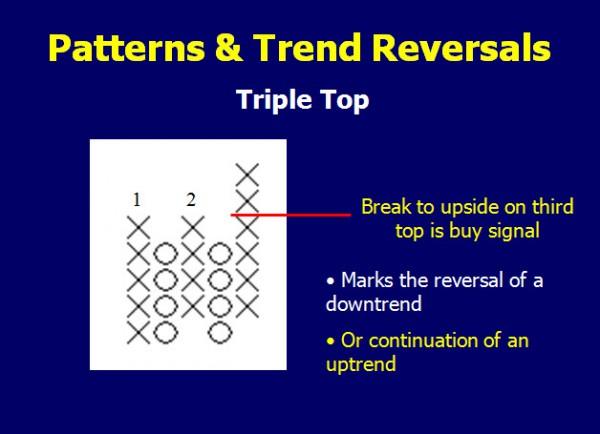
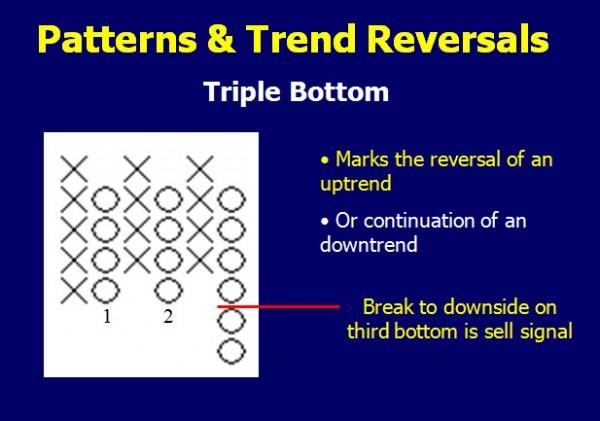
Patterns in P&F charts are a bit different than what you may be used to in candlestick charting. A triple top formation is not necessarily a reversal formation, it could be a continuation. It will still offer a trading opportunity however. Look at the following examples of both the bullish and bearish triple formation.
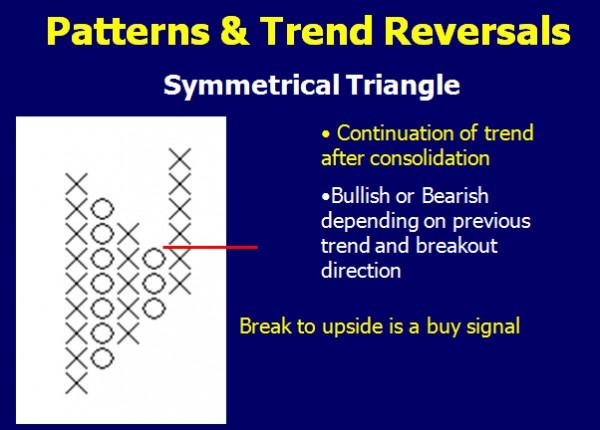
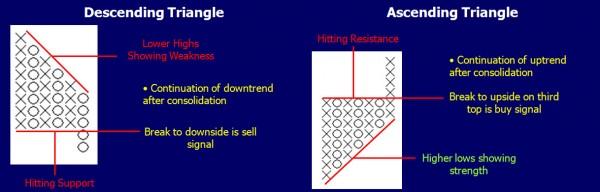
Even patterns such as triangles are visible and can be traded on P&F charts. They will work in much the same manner as they would on candlestick charts.
I previously discussed the use of horizontal price projections. Many traders choose a different price projection method. If you are not using a 1 box reversal chart and have instead selected a three box, (this refers to how much price would have to reverse for you to start a new column, $10×3 means price would have reversed a minimum of $30), you can try the vertical price projection method. I have found this style to be more accurate in projecting targets.
The vertical price projection can only be made under certain circumstances. They are:
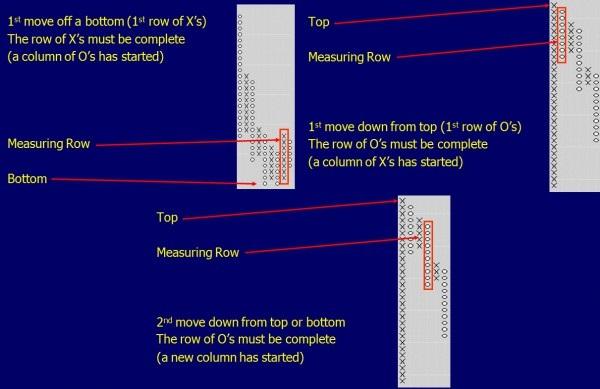
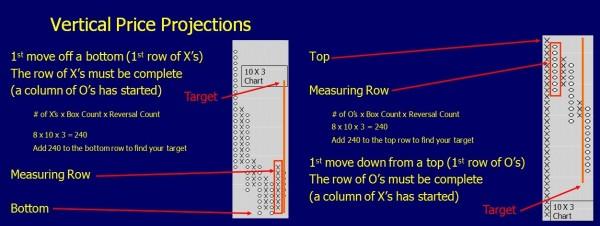
Once you have counted the correct column, you can multiply that count by the per box value and then multiply that number by the size for reversal. Your result should then either be added to the price bottom or subtracted from the price top to give you the price projection.
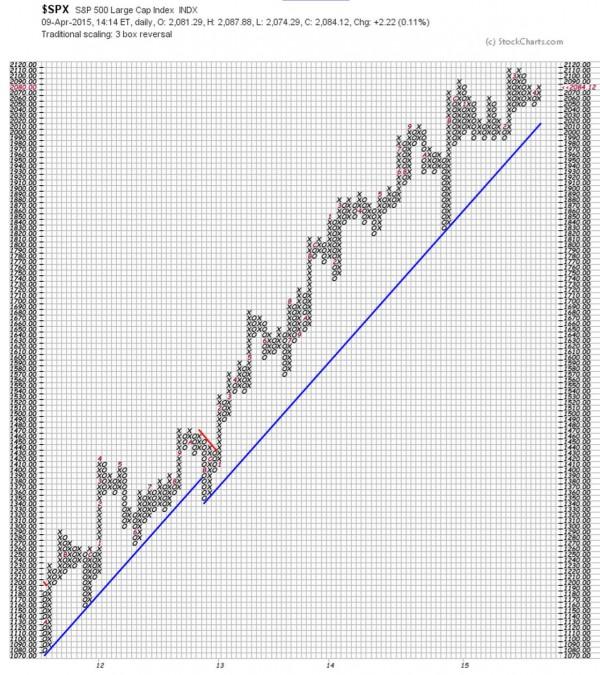
Now that we know the basics and what to look for, let’s examine a few P&F charts to see this technique in action. I have a chart of the S&P 500 Index 10×3 point and figure format. The 10 means I need a minimum of a 10 point move between closing prices to make a new box of X’s or O’s. I must also have a minimum of 30 points (10×3), to start a new column for a reversal. The numbers and letters refer to the months (1-9 are Jan. to Sept., A-C are Oct. to Dec.)
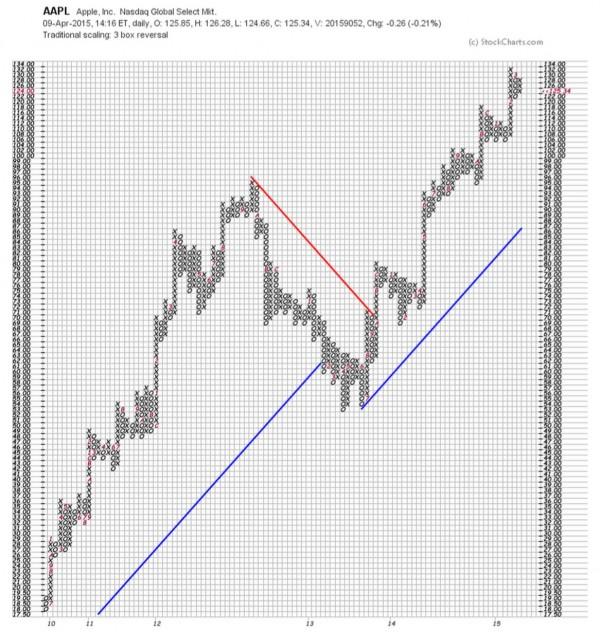
I can do the same with charts of individual stocks. I would simply adjust the box size on the chart for stocks or the indexes due to their higher or lower prices.
If you are looking for smaller duration trades, you can lessen the box size and also the closing periods. I had been using the daily closes on the previous charts. Depending on the trading software that you use, you can set box size smaller. This makes the chart more sensitive and allows you to see intraday activity. You can set the chart’s period to five minutes. If the close from a five minute period would cause a change in the chart, it is noted instead of waiting for the daily close.
By adjusting the box size and even what closing price the box will use, you can create all types of interesting charts to follow trends in the intraday or even multi decade trend following charts. The possibilities are limitless. Next week we will examine more strategies on point and figure charts and how to use them in conjunction with our core strategy of supply and demand.
Patterns in P&F charts are a bit different than what you may be used to in candlestick charting. A triple top formation is not necessarily a reversal formation, it could be a continuation. It will still offer a trading opportunity however. Look at the following examples of both the bullish and bearish triple formation.
Even patterns such as triangles are visible and can be traded on P&F charts. They will work in much the same manner as they would on candlestick charts.
I previously discussed the use of horizontal price projections. Many traders choose a different price projection method. If you are not using a 1 box reversal chart and have instead selected a three box, (this refers to how much price would have to reverse for you to start a new column, $10×3 means price would have reversed a minimum of $30), you can try the vertical price projection method. I have found this style to be more accurate in projecting targets.
The vertical price projection can only be made under certain circumstances. They are:
1st move off a bottom (1st row of X’s)
1st move down from top (1st row of O’s)
2nd move from top or bottom
Once you have counted the correct column, you can multiply that count by the per box value and then multiply that number by the size for reversal. Your result should then either be added to the price bottom or subtracted from the price top to give you the price projection.
Now that we know the basics and what to look for, let’s examine a few P&F charts to see this technique in action. I have a chart of the S&P 500 Index 10×3 point and figure format. The 10 means I need a minimum of a 10 point move between closing prices to make a new box of X’s or O’s. I must also have a minimum of 30 points (10×3), to start a new column for a reversal. The numbers and letters refer to the months (1-9 are Jan. to Sept., A-C are Oct. to Dec.)
I can do the same with charts of individual stocks. I would simply adjust the box size on the chart for stocks or the indexes due to their higher or lower prices.
If you are looking for smaller duration trades, you can lessen the box size and also the closing periods. I had been using the daily closes on the previous charts. Depending on the trading software that you use, you can set box size smaller. This makes the chart more sensitive and allows you to see intraday activity. You can set the chart’s period to five minutes. If the close from a five minute period would cause a change in the chart, it is noted instead of waiting for the daily close.
By adjusting the box size and even what closing price the box will use, you can create all types of interesting charts to follow trends in the intraday or even multi decade trend following charts. The possibilities are limitless. Next week we will examine more strategies on point and figure charts and how to use them in conjunction with our core strategy of supply and demand.
Neither Freedom Management Partners nor any of its personnel are registered broker-dealers or investment advisers. I will mention that I consider certain securities or positions to be good candidates for the types of strategies we are discussing or illustrating. Because I consider the securities or positions appropriate to the discussion or for illustration purposes does not mean that I am telling you to trade the strategies or securities. Keep in mind that we are not providing you with recommendations or personalized advice about your trading activities. The information we are providing is not tailored to any individual. Any mention of a particular security is not a recommendation to buy, sell, or hold that or any other security or a suggestion that it is suitable for any specific person. Keep in mind that all trading involves a risk of loss, and this will always be the situation, regardless of whether we are discussing strategies that are intended to limit risk. Also, Freedom Management Partners’ personnel are not subject to trading restrictions. I and others at Freedom Management Partners could have a position in a security or initiate a position in a security at any time.
Editors’ Picks

EUR/USD: US Dollar to remain pressured until uncertainty fog dissipates
Unimpressive European Central Bank left monetary policy unchanged for the fifth consecutive meeting. The United States first-tier employment and inflation data is scheduled for the second week of February. EUR/USD battles to remain afloat above 1.1800, sellers moving to the sidelines.

GBP/USD softens to near 1.3600 as BoE hints further rate cuts
The GBP/USD pair loses ground to near 1.3610 during the early Asian session on Monday. The Pound Sterling softens against the Greenback amid growing expectations of the Bank of England’s interest-rate cut. Traders will take more cues from the Fedspeak later on Monday.

USD/JPY drops back below 157.00 on Japan's verbal intervention
USD/JPY has come under moderate selling pressure below 157.00 in the Asian session on Monday. The Japanese Yen lost ground to near 157.70 following Japan’s ruling Liberal Democratic Party's outright majority win in Sunday’s lower house election, opening the door to more fiscal stimulus by Prime Minister Sanae Takaichi. However, JPY buyers jumped back and dragged the pair southward on FX verbal intervention by Japan’s Finance Minister Katayama.
Editors’ Picks
USD/JPY drops back below 157.00 on Japan's verbal intervention
USD/JPY has come under moderate selling pressure below 157.00 in the Asian session on Monday. The Japanese Yen lost ground to near 157.70 following Japan’s ruling Liberal Democratic Party's outright majority win in Sunday’s lower house election, opening the door to more fiscal stimulus by Prime Minister Sanae Takaichi. However, JPY buyers jumped back and dragged the pair southward on FX verbal intervention by Japan’s Finance Minister Katayama.

Gold eyes acceptance above $5,000, kicking off a big week
Gold is consolidating the latest uptick at around the $5,000 mark, with buyers gathering pace for a sustained uptrend as a critical week kicks off. All eyes remain on the delayed Nonfarm Payrolls and Consumer Price Index data from the United States due on Wednesday and Friday, respectively.

AUD/USD: Buyers eyes 0.7050 amid upbeat mood
AUD/USD builds on Friday's goodish rebound from sub-0.6900 levels and kicks off the new week on a positive note, with bulls awaiting a sustained move and acceptance above mid-0.7000s before placing fresh bets. The widening RBA-Fed divergence, along with the upbeat market mood, acts as a tailwind for the risk-sensitive Aussie amid some follow-through US Dollar selling for the second straight day.

Top Crypto Gainers: Aster, Decred, and Kaspa rise as selling pressure wanes
Altcoins such as Aster, Decred, and Kaspa are leading the broader cryptocurrency market recovery over the last 24 hours, as Bitcoin holds above $70,000 on Monday, up from the $60,000 dip on Thursday.

Weekly column: Saturn-Neptune and the end of the Dollar’s 15-year bull cycle
Tariffs are not only inflationary for a nation but also risk undermining the trust and credibility that go hand in hand with the responsibility of being the leading nation in the free world and controlling the world’s reserve currency.
RECOMMENDED LESSONS
Making money in forex is easy if you know how the bankers trade!

I’m often mystified in my educational forex articles why so many traders struggle to make consistent money out of forex trading. The answer has more to do with what they don’t know than what they do know. After working in investment banks for 20 years many of which were as a Chief trader its second knowledge how to extract cash out of the market.
5 Forex News Events You Need To Know

In the fast moving world of currency markets where huge moves can seemingly come from nowhere, it is extremely important for new traders to learn about the various economic indicators and forex news events and releases that shape the markets. Indeed, quickly getting a handle on which data to look out for, what it means, and how to trade it can see new traders quickly become far more profitable and sets up the road to long term success.
Top 10 Chart Patterns Every Trader Should Know

Chart patterns are one of the most effective trading tools for a trader. They are pure price-action, and form on the basis of underlying buying and selling pressure. Chart patterns have a proven track-record, and traders use them to identify continuation or reversal signals, to open positions and identify price targets.
7 Ways to Avoid Forex Scams

The forex industry is recently seeing more and more scams. Here are 7 ways to avoid losing your money in such scams: Forex scams are becoming frequent. Michael Greenberg reports on luxurious expenses, including a submarine bought from the money taken from forex traders. Here’s another report of a forex fraud. So, how can we avoid falling in such forex scams?
What Are the 10 Fatal Mistakes Traders Make
Trading is exciting. Trading is hard. Trading is extremely hard. Some say that it takes more than 10,000 hours to master. Others believe that trading is the way to quick riches. They might be both wrong. What is important to know that no matter how experienced you are, mistakes will be part of the trading process.
The challenge: Timing the market and trader psychology

Successful trading often comes down to timing – entering and exiting trades at the right moments. Yet timing the market is notoriously difficult, largely because human psychology can derail even the best plans. Two powerful emotions in particular – fear and greed – tend to drive trading decisions off course.