
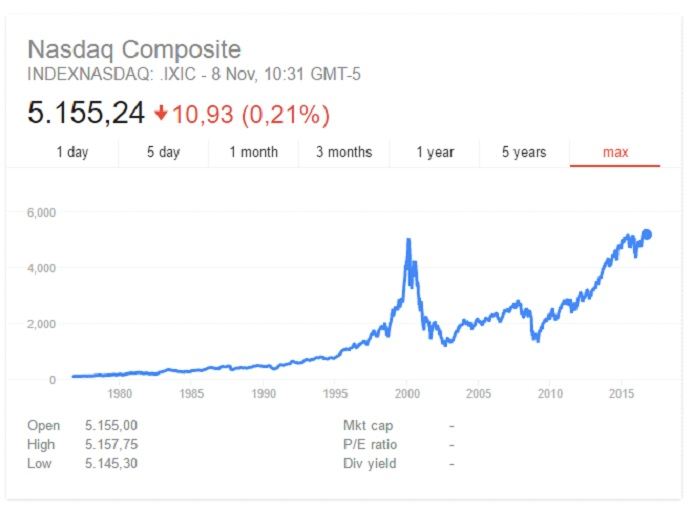
The New York Stock Exchange (NYSE) and the Nasdaq are at the heart of Wall Street; these two financial markets are closely followed by investment banking firms, institutional investors and individual investors around the world.
The financial instruments traded on the Nasdaq and NYSE are publicly-traded equity securities, this means that investors who place orders on these markets are essentially purchasing fractionary ownerships of either major companies or investment funds. These securities are popularly known as stocks, but they can also be shares of exchange-traded funds (ETF). All stocks have value that can fluctuate due to financial operations or market sentiment. Traders who purchase stocks are entitled to hold on to it until they choose to sell it at market value.
How the NYSE and Nasdaq Work
Wall Street is regulated by a number of American government agencies and professional organizations. As such, trading hours take place between 9:30 am to 4:00 pm, Monday through Friday. These markets closed during official holidays in the United States. There is some level of after-hours trading offered to investors who use certain platforms.
Individual investors and the public can access the NYSE and Nasdaq through retail binary options brokers such as PWRtrade, which offer a connection to these financial markets by means of trading accounts and online platforms.
Trading stocks on the NYSE and Nasdaq is a matter of looking up share prices and placing orders during the trading session. Online trading platforms can make this an easy endeavour with point-and-click order placement, instant price quotations, fast execution, news tickers, charts, signals, and other features that allow individual trader to fully participate in these markets.
NYSE and Nasdaq Trading Strategies
A significant part of Wall Street consists of institutional investors; these are usually investment banking firms such as Goldman Sachs or mutual fund companies such as Vanguard. Institutional investors tend to hold on to millions of shares of companies and ETFs for various reasons: they may want voting rights in the companies they partially own as majority shareholders, or else they may seek to profit from long-term stock appreciation.
Individual traders do not have the leverage of institutional investors; their portfolio balances do not allow them to take market positions worth thousands of shares. For this reason, it is more profitable for individual investors to seek trading strategies such as binary options.
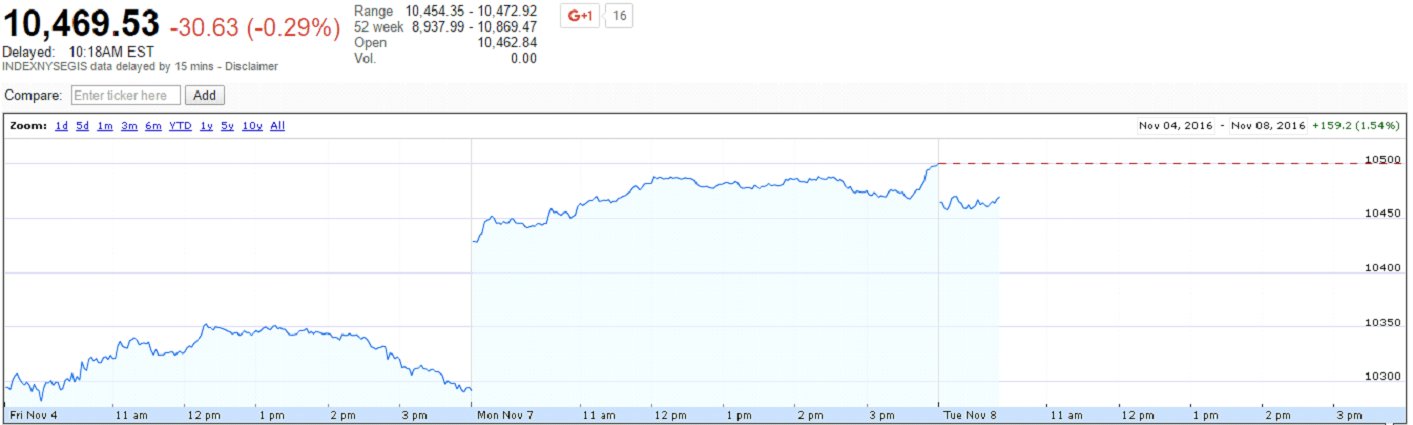
Binary trading is a financial strategy that can be based on various markets. In the case of the NYSE and the Nasdaq, it is based on major stocks and benchmark indices such as the Dow Jones, the S&P 500 and others.
With this type of trading, investors do not have to enter the market by purchasing expensive stocks that may start losing value due to a bear market or corporate scandal. When traders take market positions, they only invest in the value of an option contract that may pay out under certain circumstances.
An example of a binary trade would be options contract on Microsoft (MSFT) stock, which trades on the Nasdaq. The trader does not have to risk his or her own capital by purchasing MSFT shares; an option can be a small investment that seeks to profit on whether the price of MSFT will either rise or fall during a certain period. Once the options contract reaches the end of the period, the trader pockets the profit if he or she was in the money; if not, the only loss would be the value of the contract itself.
Institutional investors and Individual traders
The massive leverage enjoyed by institutional investors allows them to make money when the stocks they hold gain just a few pennies on the dollar. To this effect, individual traders cannot normally compete against institutional investors.
Options trading lowers the NYSE and Nasdaq barrier of entry by giving individual traders the opportunity to participate and get returns on their investments. Nevertheless, options trading requires technical and fundamental analysis evaluation.
In the end, options trading is an opportunity for individual investors who want to participate in the Nasdaq and NYSE markets without having to worry about the intricacies of Wall Street.

Editors’ Picks

EUR/USD flat lines around 1.1900; looks to US NFP report for fresh directional impetus
The EUR/USD pair is seen oscillating in a narrow trading band around the 1.1900 mark during the Asian session on Wednesday as traders opt to wait for the release of US monthly employment details before placing fresh directional bets.

GBP/USD slips back to daily lows near 1.3640
GBP/USD drops to daily lows near 1.3640 as sellers push harder and the Greenback extends its rebound in the latter part of Tuesday’s session. Looking ahead, the combination of key US releases, including NFP and CPI, alongside important UK data, should keep the pound firmly in focus over the coming days.

USD/JPY extends three-day rout below 154.00, NFP eyed
USD/JPY is extending its three-day rout below 154.00 in the Asian session on Wednesday, awaiting the release of the closely-watched US NFP report. In the meantime, rising bets on Fed rate cuts keep the US Dollar depressed. In contrast, expectations that PM Takaichi's policies will boost the economy and allow the BoJ to stick to its hawkish stance underpin the Japanese Yen, weighing on the pair amid intervention fears.
Editors’ Picks

AUD/USD tests 0.7100 after China inflation and RBA Hauser's comments
AUD/USD flirts with three-year highs at 0.7100 in Wednesday's Asian trading. The pair remains undeterred by the mixed Chinese inflation data for January, which showed the growth in the Consumer Price Index slowing more than expected, while the Producer Price Index beat estimates. RBA official Hauser's hawkish commentary provides an extra boost to Aussie bulls.
USD/JPY extends three-day rout below 154.00, NFP eyed
USD/JPY is extending its three-day rout below 154.00 in the Asian session on Wednesday, awaiting the release of the closely-watched US NFP report. In the meantime, rising bets on Fed rate cuts keep the US Dollar depressed. In contrast, expectations that PM Takaichi's policies will boost the economy and allow the BoJ to stick to its hawkish stance underpin the Japanese Yen, weighing on the pair amid intervention fears.

Gold awaits US Nonfarm Payrolls data for a sustained upside
Gold remains capped below $5,100 early Wednesday, gathering pace for the US labor data. The US Dollar licks its wounds amid persistent Japanese Yen strength and potential downside risks to the US jobs report. Gold holds above $5,000 amid bullish daily RSI, with eyes on 61.8% Fibo resistance at $5,141.

Ethereum: Whales buy the dip amid rising short bets
Following one of Ethereum's largest weekly drawdowns, whales are slowly returning to action alongside a drop in retail selling pressure. After slightly selling into the decline at the start of the month, whales or wallets with a balance of 10K-100K ETH began buying the dip last Wednesday as prices crashed further.
Dollar drops and stocks rally: The week of reckoning for US economic data
Following a sizeable move lower in US technology Stocks last week, we have witnessed a meaningful recovery unfold. The USD Index is in a concerning position; the monthly price continues to hold the south channel support.
RECOMMENDED LESSONS
Making money in forex is easy if you know how the bankers trade!

I’m often mystified in my educational forex articles why so many traders struggle to make consistent money out of forex trading. The answer has more to do with what they don’t know than what they do know. After working in investment banks for 20 years many of which were as a Chief trader its second knowledge how to extract cash out of the market.
5 Forex News Events You Need To Know

In the fast moving world of currency markets where huge moves can seemingly come from nowhere, it is extremely important for new traders to learn about the various economic indicators and forex news events and releases that shape the markets. Indeed, quickly getting a handle on which data to look out for, what it means, and how to trade it can see new traders quickly become far more profitable and sets up the road to long term success.
Top 10 Chart Patterns Every Trader Should Know

Chart patterns are one of the most effective trading tools for a trader. They are pure price-action, and form on the basis of underlying buying and selling pressure. Chart patterns have a proven track-record, and traders use them to identify continuation or reversal signals, to open positions and identify price targets.
7 Ways to Avoid Forex Scams

The forex industry is recently seeing more and more scams. Here are 7 ways to avoid losing your money in such scams: Forex scams are becoming frequent. Michael Greenberg reports on luxurious expenses, including a submarine bought from the money taken from forex traders. Here’s another report of a forex fraud. So, how can we avoid falling in such forex scams?
What Are the 10 Fatal Mistakes Traders Make
Trading is exciting. Trading is hard. Trading is extremely hard. Some say that it takes more than 10,000 hours to master. Others believe that trading is the way to quick riches. They might be both wrong. What is important to know that no matter how experienced you are, mistakes will be part of the trading process.
The challenge: Timing the market and trader psychology

Successful trading often comes down to timing – entering and exiting trades at the right moments. Yet timing the market is notoriously difficult, largely because human psychology can derail even the best plans. Two powerful emotions in particular – fear and greed – tend to drive trading decisions off course.