 Gabe Velázquez
Online Trading Academy
The golden rule in conventional trading books is that you must trade in the direction of the prevailing trend in order to be successful. These same books also tell you that the biggest no-no is trying to pick tops and bottoms. On the surface it seems like pretty reasonable advice, however, there are different ways to trade the trend; and if you are skilled enough, picking tops and bottoms should be feasible. In this article we will explore alternative, low-risk entries, that will allow us to join the market trend and not fall prey to the high risk way of looking at the trend.
Conventional technical analysis teaches that one must always wait for trend confirmation. This can mean a trend line that can be connected at three points, or a moving average sloping higher confirming an uptrend. Price confirmation of trend can also be used by simply identifying a series of higher highs or lower lows. This is all text book stuff that most of you already know, so why am I going over it, you might be asking. The answer is that although we might be able to use these tactics, the fact is that if we utilize them in the wrong manner we will end up taking high risk trades, which will result in us losing more of our hard earned money more often than not.
The reality is that market trends are formed by saw-tooth type patterns, not straight forty-five degree angle lines. These undulations tend to trap trend traders because they wait for too much confirmation before they engage the trend. The most likely reason this happens is because of how traders are conditioned to trade trending type markets.
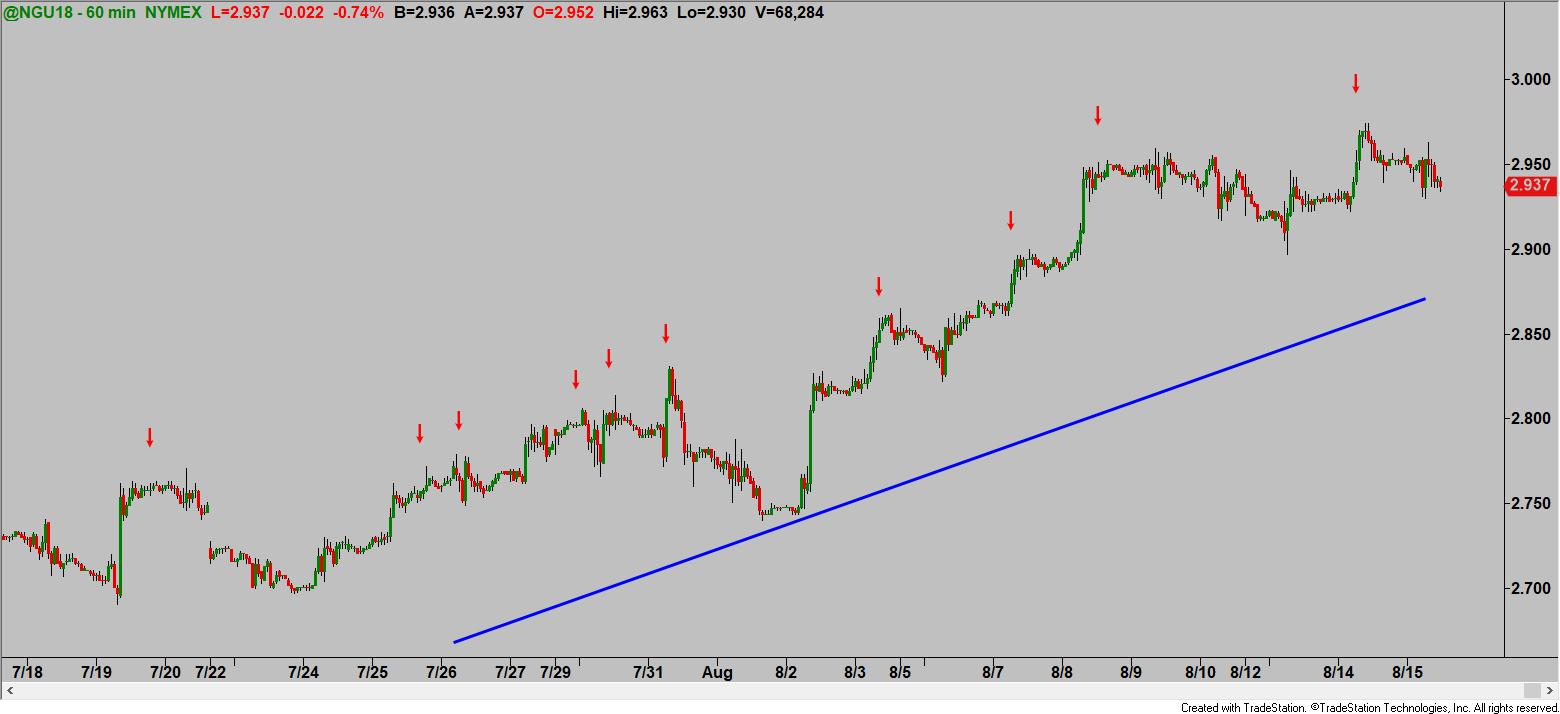
An example this thinking flawed thinking would be, when a market is trending higher it’s safer to buy when it makes a higher peak. Conversely, lots of traders are trained by many conventional trading books to sell only when the market breaks to a new low. As we can see in the chart below, when the market is trending higher, most of the new peaks are followed by counter-trend moves otherwise known as corrections. Therein lies the problem when buying after the new high price has printed, that is unless you’re willing to sit through big draw-downs waiting for the trend to resume.
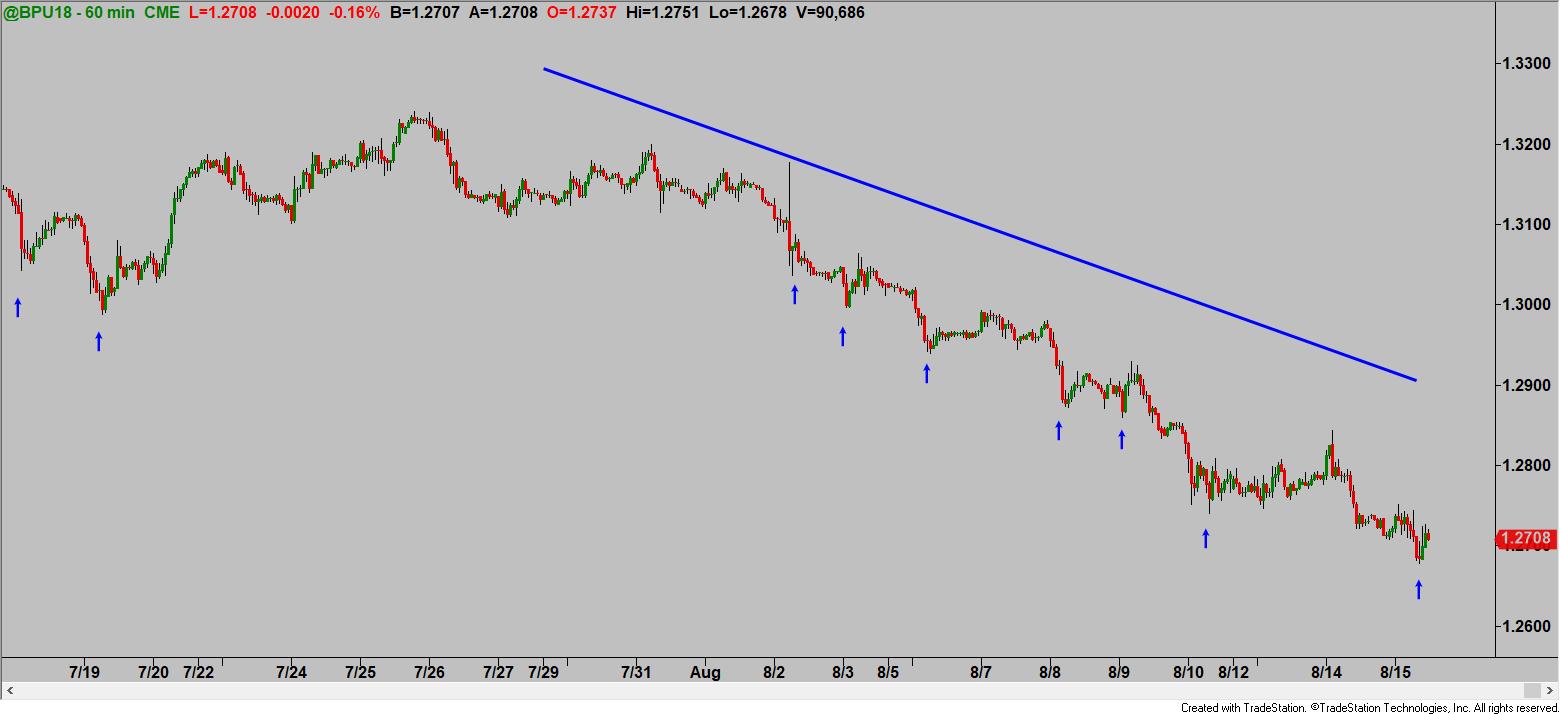
Likewise, in a downtrend, when the market breaks to new lows, an upward move ensues. This is illustrated in the 60 minute chart of the British Pound Futures contract shown below. Traders waiting for a break in price before shorting will encounter the same difficulty.
As stated before, in order to engage the market trend in a lower risk manner, we have to utilize a different tact than the conventional thinking espoused by the trading books. A lower risk approach to joining the trend would be to wait for the counter-trend moves into quality supply in order to sell short when in a downtrend and buy pullbacks into quality demand when the market is in an uptrend. When I refer to quality levels, I mean levels that score high using our odds enhancers.
The bottom line is that trend following done in a low risk strategy format can be rewarding. In addition, have a set of specific criteria to define the time-frame in which you define the trend. The next step, and by far the most important, is to anticipate when the market trend will change. This is because, by the time everyone has figured out that it’s a trend, it’s just about then, that the market will pullback or change its trend.
Until next time, I hope everyone has a fabulous week.
Read the original article here - Is the Trend Really Your Friend?
This content is intended to provide educational information only. This information should not be construed as individual or customized legal, tax, financial or investment services. As each individual's situation is unique, a qualified professional should be consulted before making legal, tax, financial and investment decisions. The educational information provided in this article does not comprise any course or a part of any course that may be used as an educational credit for any certification purpose and will not prepare any User to be accredited for any licenses in any industry and will not prepare any User to get a job. Reproduced by permission from OTAcademy.com click here for Terms of Use: https://www.otacademy.com/about/terms
Editors’ Picks

EUR/USD flat lines below 1.1900; divergent Fed-ECB expectations offer support
The EUR/USD pair struggles to capitalize on the overnight bounce from the 1.1835-1.1830 region and oscillates in a narrow band during the Asian session on Thursday. Spot prices currently trade around the 1.1875 area, remaining nearly unchanged for the day and staying within striking distance of an over one-week high, reached on Tuesday, amid mixed cues.

GBP/USD slips heading into the Thursday trading window
The Pound Sterling pulled back from four-year highs on Wednesday, weighed down by a combination of Bank of England dovishness and UK political uncertainty, even as the US Dollar weakened on soft labor market revisions.

USD/JPY strengthens above 153.00 despite stronger US jobs data
The USD/JPY pair attracts some sellers to around 153.20 during the early Asian session on Thursday. The Japanese Yen strengthens against the US Dollar in the aftermath of Prime Minister Sanae Takaichi's landslide election victory. The attention will shift to the US Consumer Price Index inflation report, which is due later on Friday.
Editors’ Picks

AUD/USD bulls pause amid post-NFP USD rebound
AUD/USD is trading with a mild negative bias during the Asian session on Thursday, below a three-year high set the previous day. The US Dollar looks to build on Wednesday's upbeat US NFP-inspired bounce from an over one-week low, acting as a headwind for spot prices. However, the divergent Fed-RBA expectations, along with the underlying bullish sentiment, should help limit any meaningful corrective fall for the risk-sensitive Aussie.
USD/JPY strengthens above 153.00 despite stronger US jobs data
The USD/JPY pair attracts some sellers to around 153.20 during the early Asian session on Thursday. The Japanese Yen strengthens against the US Dollar in the aftermath of Prime Minister Sanae Takaichi's landslide election victory. The attention will shift to the US Consumer Price Index inflation report, which is due later on Friday.

Gold posts modest gains above $5,050 as US-Iran tensions persist despite strong labor data
Gold price trades in positive territory near $5,060 during the early Asian session on Thursday. The precious metal edges higher despite stronger-than-expected US employment data. The release of the US Consumer Price Index inflation report will take center stage later on Friday.

Bitcoin holds steady despite strong US labour market
Bitcoin briefly bounced from $66,000 to above $68,000 but slightly reversed those gains following Wednesday's US January jobs report. The top crypto is hovering around $67,000, down 2% over the past 24 hours as of writing on Wednesday.

The market trades the path not the past
The payroll number did not just beat. It reset the tone. 130,000 vs. 65,000 expected, with a 35,000 whisper. 79 of 80 economists leaning the wrong way. Unemployment and underemployment are edging lower. For all the statistical fog around birth-death adjustments and seasonal quirks, the core message was unmistakable. The labour market is not cracking.
RECOMMENDED LESSONS
Making money in forex is easy if you know how the bankers trade!

I’m often mystified in my educational forex articles why so many traders struggle to make consistent money out of forex trading. The answer has more to do with what they don’t know than what they do know. After working in investment banks for 20 years many of which were as a Chief trader its second knowledge how to extract cash out of the market.
5 Forex News Events You Need To Know

In the fast moving world of currency markets where huge moves can seemingly come from nowhere, it is extremely important for new traders to learn about the various economic indicators and forex news events and releases that shape the markets. Indeed, quickly getting a handle on which data to look out for, what it means, and how to trade it can see new traders quickly become far more profitable and sets up the road to long term success.
Top 10 Chart Patterns Every Trader Should Know

Chart patterns are one of the most effective trading tools for a trader. They are pure price-action, and form on the basis of underlying buying and selling pressure. Chart patterns have a proven track-record, and traders use them to identify continuation or reversal signals, to open positions and identify price targets.
7 Ways to Avoid Forex Scams

The forex industry is recently seeing more and more scams. Here are 7 ways to avoid losing your money in such scams: Forex scams are becoming frequent. Michael Greenberg reports on luxurious expenses, including a submarine bought from the money taken from forex traders. Here’s another report of a forex fraud. So, how can we avoid falling in such forex scams?
What Are the 10 Fatal Mistakes Traders Make
Trading is exciting. Trading is hard. Trading is extremely hard. Some say that it takes more than 10,000 hours to master. Others believe that trading is the way to quick riches. They might be both wrong. What is important to know that no matter how experienced you are, mistakes will be part of the trading process.
The challenge: Timing the market and trader psychology

Successful trading often comes down to timing – entering and exiting trades at the right moments. Yet timing the market is notoriously difficult, largely because human psychology can derail even the best plans. Two powerful emotions in particular – fear and greed – tend to drive trading decisions off course.