How to use the directional movement index

The Directional Movement Index is a great technical tool that helps you see the direction of the market and whether the market is making gains or losses. That’s easy, you say – what’s the point of that? Well, the Directional Movement Index (DMI) lets you see the rate of change. This makes it very useful for showing a few things:
-
When the pace of gains is slowing,
-
When the rate of gains has peaked and is starting to reverse.
In summary, the DMI can help you spot a trend reversal early. Here is how it works.
The DMI calculation
The DMI is calculated this way. It is a lengthy explanation, so follow this link for the calculation. However, the bottom line is that the DMI gives a visualised measure meant for the rate of gains. When the +DM is rising and crosses the -DM then gains are outpacing losses. When the -DM is rising and crosses the +DM then falls are outpacing gains. Take a look here for an example in silver.
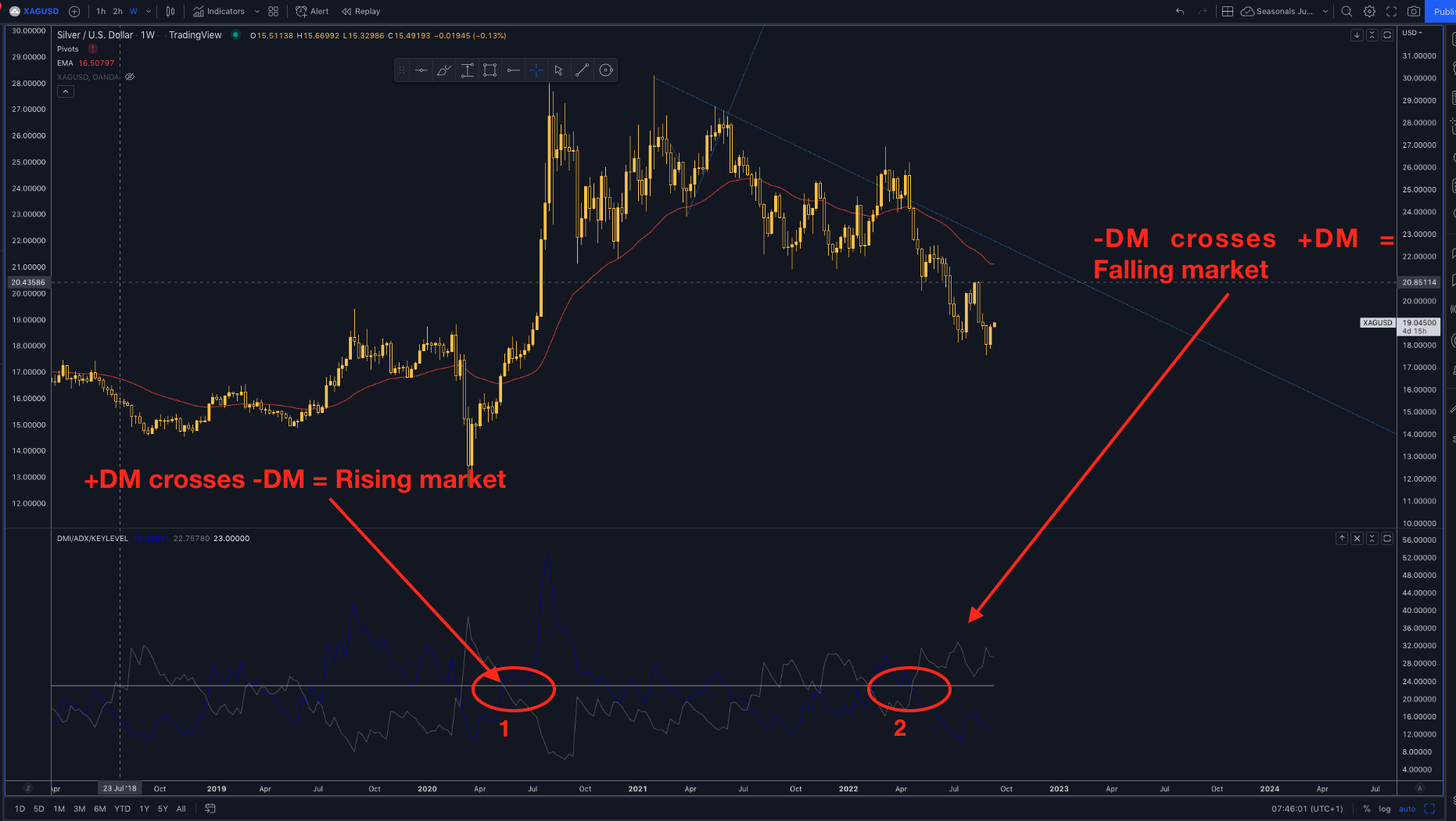
Looking above at the first cross marked 1 you can see that the pace of gains clearly outpaces that pace of falls over the last 14 day period (see calculation methodology in link above). This would provide a decent entry in a trending market. Similarly, looking at the cross marked 2 you can see that the pace of falls is outpacing gains and that would have provided a good entry on the sell side.
The real world application
Now it is easy to use any indicator and ‘cherry pick’ dream entries. So traders must be aware when it is appropriate to use a tool and when it is not. The DMI is best used for trending markets. So, if there is a market that you think is fundamentally due for a nice trend then consider using the DMI as one of your tools. It can help with entry confirmation and give you another way of seeing the technical picture which has proved very helpful to some very successful traders.
Author

Giles Coghlan LLB, Lth, MA
Financial Source
Giles is the chief market analyst for Financial Source. His goal is to help you find simple, high-conviction fundamental trade opportunities. He has regular media presentations being featured in National and International Press.