Exhaustion as an odds enhancer for market reversals

One of the many rewards of being an instructor at Online Trading Academy is the interaction received from students, both in the classroom and via email. The questions and challenges are what keeps you sharp as a trader. By constantly recalling my knowledge and seeing trading concepts through the eyes of new traders, it prevents me from becoming stale and makes me a better trader.
While teaching and trading live in the Extended Learning Track (XLT), this morning, a topic that kept coming up was on candle shape and the importance of price arrival to a supply or demand zone. This reminded me of an old email I received from a student.
“I want you to tell me the importance of how a price comes back to a level? What is the significance of how it arrives, if it comes in like a glider plane or a lead balloon? I think what is important is how it leaves but the arrival is an odd’s enhancer. I am a ‘why’ guy. So why is arrival so important?”
This is a great question and the answer highlights the true market forces behind price movement, fear and greed. I want you to think about a flagpole. If I climbed to the top of that pole it would hold my weight. However, as more and more people climbed up to the top of that same pole, eventually it would bend and break from the added weight. Prices are similar. Stock prices rise because of demand. The demand being greater than the supply causes buyers to outbid each other in an attempt to attract elusive supply and climb the pole. At some point, the buyers have exhausted themselves and everyone who wanted to buy has already done so or is prevented from buying due to the high cost.
Prices start to fall as fear takes hold. Most investors and traders will start to panic when the price starts moving against them (market reversals) or their stops will be triggered. If there was a lot of buying pressure and large green candles going into the supply level, there will be few buyers to stop the collapse and catch the supply being dumped onto the markets from stop orders being triggered.
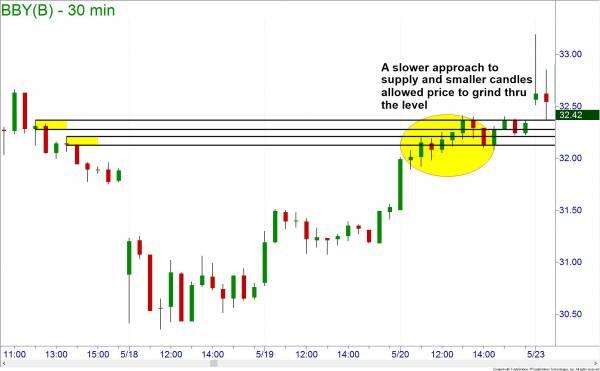
Compare this with a gradual climb that features smaller green candles and some small pullbacks to shake out weak traders. As prices fall away from a supply level in this scenario, they will be met with less stop orders and more buying pressure as the demand was not exhausted on the way up.
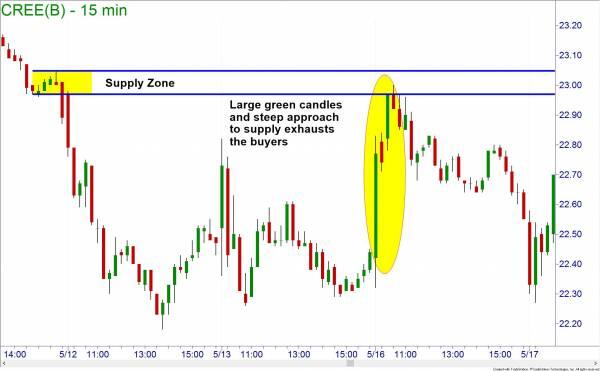
When the approach to the supply level is slower and had smaller candles, price is more likely to break through the level rather than respect it.
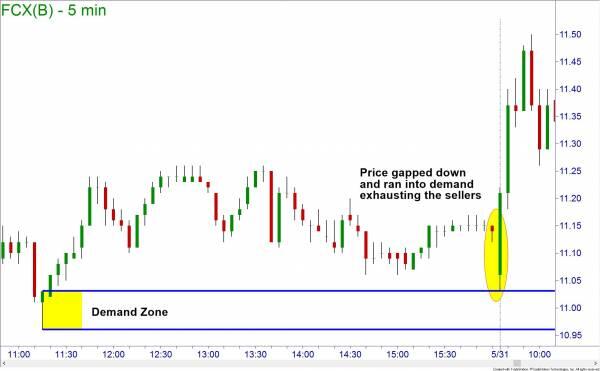
Arrival to demand zones are also important. If you arrive to the demand with large red candles signaling panic and fear, you are likely to have a bigger and better bounce. The large red candles signal that everyone who wanted to sell has now exited the stock. When buyers step in they must raise their bids quickly to attract a seller who may still be around.
If the arrival to the demand zone is quiet, there are still many worried holders of the stock who are looking to sell at a smaller loss when the bounce occurs. This added supply will mute the bounce of price from the demand level.
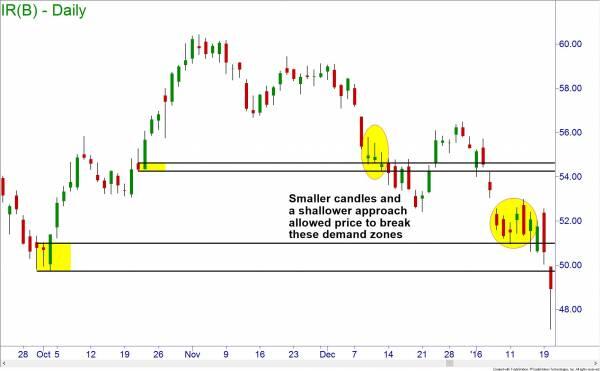
So one of the important odds enhancers for analyzing our trades is how price arrives to test the supply or demand level. To learn all of the other odds enhancers, be sure to visit your local Online Trading Academy Center and enroll for one of our trading courses. Until next time, trade safe and trade well!
Author

Brandon Wendell, CMT
Brandon Wendell
Brandon started off in the industry as a retail stockbroker working the phones. With a thirst to learn more about market mechanics, he moved into back-office operations handling order flow as an Agency Desk Operator for a major brokerage.