Yield-bearing stables’ are not money or stablecoins: Agora’s van Eck

Stablecoin issuers that offer a yield-bearing element to give holders passive income are missing the point of a stablecoin’s core mission, argues Nick van Eck, CEO of stablecoin issuer firm Agora.
Instead, these firms should focus on utility, liquidity and means of transaction in a way that reaches as many individuals and businesses as possible, the son of investment management maestro Jan van Eck explained in a May 27 Medium post.
Yield-bearing stablecoins have offered a new dimension for decentralized finance users looking to earn interest, but van Eck says such products will likely be classed as security products in many countries and, therefore, restrict customer reach.
“Not only does this deprive you of customers, it also deprives you of liquidity providers, vendors, and a higher utility ceiling. Your product is not freely tradeable,” said van Eck, adding:
Regulated financial service companies outside of the US are unlikely to use your product as it introduces risk without offering sufficient reward.
Examples include Dai (DAI), Ethena's USDe and the Mountain Protocol's USDM.
Yield-bearing stablecoins also lack a sufficient margin to sustain business operations, let alone pay for liquidity and expand an ecosystem, the Agora CEO added.
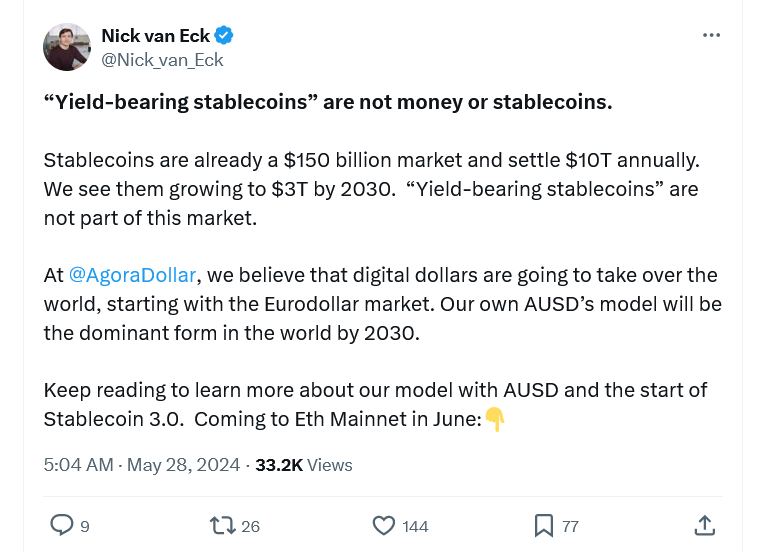
Source: Nick van Eck
The other main issue is that certain stablecoin issuers have formed strong ties with cryptocurrency trading firms such as Circle with Coinbase and Binance’s own BUSD — before started to wind down — which van Eck describes as a model “rife with conflict of interest.”
Van Eck said Agora won’t “pick winners and losers” when it launches the Agora digital dollar (AUSD) on Ethereum next month in June. Instead, it will try to work with as many cryptocurrency exchanges, trading firms and fintech firms as possible.
He described Tether's (USDT $1.00) as stablecoin 1.0, with Circle’s USD Coin (USDC)and a few issuers expanding on that with improved transparency around reserves, banking partners and regulatory compliance to form the stablecoin 2.0 era.
Van Eck said he hopes AGORA will mark the third iteration of stablecoins focused solely on utility, liquidity and means of transaction.
However, Agora will enter a fierce stablecoin market, led by USDT and USDC which boast market caps of $111.7 billion and $32.5 billion, respectively, according to CoinGecko.
The next seven largest stablecoins have market caps above $500 million, too.
However, van Eck said back in April that there’s still room for a newcomer in the $161.3 billion industry, especially one that offers an alternative model to the likes of Tether and Circle.
Van Eck expects the industry to expand to $3 trillion by 2030, an impressive 70.1% compounded annual growth rate.
Agora closed a $12 million funding round in April.
AUSD will be fully backed by cash, U.S. Treasury bills and overnight repo agreements, while $90-billion asset management firm VanEck — where Jan van Eck is CEO — will manage a fund for Agora’s reserves.
Author

Cointelegraph Team
Cointelegraph
We are privileged enough to work with the best and brightest in Bitcoin.