XRP price action warns of a possible 50% price collapse
- XRP price is at the end of a long-term bearish pattern.
- Multiple indications that XRP could break down even further.
- Upside potential exists but is increasingly unlikely to occur.

XRP price action on the weekly chart looks depressing if you’re a bull but magical if you’re a bear. No matter which way you want to look at it, XRP’s chart is bearish and warns of a massive collapse unless bulls come in and reverse the current setup.
XRP price could smash through $0.50 to $0.25
XRP price is currently inside a descending triangle pattern. The descending triangle pattern is one of the most bearish standard patterns in technical analysis. Whether it shows up (uptrend or downtrend), it is overwhelmingly bearish in nature.
With any triangle pattern, some behaviors are expected. The universal behavior is that any breakout from a triangle often occurs within the final third of the pattern – which is where XRP price is currently at.
Upon any successful close below the descending triangle, XRP price could flash crash to the 2020 Volume Point of control at $0.25. However, there is a possibility that a major fakeout may develop instead.
Below the bottom of the descending triangle is the 2021 Volume Point of Control at $0.48. A high-volume node from 2020 is also in the $0.48 value area. Another reason for the major fakeout and bear trap is the presence of a Kumo Twist.
Kumo Twists in the Ichimoku system can often identify where new swing highs and lows may form – especially if an instrument has been trending into the Kumo Twist.
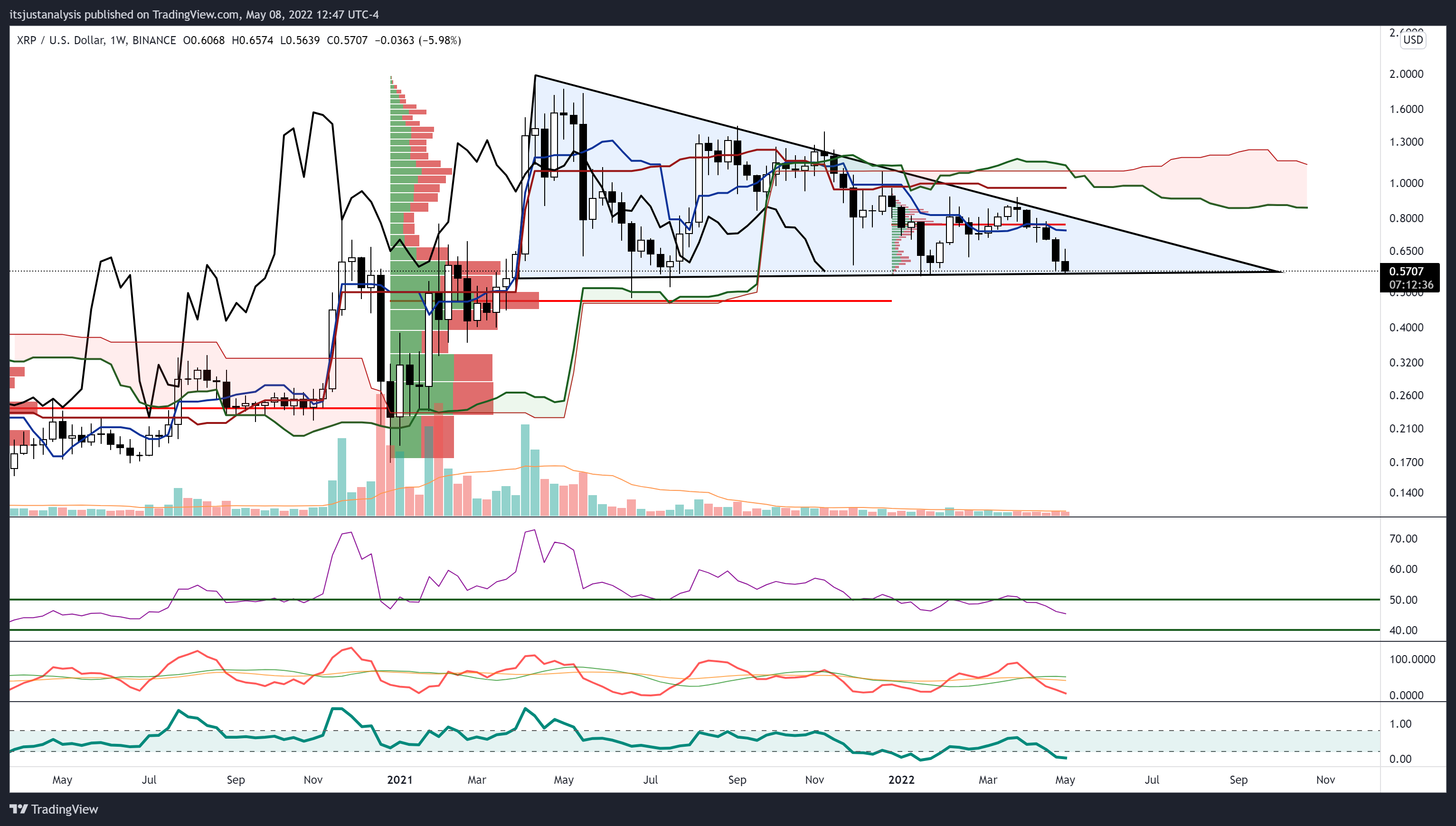
XRP/USDT Weekly Ichimoku Kinko Hyo Chart
False breakouts from triangle patterns are very common. Most conservative pattern traders ignore the initial breakout from a triangle and wait for the retest to confirm the breakout or capitalize on the trap that forms when price returns inside the triangle and moves to the inverse of the original breakout. In that scenario, XRP price would be well on its way to retest the $0.75 and $1.00 value area.
Author

Jonathan Morgan
Independent Analyst
Jonathan has been working as an Independent future, forex, and cryptocurrency trader and analyst for 8 years. He also has been writing for the past 5 years.