UNI crashes 70%: From $9 to $2.80 as futures open interest plunges 60%
- Uniswap drops from $9 to $2.80 as futures open interest collapses over 60%.
- The intraday spike from $3.30 to $4.60 reverses quickly, leaving a pronounced upper wick.
- The $4.00 to $4.10 zone shows technical confluence: Fibonacci 0.618, descending VWAP and volume profile.


Uniswap (UNI) dropped from trading in the $9 to $10 zone weeks ago to marking recent lows around $2.80, accompanied by a sharp contraction in futures open interest (OI). OI fell from over $750 million to a range of $220 to $260 million, representing a decline exceeding 60% from previous levels.
-1770956842054-1770956842055.png&w=1536&q=95)
The simultaneous drop in price and OI indicates primarily capital exit and leveraged position closures, rather than aggressive short building. UNI's derivatives market traverses a decompression phase where participants unwind exposure instead of increasing it.
-1770957067522-1770957067523.png&w=1536&q=95)
Until OI recovers sustained levels above $300 to $350 million, the futures market structure will continue showing weakness and low speculative appetite.
Technical analysis: Consolidation at $3.24 with key resistance at $4.00-$4.10
On the 1-hour timeframe, UNI/USDT trades around $3.24, consolidating in a sideways range between $3.20 and $3.60 after recent high volatility. The previous day, price jumped from $3.30 to touching $4.60 within hours, but the move absorbed quickly. The pronounced upper wick confirms the $4.00 to $4.10 zone acts as key resistance.
-1770957227677-1770957227678.png&w=1536&q=95)
The most relevant resistance levels sit at $3.86 (Fibonacci 0.5 retracement) and especially at $4.10 (Fibonacci 0.618). The $4.10 zone shows technical confluence: the descending VWAP aligns with the upper extreme of the volume profile and coincides with the Fibonacci retracement, reinforcing its importance in the short and medium term.
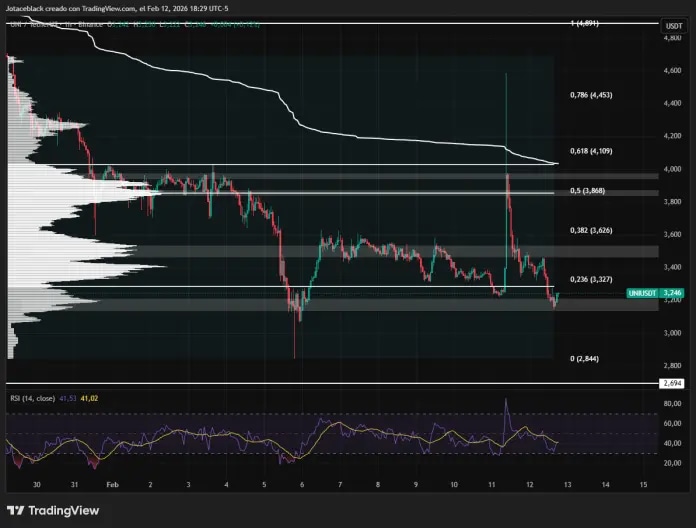
UNI needs to surpass the $4.10 barrier sustainably to validate a structure change. Until then, the combination of weakened OI and well-defined technical resistances keeps the asset in a consolidation phase with neutral-to-bearish bias.
Author
Isai Alexei
Independent Analyst
I am Isai Alexei. I work as a journalist and financial analyst covering cryptocurrency markets and traditional securities. I have spent ten years analyzing digital assets, trading activity, and market structure.