Solana set for a consensus switch with the introduction of Alpenglow
- Anza is developing a new consensus protocol, Alpenglow, to replace Solana's TowerBFT and Proof-of-History hybrid model.
- Alpenglow focuses on Solana's consensus speed with the introduction of Votor and Rotor.
- SOL showed signs of recovery following the announcement, reducing its loss on Monday to 1%.

Solana (SOL) showed signs of recovery in the American trading session on Monday following the introduction of a new consensus protocol, Alpenglow, which would replace the network's current Proof-of-History and TowerBFT mechanisms.
SOL recovers slightly as Solana community celebrates upcoming consensus change
The Solana ecosystem revealed a new consensus model, Alpenglow, which is being built to replace the network's Proof-of-History mechanism.
Research firm Anza, the developer behind the new model, announced the initiative on Monday at the Solana Accelerate event. Alpenglow focuses on Solana's consensus speed, attempting to cut down block finality from 12.8 seconds to a median of 150 ms.
"A median latency of 150 ms does not just mean that Solana is fast — it means Solana can compete with Web2 infrastructure in terms of responsiveness," Anza stated in a press release.
To replace TowerBFT and Proof-of-History, Alpenglow will introduce two new components — Votor and Rotor — to serve as the "new voting and finalization logic."
Votor will act as the voting protocol and is expected to finalize blocks once or twice, depending on the stake. A voting round will be sufficient when 80% of the stake is available, while two voting rounds will be required if there is 60% participation.
On the other hand, Rotor focuses on data transmission by utilizing Solana's Turbine structure. Rotor will introduce single-layer nodes instead of Turbine's multilayer tree structure, which intends to cut constant "hops" during data dissemination.
"Like Turbine, Rotor utilizes the bandwidth of participating nodes proportionally to their stake, alleviating the leader bottleneck for high throughput," Anza added.
Solana founder Anatoly Yakovenko commended the Alpenglow model in an X post on Monday, stating that it offers a "simple and elegant design that's really easy to intuit."
The Alpenglow prototype is live for testing, according to the Solana Foundation. The new consensus could be integrated into the Solana testnet in a few months. A mainnet upgrade will require a Solana Improvement Document (SIMD) proposal, which is expected later in the year.
Following the announcement, SOL found support near the $163 level, which coincides with the 100-period Simple Moving Average (SMA) and lower boundary of an ascending channel on the 4-hour chart. Hence, the altcoin has tapered some of its losses seen earlier in the day, with its price down by just 1% at publication time.
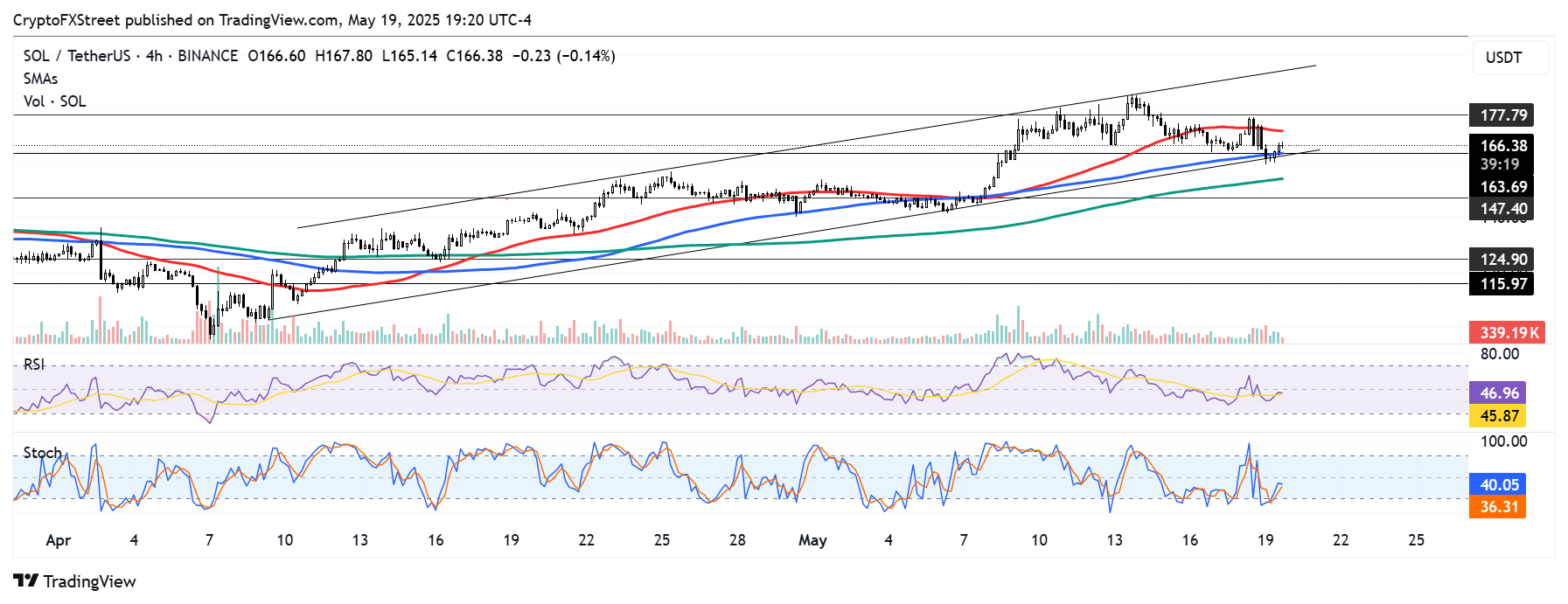
SOL/USDT 4-hour chart
On the upside, Solana price faces resistance at $177 and the ascending channel's upper boundary. On the downside, SOL could test the $147 support if it fails to hold the $163 level.
Author

Michael Ebiekutan
FXStreet
With a deep passion for web3 technology, he's collaborated with industry-leading brands like Mara, ITAK, and FXStreet in delivering groundbreaking reports on web3's transformative potential across diverse sectors. In addition to