Could XRP price breakout on growing risk-on sentiment?
- XRP price glued to support at $2.00 as breakout attempts lose momentum at around $2.22.
- Whale risk appetite grows as addresses with between 10 million and 100 million XRP account for 11.83% of the total supply.
- XRP exchange inflows plummet to 74 million tokens daily, suggesting reduced sell-side pressure.
- XRP's 24-hour active addresses dropped, per Santiment, which indicates low network activity and weakening bullish momentum.

Ripple (XRP) price stabilizes above its $2.00 support during the late Asian session on Tuesday. An attempt to break out of the consolidation range the previous day left more long than short positions liquidated, dampening market sentiment. Meanwhile, with whales buying amid the ongoing consolidation, XRP could be poised for a major run targeting the psychological resistance at $3.00.
Can whale accumulation revive XRP's bullish momentum?
As XRP consolidates, signaling market indecision, whale activity per Santiment data paints a different picture. Addresses with between 10 million and 100 million XRP (black line) show a steady increase, peaking around 11.83% of the total supply on Thursday from 10.91% on April 1. This implies consistent accumulation despite growing macroeconomic risks.
Similarly, addresses holding more than 1 billion tokens (red line) have gradually increased their share. This whale cohort currently accounts for 39.37% of the total supply, compared to 37.67% towards the end of March.
 [05-1745297501971.46.22, 22 Apr, 2025].png)
XRP Supply Distribution | Source: Santiment
Both whale cohorts have a high-risk appetite for XRP, possibly betting on the price increasing in the coming weeks or months.
According to CryptoQuant data, the cross-border money remittance token experienced a significant drop in exchange inflows. At the start of the year, exchange inflows peaked at 2.7 billion XRP, but they've since dropped significantly, with only 74 million XRP flowing into exchanges on Monday. Binance, the largest exchange by daily traded volume experienced the biggest drop, especially around February. This steady decline suggests investors are optimistic about XRP's potential and are choosing to hold the asset longer, easing sell-side pressure.
-1745297471919.png)
XRP Exchange Inflows | Source | CryptoQuant
However, the massive drop in the number of 24-hour active addresses on the XRP Ledger from the yearly local top of roughly 612,000 on March 19 to approximately 36,000 as of April 17 is worth noting. This indicates that fewer unique addresses interact with the network (sending or receiving XRP) and reflects reduced network activity.
 [05-1745297524405.53.23, 22 Apr, 2025].png)
XRP Active Addresses | Source: Santiment
If this downtrend progresses, traders may want to acclimatize to lower transaction volume, weakening bullish momentum and dwindling market sentiment. Hence, there is a need to prepare for all outcomes to avoid being caught off guard by sudden price movements.
XRP price holds support at $2, but for how long?
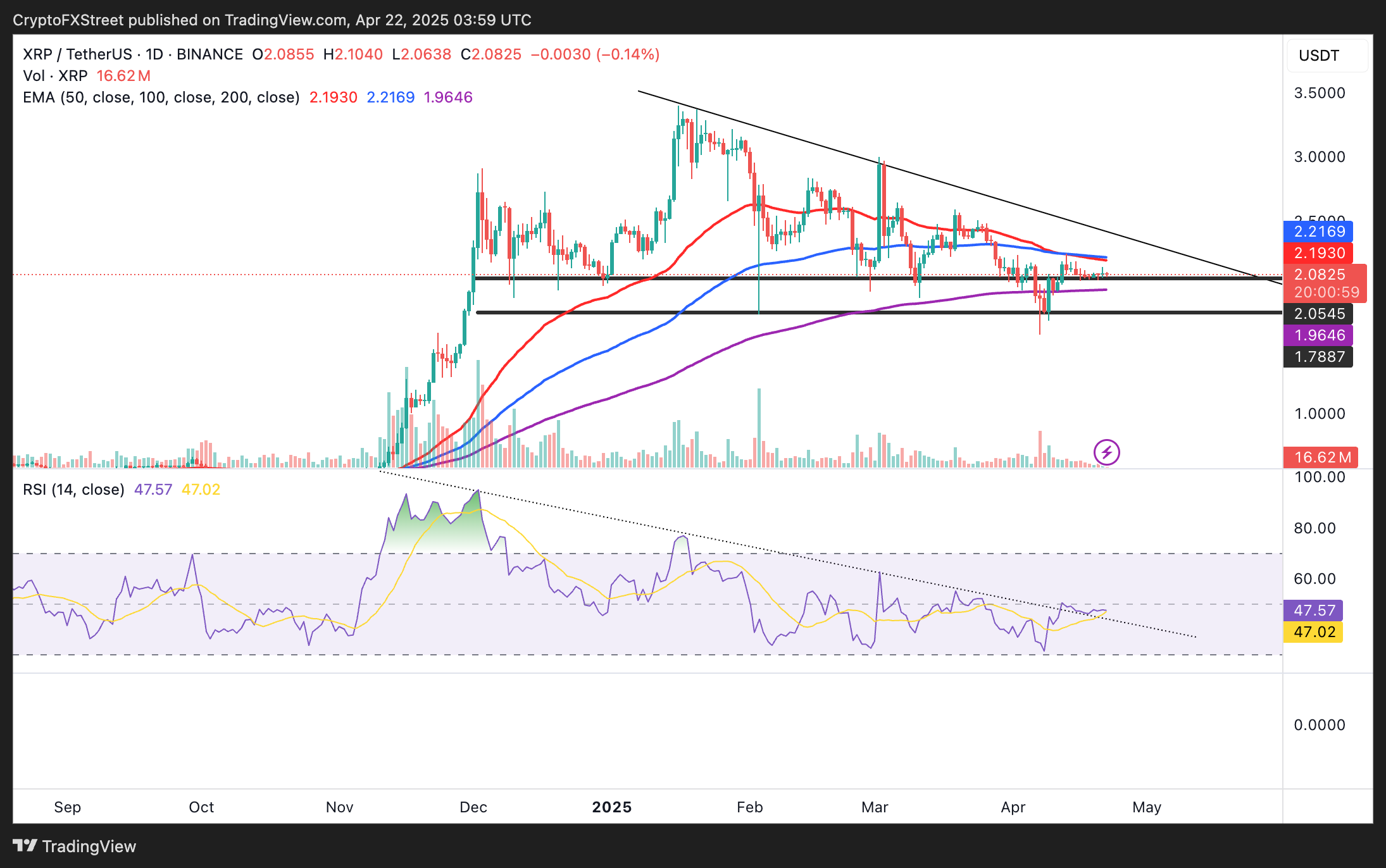
XRP price holds between a rock and a hard place, trading at $2.08 at the time of writing on Tuesday. Support at $2.00 is intact, but upside movement has been capped at under $2.22, a resistance highlighted by the 100-day Exponential Moving Average (EMA).
The Relative Strength Index (RSI) indicator on the daily chart sits above a descending trendline, suggesting that bullish optimism is still intact. However, it has yet to break above the midline, hinting at gradually building sell-side pressure.
XRP/USDT daily chart
A break above the upper range limit at $2.22 would confirm the bullish grip, encouraging more traders to buy XRP and creating bullish momentum to support a breakout toward $3.00.
However, if support at $2.00 is lost, XRP may drop to retest the 200-day EMA around $1.96 before extending the leg down to the April 7 low of $1.62, seeking liquidity ahead of another recovery attempt.
SEC vs Ripple lawsuit FAQs
It depends on the transaction, according to a court ruling released on July 14, 2023: For institutional investors or over-the-counter sales, XRP is a security. For retail investors who bought the token via programmatic sales on exchanges, on-demand liquidity services and other platforms, XRP is not a security.
The United States Securities & Exchange Commission (SEC) accused Ripple and its executives of raising more than $1.3 billion through an unregistered asset offering of the XRP token. While the judge ruled that programmatic sales aren’t considered securities, sales of XRP tokens to institutional investors are indeed investment contracts. In this last case, Ripple did breach the US securities law and had to pay a $125 million civil fine.
The ruling offers a partial win for both Ripple and the SEC, depending on what one looks at. Ripple gets a big win over the fact that programmatic sales aren’t considered securities, and this could bode well for the broader crypto sector as most of the assets eyed by the SEC’s crackdown are handled by decentralized entities that sold their tokens mostly to retail investors via exchange platforms, experts say. Still, the ruling doesn’t help much to answer the key question of what makes a digital asset a security, so it isn’t clear yet if this lawsuit will set precedent for other open cases that affect dozens of digital assets. Topics such as which is the right degree of decentralization to avoid the “security” label or where to draw the line between institutional and programmatic sales persist.
The SEC has stepped up its enforcement actions toward the blockchain and digital assets industry, filing charges against platforms such as Coinbase or Binance for allegedly violating the US Securities law. The SEC claims that the majority of crypto assets are securities and thus subject to strict regulation. While defendants can use parts of Ripple’s ruling in their favor, the SEC can also find reasons in it to keep its current strategy of regulation by enforcement.
Author

John Isige
FXStreet
John Isige is a seasoned cryptocurrency journalist and markets analyst committed to delivering high-quality, actionable insights tailored to traders, investors, and crypto enthusiasts. He enjoys deep dives into emerging Web3 tren