GENIUS Act heads to Trump’s desk: Here’s what will change


President Donald Trump is a signature away from enacting a bill to regulate stablecoins that will dictate how issuers of the tokens must be regulated to serve the US market.
The US House passed three crypto bills on Thursday, including the GENIUS Act, a backronym for “Guiding and Establishing National Innovation for US Stablecoins Act.”
The bill originated from the Senate, so it now only needs Trump’s signature to become law, which is expected to take place at 2:30 pm Friday in Washington, DC, during a “signing ceremony,” according to reporter Eleanor Terrett.
The law will come into effect 18 months after Trump signs it, or 120 days after the so-called “primary federal payment stablecoin regulators,” including the Treasury and Federal Reserve, issue final regulations implementing the GENIUS Act.
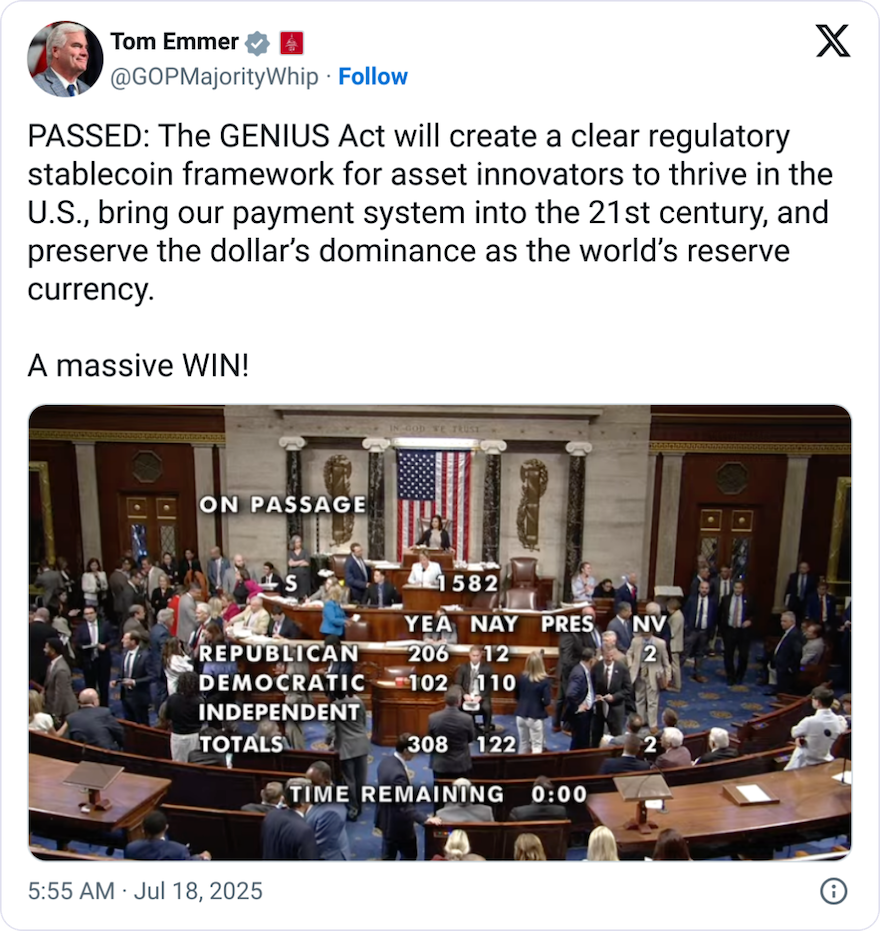
The House voted 308-122 to pass the GENIUS Act on Thursday after multiple delays with moving the bill forward. Source: Tom Emmer
Stablecoin issuers will want to be banks
Logan Payne, a crypto-focused lawyer at Winston & Strawn, told Cointelegraph that the GENIUS Act creates an incentive for stablecoin issuers to seek a banking license.
He said a new stablecoin licence under the GENIUS Act limits a company’s activities to “purely stablecoin issuance,” but most stablecoin issuers do more than that.
“Pretty much every stablecoin issuer in the United States issuing under US law right now engages in activities outside the scope of that license,” Payne said.
Even if an issuer gets a GENIUS Act-approved license, Payne said they’d still need state-level money transmission licenses to operate nationally.
That creates an incentive for stablecoin issuers to apply for a national trust bank charter with the Office of the Comptroller of the Currency (OCC), like Circle and Ripple have done, “which allows for them to engage in stablecoin issuance plus a wider range of activities, but without having to get state-to-state licenses,” he said.
Interest on stablecoins will be killed
A contentious part of the bill to some crypto users is a section that bans stablecoin issuers, both foreign and regulated under US law, from giving holders and users interest or yield.
Yield offerings are one of the biggest marketing devices for stablecoins to pull in users. Some offer yield natively for holders while others, like Circle’s USDC (USDC), reward those holding the stablecoin on exchanges such as Coinbase and Kraken.
“I would be unsurprised to see a lot of those arrangements change or be modified moving forward,” Payne said.
DeFi will have “a lot of uncertainty”
Payne said that the GENIUS Act could inject uncertainty into decentralized finance (DeFi) over how platforms are to handle stablecoins.
“How GENIUS will impact DeFi is intentionally a bit unaddressed, for now at least,” he said. “There’s still going to be a lot of uncertainty, but in a general policy environment, if it continues, we’ll start to have some of the answers being given over time.”
Payne said “additional legislation and then also regulation that fills in some of the gaps that will address DeFi” will come over the next few years. One is the CLARITY Act, a bill that classifies types of digital assets and which authorities will regulate them, which the House passed to the Senate on Thursday.
Expect monthly reserve reports
The GENIUS Act says permitted stablecoin issuers must back their tokens 1:1 with reserves of US dollars or other monetary products such as Treasury bills.
The issuers will have to publish the composition of those reserves publicly and have them “examined by a registered public accounting firm,” along with submitting a certification of the accuracy of the reports to their federal or state regulatory body.
Non-approved issuers barred, foreign stablecoins given exemptions
Three years after the bill is signed, it will outlaw any stablecoins that don’t come from an approved issuer from being offered in the US.
It will also be illegal for foreign-issued stablecoins to be offered in the US unless the issuer of that stablecoin can and will comply with the bill’s legal requirements.
The bill gives a host of carve-outs for foreign stablecoin issuers, including if the Treasury determines that the country in which they’re based has a comparable regulatory regime.
If that’s the case, foreign issuers can serve the US market if they successfully register with the OCC, which will answer within 30 days, and hold sufficient reserves in a US financial institution to cover their US customers.
Multiple agencies to regulate stablecoins in the US
The bill allows multiple types of regulated entities, such as banks, credit unions and nonbanks, to issue stablecoins and creates a dual federal and state legal framework to police them.
These entities, depending on their type, will be regulated by either the National Credit Union Administration, the Federal Deposit Insurance Corporation, the Office of the Comptroller of the Currency, the Treasury or the Federal Reserve.
Notably, entities can choose to be regulated at the state level if they don’t have over $10 billion in issued stablecoins, but a state does not have to create a stablecoin regulator.
Author
Cointelegraph Team
Cointelegraph
We are privileged enough to work with the best and brightest in Bitcoin.