European regulator's DeFi categories could make inroads with broader regulatory framework
- ESMA report underlines the increasing complexity of DeFi with several protocols being built on top of each other.
- The report categorizes smart contracts into five groups, a step towards its potential inclusion in future regulatory frameworks like MiCA.
- The set of clear rules has made way for more crypto businesses applying for licenses in the region.


The European Securities & Markets Authority (ESMA) released a comprehensive report on challenges that decentralized finance (DeFi) presents to regulations on Wednesday. The document identifies five main categories of smart contracts ahead of the implementation of the Markets in Crypto-Assets (MiCA) framework.
European regulator finds latest DeFi launches complex
One of the standout findings in ESMA's report is the contrast between the first surge of smart contract deployment in 2017 and 2018 against the second wave seen between 2021 and 2023. The regulator underlines that there is growth in the complexity of smart contracts due to the adoption of more sophisticated protocols.
The report finds that the DeFi industry has matured and a new generation of smart contracts that focus on complex applications has emerged. This includes derivatives management, prediction markets, insurance, yield farming, stablecoins and decentralized asset management. The watchdog now defines smart contracts across five categories: financial, operational, token, wallet and infrastructure.
Crypto businesses expand into the EU
ESMA also notes the potential of smart contracts in financial innovation, primarily due to their composability feature that allows open-source integration and interaction of decentralized applications (dApps).However, the agency highlights several risks associated with the sector, including the inability to modify or terminate smart contracts, transaction-ordering dependency, timestamp dependency, lack of accountability, and the rise of illicit smart contracts.
Moreover, ESMA finds that the dependency risk is a significant concern with smart contracts built on one another, making the entire system more interconnected and vulnerable to potential failure.
But amid clearer rules in the region, new businesses are expanding their footprint. Recently, digital bank Xapo secured a securities broker license in Europe that allows it to trade stocks while expanding its cryptocurrency wealth management services. Based on a report by Bloomberg, crypto exchange Deribit is next in line for a brokerage license in the European Union.
The report comes ahead of the MiCA framework, which is scheduled for broader implementation by December 2024. The EU members gave a green light to the set of rules earlier in May.
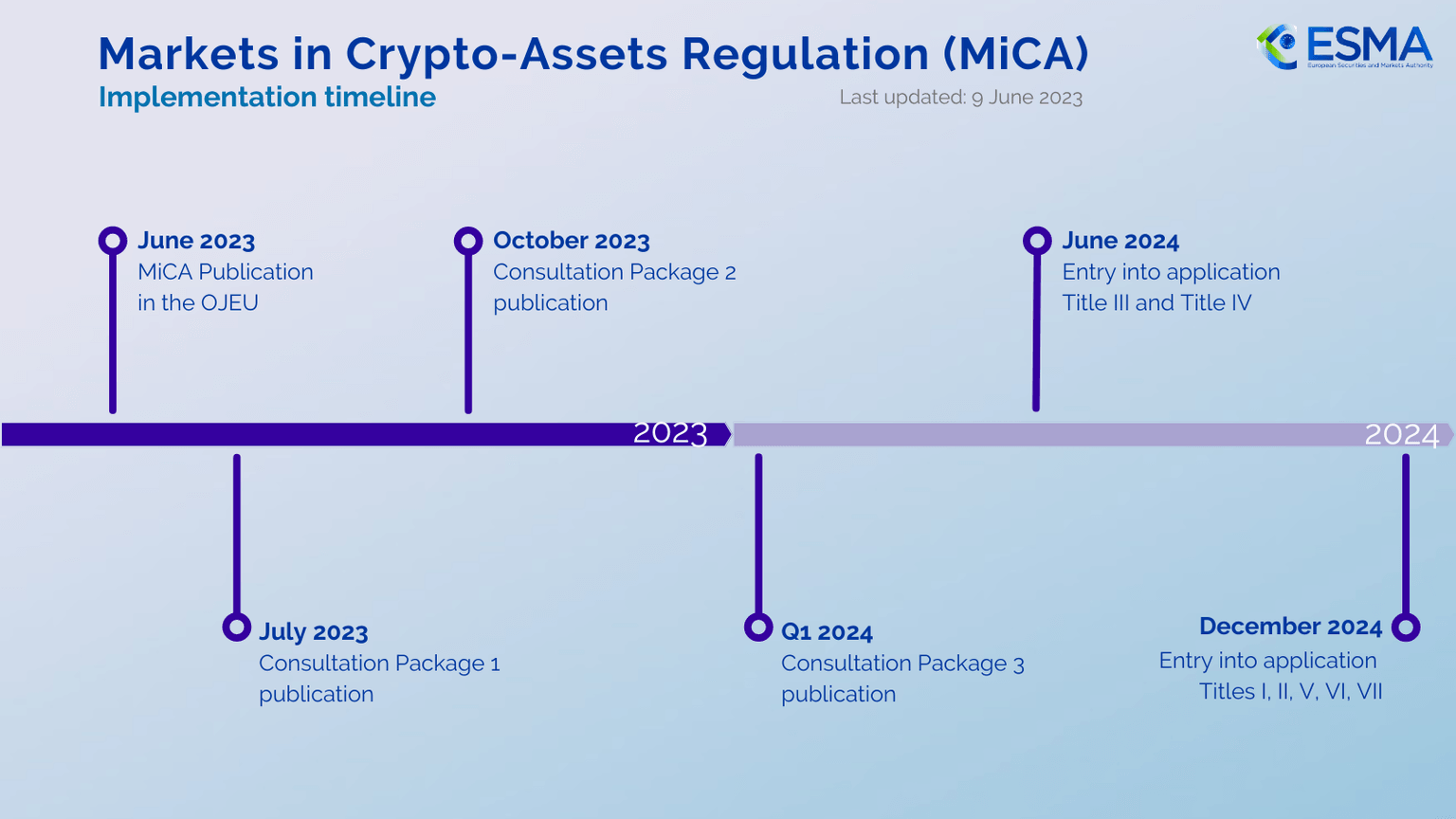
MiCA timeline
The ESMA report offers an overview into DeFi categories that may find their place within more comprehensive regulatory frameworks like MiCA. Especially when MiCA, as a European-level legal framework, does not encompass direct regulation of DeFi. The agency also highlights the necessity for ongoing monitoring in the DeFi space, which could lay the foundation for new regulatory measures.
Author
Shraddha Sharma
FXStreet
With an educational background in Investment Banking and Finance, Shraddha has about four years of experience as a financial journalist, covering business, markets, and cryptocurrencies.