Ethereum reaches 1M validators, community thinks it’s ‘too much’

The Ethereum network recently hit the one million validator milestone, with 32 million Ether
ETH
$3,584
currently staked, valued at approximately $114 billion based on current market prices.
On March 28, the Dune Analytics dashboard created by Hildobby to track Ethereum staking progress showed that the network achieved a validator count of one million, with the 32 million ETH staked accounting for 26% of the total supply.
The data also showed that around 30% of the ETH is staked using the Ethereum staking pool Lido, a liquid staking platform for proof-of-stake (PoS) cryptocurrencies.
Staking pools like Lido remain popular because they allow users with a smaller amount of ETH to pool their assets and participate.
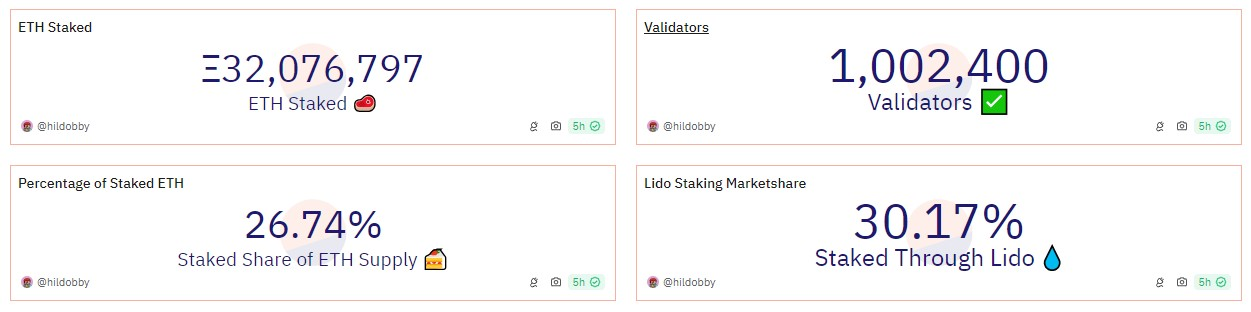
Ethereum reaches one million validators. Source: Dune
Validators ensure the security of a blockchain by monitoring the network for any malicious transactions, such as double-spending, which is essentially spending the same currencies twice.
In Ethereum, validators participate in proposing and validating transactions within the network. Those who wish to participate in this process are required to stake 32 ETH. In return, they get a small portion of ETH as a reward.
While the number of validators could translate into higher security for a blockchain, some community members think too many validators could pose a problem.
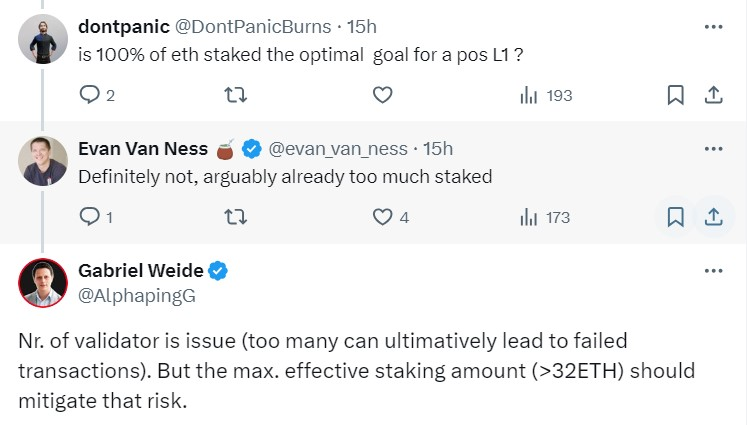
Source: Gabriel Weide
Venture investor and Ethereum advocate Evan Van Ness said there’s arguably already “too much” staked. Gabriel Weide, who runs a staking pool, believes that too many validators can eventually lead to “failed transactions.”
Meanwhile, Peter Kim, the head of engineering at Coinbase Wallet, said that while the number of validators is “impressive,” it’s “artificially inflated by the 32 ETH cap.” However, he suggested this may change soon.
As the number of validators continues to rise, Ethereum co-founder Vitalik Buterin proposed a way to improve the network’s decentralization. On March 27, Buterin published a blog post proposing to penalize validators in proportion to their average failure rate.
If many validators fail in a given slot, each failure’s penalties will be higher. Such an approach could potentially reduce the advantage of large ETH stakers over smaller ones, according to Buterin.
Author

Cointelegraph Team
Cointelegraph
We are privileged enough to work with the best and brightest in Bitcoin.