Ethereum nears Visa in processed transaction volume, what this means
- Ethereum almost caught up with Visa in processed transaction volume, recording $3.01 trillion vs. $3.08 trillion respectively.
- The popular blockchain is already the network of choice for many established players looking to utilize the novel technology, Visa included.
- Notably, Ethereum is far younger than the traditional payments giant.
- The report attests to growth in mainstream adoption of crypto and blockchain, despite association with scammers, drug dealers, and cybercriminals.

Ethereum (ETH), though younger than traditional payment moguls like Visa, has shown that blockchain has become a formidable force in the financial market for the second time in three years. The news comes after a Coingraph report indicating that the Ethereum blockchain recorded a trading volume of $3.01 trillion against Visa's $3.08 trillion.
JUST IN: $ETH almost caught up with Visa in processed transaction volume - $3.01 trillion vs. $3.08 trillion, respectively.
— Coingraph | News (@CoingraphNews) May 29, 2023
Ethereum premiered in 2016, 58 years after Bank of America (BofA) founded Visa as the BankAmericard credit card program.
Also Read: Ethereum ZK rollups eye Arbitrum's market share as adoption rises
Ethereum almost caught up with Visa in processed transaction volume
Ethereum (ETH) blockchain has recorded a massive $3.01 trillion trading volume, only about 0.07 trillion less than Visa. The competition is remarkable, especially for Ethereum, because of the bearish market since mid-2022.
With this information, Ethereum testifies to the growth in blockchain technology so much that it can now rival established players within the payments technology space. It also evidences the growth in mainstream adoption of a budding technology often associated with an enabler of crime. This is because scammers, drug dealers, and cyber criminals are now more inclined to digital assets than traditional finance.
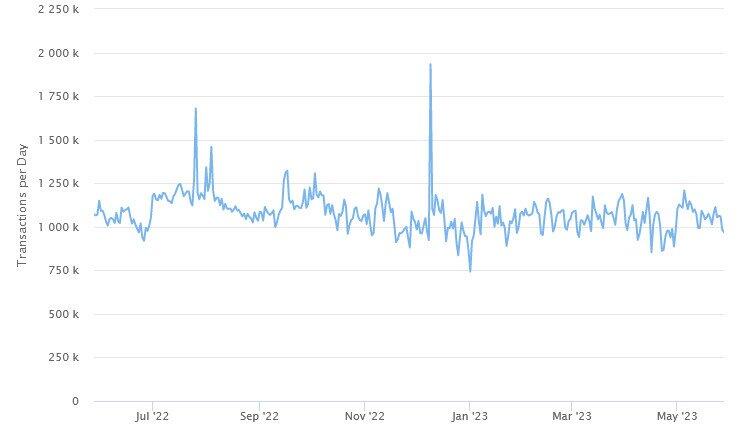
Based on Etherscan data, Ethereum daily transactions hit 968,996 on May 28, with the all-time high being 1,932,711 transactions on December 9, 2022.
Also Read: Ethereum worth $7.5M stolen in Arbitrum-based Jimbos Protocol exploit
As the second-largest blockchain in the world, Ethereum powers a wide range of financial technology solutions committed to revolutionizing the finance market on a global scale. These solutions include staking, lending, flash loans, and decentralized finance (DeFi).
Further, the Ethereum blockchain has become a wealthy, agile, and dynamic environment with a wide provision for further development. This is another advantage of Ethereum over traditional financial layers.
Ethereum foray into TradeFi
The famous blockchain is already the choice network for most established traders and investors like Visa, who want to use the novel technology. A May report about Ethereum's economics indicated that Visa employed Ethereum's Goerli testnet to try transaction-free payments using account abstraction.
It leveraged a smart contract christened 'Paymaster,' which allowed the company to capitalize on account abstraction to perform complex tasks on behalf of accounts and manage transaction costs. Citing Head of Crypto Cuy Sheffield at Visa at the time:
Excited to see Visa deploy our first paymaster smart contract on testnet as we continue to research and experiment with account abstraction and ERC-4337.
ERC-4337 is an Ethereum standard that performs account abstraction without a consensus-layer alteration. This allows users to bundle and automate transactions on the network.
Ethereum previous triumph over visa: A deep dive into the factors
This is not the first time Ethereum has shown its gusto against Visa. The blockchain network had outperformed the payments giant in 2021, recording $11.6 trillion against Visa's $10.4 trillion trading volume.
In 2021, VISA moved $10.4 trillion in payments volume, Ethereum moved $11.6 trillion.
— Blockworks (@Blockworks_) January 19, 2022
This was attributed to the second largest crypto recording 4.5X as many daily transactions as Visa and was corroborated by Ethereum Foundation's Josh Stark.
FUN FACT: #Ethereum processed 4.5x times more transactions than Visa in 2021.
— Watcher.Guru (@WatcherGuru) May 6, 2022
Despite the difficult conditions in the crypto market, Ethereum survived through regulatory clampdowns, a myriad of bank crises amidst turbulences in traditional finance, and the ensuing Fear, of Uncertainty and Doubt (FUD). The role of developments and upgrades cannot be ignored as these are the major reasons for ETH high volume transactions. The Merge upgrade and Shanghai/Capella (Shapella) upgrade are among the major upgrades, as they reduced the gas fees and spiked the number of transactions between 2022 and 2023.
Author

Lockridge Okoth
FXStreet
Lockridge is a believer in the transformative power of crypto and the blockchain industry.