Cardano sharks continue ADA accumulation despite declining sentiment among traders
- Cardano market capitalization has declined 35% since ADA price hit a local peak at $0.4610, nearly four months ago.
- There are now 25,294 wallets with over 100,000 in ADA token holdings.
- Bearish sentiment among ADA holders failed to deter large wallet investors from accumulating the altcoin.

Trader sentiment toward Cardano has changed over the past four months. The Ethereum alternative altcoin lost 35% of its market capitalization since it hit a local top of $0.4610 in April 2023.
The declining sentiment has failed to deter whales and sharks from scooping up ADA however. Based on data from Santiment, there are upwards of 25,000 wallets with 100,000 ADA, the highest number in the past 16 months.
Also read: Attorney Jeremy Hogan claims that XRP is not a security, its status is not subject to SEC appeal
Cardano enters accumulation phase
Cardano, one of the largest altcoins in the crypto ecosystem and an alternative to Ethereum, has entered the accumulation phase. Large wallet investors holding ADA have continued scooping up the altcoin, despite its consistent price decline over the past four months.
Cardano price hit its April 2023 top of $0.4610. Since then the altcoin’s price has been on a downward trend. The sentiment among ADA holders and traders has turned bearish alongside the decrease in its market capitalization and price.
Notably, the decline has no significant impact on whales and sharks. Data from Santiment sheds light on the accumulation by these classes of investors.
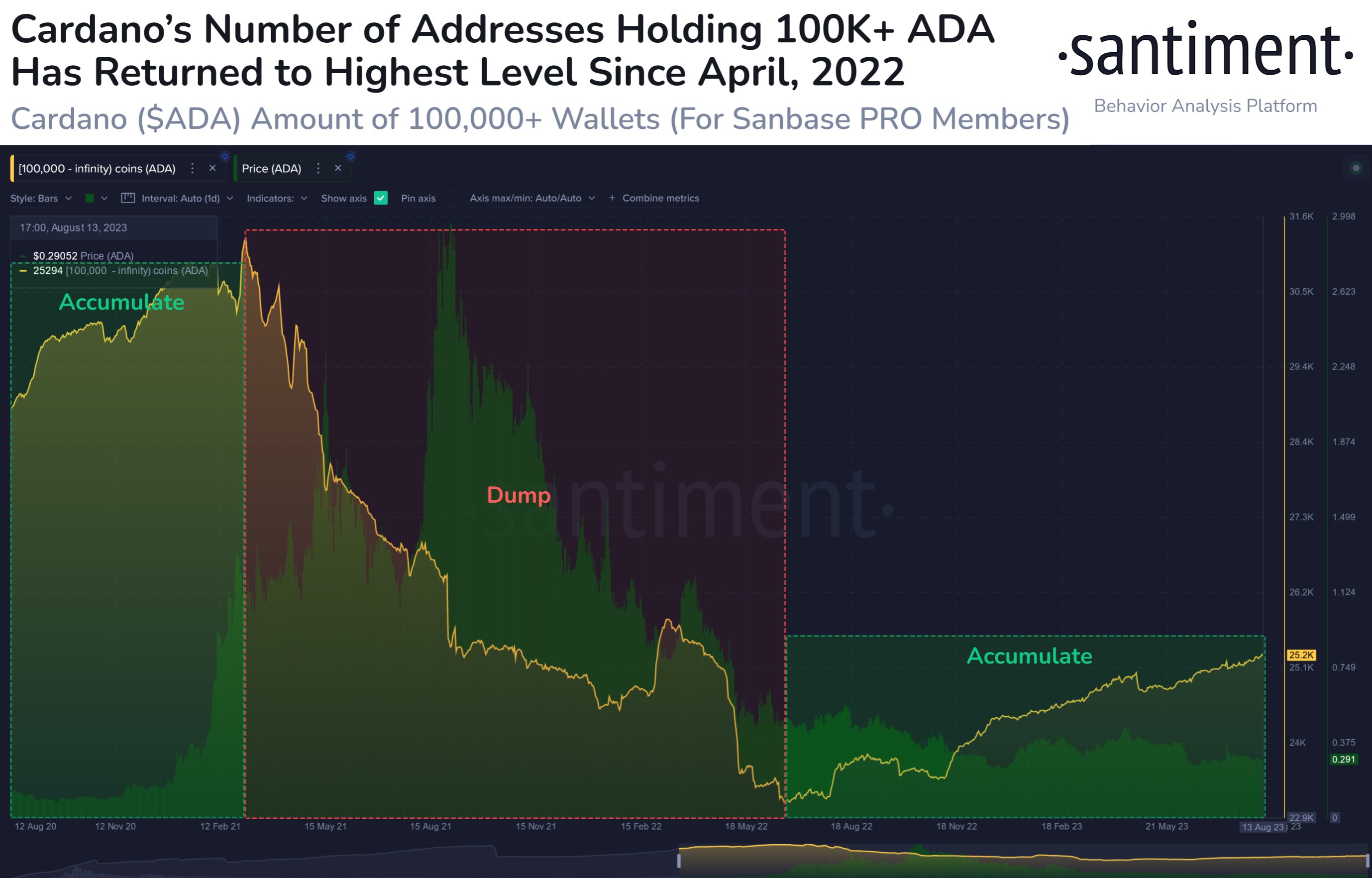
Cardano accumulation between May and August 2023
The number of ADA wallets holding more than 100,000 tokens hit a peak of 25,294 this month and appears likely to make a run at the early 2022 high shortly.
Accumulation of an asset is typically considered bullish for its price in the long term. At the time of writing, Cardano price is trading at $0.2907, below its three long-term Exponential Moving Averages – the 200, 50 and 10-day EMAs at $0.3432, $0.3035 and $0.2943.
Bitcoin, altcoins, stablecoins FAQs
What is Bitcoin?
Bitcoin is the largest cryptocurrency by market capitalization, a virtual currency designed to serve as money. This form of payment cannot be controlled by any one person, group, or entity, which eliminates the need for third-party participation during financial transactions.
What are altcoins?
Altcoins are any cryptocurrency apart from Bitcoin, but some also regard Ethereum as a non-altcoin because it is from these two cryptocurrencies that forking happens. If this is true, then Litecoin is the first altcoin, forked from the Bitcoin protocol and, therefore, an “improved” version of it.
What are stablecoins?
Stablecoins are cryptocurrencies designed to have a stable price, with their value backed by a reserve of the asset it represents. To achieve this, the value of any one stablecoin is pegged to a commodity or financial instrument, such as the US Dollar (USD), with its supply regulated by an algorithm or demand. The main goal of stablecoins is to provide an on/off-ramp for investors willing to trade and invest in cryptocurrencies. Stablecoins also allow investors to store value since cryptocurrencies, in general, are subject to volatility.
What is Bitcoin Dominance?
Bitcoin dominance is the ratio of Bitcoin's market capitalization to the total market capitalization of all cryptocurrencies combined. It provides a clear picture of Bitcoin’s interest among investors. A high BTC dominance typically happens before and during a bull run, in which investors resort to investing in relatively stable and high market capitalization cryptocurrency like Bitcoin. A drop in BTC dominance usually means that investors are moving their capital and/or profits to altcoins in a quest for higher returns, which usually triggers an explosion of altcoin rallies.
Like this article? Help us with some feedback by answering this survey:
Author

Ekta Mourya
FXStreet
Ekta Mourya has extensive experience in fundamental and on-chain analysis, particularly focused on impact of macroeconomics and central bank policies on cryptocurrencies.



