Bitcoin law sparks protests in El Salvador as concerns on corruption arise
- In anticipation of Bitcoin becoming legal tender in El Salvador next week, President Nayib Bukele announced that the Chivo Wallet is ready to be used on September 7.
- While Bukele believes that the legislation would benefit its citizens, it seems like not all of them agree.
- Protests have broken out as residents in the country have deep concerns about the use of Bitcoin in the country known for its corruption and non-transparent policies.

The El Salvador Bitcoin law is expected to be implemented on September 7. President Nayib Bukele has recently announced that the Chivo Wallet is ready to be used on the same day, allowing users to exchange their BTC for dollars. Although Bukele aims to introduce new advantages of the new asset class to the country, hundreds of protestors recently raised their voices against the new legislation.
Citizens speak out against the Bitcoin law
On September 7, the day of the Bitcoin law becoming official in El Salvador, residents would be able to download an application to receive payments in Bitcoin or dollars. Users will automatically be given $30 equivalent in BTC for consumption.
President Bukele said that the new Bitcoin legislation aims to allow citizens to save on cross-border remittances. According to Bukele, the Latin American country spends over $400 million per year on remittance costs. With the Chivo wallet, Salvadorans who live abroad could use the application to send money back to their family at home.
Although the new law will come into effect next week, using Bitcoin as legal tender is not mandatory. The finance minister of El Salvador, Alejandro Zelaya, said that the government would not force any of its citizens to receive BTC as a form of payment.
Bukele added that should residents choose to carry cash and not grow their business and pay commission on remittances, they could continue to do so. However, Article 7 of the Bitcoin legislation states that all economic agents would need to accept the leading cryptocurrency as a form of payment when offered in exchange for acquiring goods and services.
However, the citizens in the Latin American country have spoken out against the new law, as hundreds of protestors went out on the streets to protest, with volatility and instability of Bitcoin as their primary concern. According to Stanley Quinteros, a member of the Supreme Court of Justice’s workers union, the adoption of Bitcoin could damage the country’s finances since there is no method to stabilize the cryptocurrency’s price.
Some of the protestors said that Bitcoin is not welcomed. They are also against the use of cryptocurrency, believing it will facilitate corruption in a country known for a lack of transparency in its policies. Others believe that the law was approved prior to consultation and could harm the interest of Salvadorans.
Dante Mossi, the executive president of the Central American Bank for Economic Integration, said that the world is now watching if the integration of Bitcoin as legal tender goes well for El Salvador, and other countries may follow if the advantages outweigh the drawbacks.
Bitcoin price showing signs of hesitation
Bitcoin price has continued to consolidate following its swing high on August 23, reaching over $50,000. The leading cryptocurrency has trended sideways since, unable to sustain its momentum, testing the reliability of support.
The bellwether cryptocurrency has slid below the diagonal trend line, which acted as support for Bitcoin price on August 29, as the bulls catch their breath following the consistent uptrend that has lasted for over a month.
Until Bitcoin price slices above the aforementioned trend line, BTC could continue to move sideways until the bulls can lift prices higher against the distribution of the sellers.
Bitcoin price will discover the first level of support at $47,730, then at the 50 twelve-hour Simple Moving Average (SMA), coinciding with the 50% Fibonacci extension level at $46,711. The following line of defense will emerge at $45,335 should the bears continue to take control.
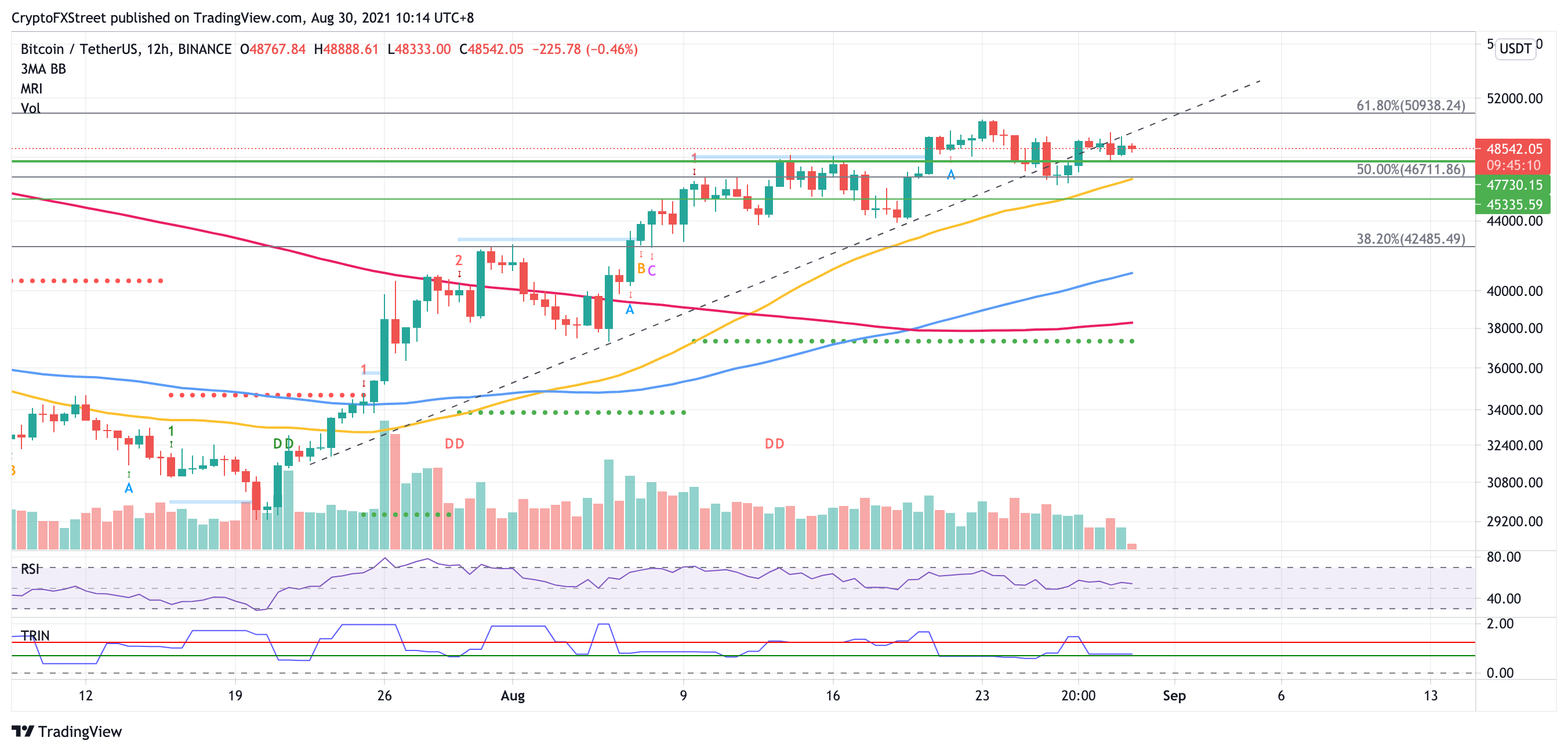
BTC/USDT 12-hour chart
On the upside, Bitcoin price must break above the diagonal trend line at $49,880 before tackling the previous high at $50,491. Further buying pressure may push BTC toward the 61.8% Fibonacci extension level at $50,938 prior to aiming for bigger aspirations.
Author

Sarah Tran
Independent Analyst
Sarah has closely followed the growth of blockchain technology and its adoption since 2016.