Bitcoin is designed to moon due to its core economic model
- Bitcoin's anti-inflationary design has been a critical factor affecting its price action since its inception.
- Another bull rally is set to occur following this year's halving event due to the significant supply shock.
- The stock-to-flow-index adds credence to the bullish narrative, forecasting a $100,000 Bitcoin by June 2021.

It appears that the most recent block rewards reduction event is yet to have an impact on Bitcoin's price. While the pioneer cryptocurrency becomes more scarce, awareness is skyrocketing among investors. Such an economic dynamic is designed to help propel BTC to higher highs over the years to come.
The impact of Bitcoin’s deflationary mechanism
Constant supply shocks govern Bitcoin's core economic principle and are critical for its price action. A system of halvings or block reward reductions and bi-weekly mining difficulty adjustments enable the flagship cryptocurrency to rise despite all odds.
The halving is a quadrennial event on the Bitcoin network that slashes the rewards miners get for minting new coins in two, enforcing a fixed supply. The first halving occurred in 2012 and saw miners’ rewards go from 50 to 25 BTC. A similar event took place in 2016, reducing rewards to 12.5 coins. The third halving occurred this year, and now Bitcoin miners are earning 6.25 tokens per block.
Historical data shows that roughly 12 months after the block rewards reduction event takes place, demand tends to outweigh the number of tokens that market participants are willing to sell. Such behavior leads to a supply shortage, ultimately causing Bitcoin’s price to go ballistic.
Bitcoin economic dynamics 12 months after its halving
The two-week difficulty adjustment prevents miners from gaming the supply structure by front running future margins. Thereby, it ensures that the same amount of Bitcoin is available for mining, regardless of the number of miners on the network. Preston Pysh, the founder of the Pylon Holding Company, compared this process to gold mining.
"In this situation, it's akin to a god enforcing a fixed rate of supply per day regardless of how many workers show up for the job. So if ten people show up to mine, it's no different than 1 million people showing up to mine. They'll still find the same amount of gold every day."
While it may seem speculative to assume that the pioneer cryptocurrency plays into a self-fulfilling prophecy by responding to the halving effect, a well-known statistical model supports the narrative.
Massive gains on the horizon
The stock-to-flow model is a long-aged metric used to gauge the scarcity of natural resources. It essentially takes into consideration the current supply of a given commodity and its production rate. The higher the stock-to-flow, the lesser supply that goes into circulation.
S/F = stock (total available amount)/ flow (yearly production)
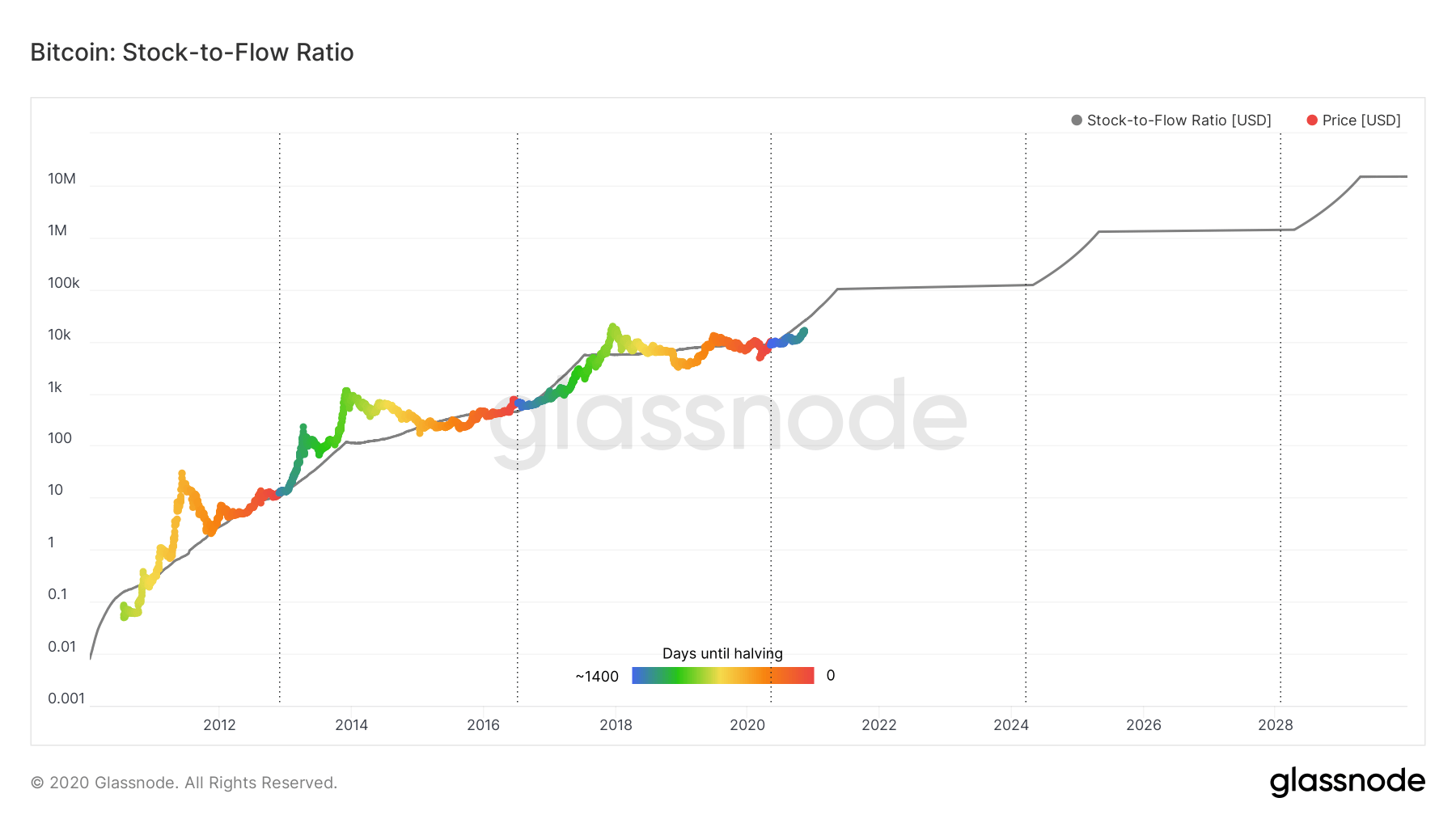
Bitcoin’s stock-to-flow model by Glassnode
The S2F model shows that Bitcoin is about to enter a parabolic advance due to the most recent halving. Based on this indicator’s previous performance, the bellwether cryptocurrency is set to go through a significant price explosion within the next few months as scarcity increases.
BTC will rise to $100,000 by June 2021 if the stock-to-flow model proves right once again. Regardless of the short-term price action, Bitcoin’s economic mechanism will ensure that prices continue rising over time, making it an ideal store of value.
Author

FXStreet Team
FXStreet
Composed of a group of economic journalists and FX experts, the FXStreet content team produces and oversees all content published on FXStreet. It provides a purely journalistic approach to the Forex market.