Widening Trade Deficit Will Exert Drag on GDP Growth in Q4

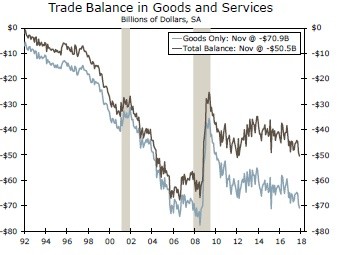
The trade deficit widened markedly in the last two months of 2017. Consequently, real net exports likely exerted a significant drag on overall GDP growth in the fourth quarter.
Deficit Widens as Imports Jump More than Exports
The U.S. trade deficit widened to $50.5 billion in November from $48.9 billion in October (top chart). Not only was the outturn a bit higher than most analysts had expected, but it was the first time that the deficit has exceeded $50 billion since March 2012. Although exports of goods and services jumped by 2.3 percent in November, imports were up 2.5 percent. There was broad-based strength on the export side of the ledger. The $2.5 billion increase in the export of capital goods was flattered by the $1.2 billion jump in exports of civilian aircraft, which can be volatile on a monthly basis. This sizeable increase in overall capital goods exports in November may reflect, at least in part, some statistical payback for weakness during the previous two months. Smoothing through the monthly volatility shows that overall exports clearly have rebounded in 2017 after their weakness in 2016. The value of American exports was up 6.0 percent in the September-November period relative to the same period in 2016 (middle chart).
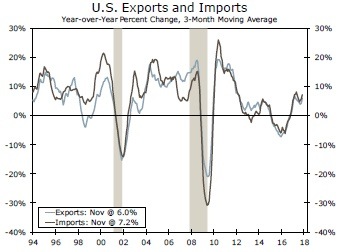
There was also broad-based strength on the import side of the ledger. The value of imported petroleum products was up $1.5 billion in November. This increase in the value of petroleum imports largely reflects the trend increase in oil prices that occurred during the autumn. The volume of petroleum imports edged higher in November, but they remain well off their peak of a decade ago. Imports of cell phones jumped about $1.1 billion, which likely reflects the introduction of the Apple iPhone X. These one-off factors notwithstanding, import growth also strengthened over the course of 2017. Some of the increase in import values reflects higher commodity prices (e.g., oil), but growth in import volumes has strengthened as growth in domestic demand has picked up.
Net Exports Probably Exerted Headwinds on GDP Growth in Q4
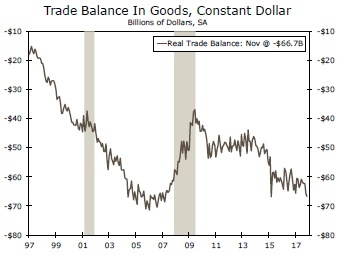
In real (i.e., price adjusted) terms, the trade deficit widened by $1.1 billion in November. The real trade deficit is important because it enters directly into calculations of real GDP growth. Real net exports of goods and services provided modest positive contributions to overall GDP growth in the first three quarters of 2017, but it appears that the string will end in the last quarter of the year because real net exports of goods deteriorated significantly in October and again in November (bottom chart). If real exports and real imports in December remain at their respective November levels, then real net exports would slice more than one percentage point off of the topline GDP growth rate in Q4. Although we do not expect that the overall drag will be quite that large, real net exports likely exerted significant headwinds on overall GDP growth in Q4. Moreover, we look for a modest drag from trade to continue for the next few quarters.
Author

Wells Fargo Research Team
Wells Fargo