US Dollar Weekly Forecast: Markets will now look at the US labour market
- The US Dollar closed its second consecutive week of losses.
- President Trump appointed Kevin Warsh to succeed Jerome Powell.
- The Fed left its interest rates unchanged, as previously estimated

The week that was
It was a rough and volatile week for the US Dollar (USD).
Indeed, the US Dollar Index (DXY) built on the previous week’s decline and retreated to the 95.50 region, an area last visited in February 2022. However, the Greenback managed to recoup most of that pullback in the wake of the Federal Reserve (Fed) meeting and following President Trump’s announcement of Kevin Warsh to become Jerome Powell’s successor at the Fed’s helm.
In rates, the picture was mixed: While the 2-year yields retreated every single day, the 10-year yields advanced marginally vs. a stronger uptick in the longer end of the curve.
The Fed pauses… and waits… watchful
The Federal Reserve left rates unchanged at its January meeting, keeping the fed funds target range at 3.50%–3.75%, in line with expectations. Policymakers sounded slightly more confident on the outlook, noting solid growth and no longer flagging rising downside risks to employment.
Chair Jerome Powell said the current policy stance remains appropriate, pointing to signs of labour market stabilisation and ongoing progress in services inflation. He argued that recent inflation pressures have been driven largely by tariff-related goods prices, which are expected to peak around mid-year.
Powell reiterated that decisions will remain meeting by meeting, stressing that rate hikes are not the base case and that risks on both sides of the Fed’s mandate have eased.
Consensus remains far from united
Fed speakers offered a telling range of views toward the end of the week, underlining how divided the debate has become between lingering inflation risks and signs of a softening labour market. While some policymakers are starting to sound more comfortable with the inflation backdrop, others are increasingly uneasy that waiting too long could leave the Fed behind the curve. At this point, the discussion is shifting from when to cut rates to what problem the Fed is really trying to solve.
Stephen Miran (FOMC Governor, permanent voter) was firmly in the relaxed camp, arguing that inflation is no longer a pressing issue and brushing off the latest strong PPI print as unlikely to change the broader picture. He also played down tariff-related inflation risks and renewed his call for a much smaller Fed balance sheet, saying quantitative tightening should go further.
Christopher Waller (FOMC Governor, permanent voter), by contrast, struck a more urgent note. He said his dissent in favour of a 25bp rate cut reflected growing concern about the labour market, warning that weak job growth and recent data point to a real risk of a sharper downturn in hiring.
Sitting somewhere in between, Raphael Bostic (Atlanta, non-voter) argued that inflation is still too high and has shown little progress over the past two years. While he does not expect price pressures to reaccelerate, he warned they could remain stubborn, making a patient approach appropriate for now. In his view, the case for near-term rate cuts remains unconvincing, with labour market risks seen as less immediate.
Taken together, the comments paint a picture of a Fed that is clearly split on how quickly policy should ease. Some officials see inflation risks fading and room to move, while others remain wary of cutting too soon. For now, rate cuts still look likely, but the path there is shaping up to be anything but smooth.
Markets see cuts; the Fed sees unfinished business
The most recent US inflation numbers matched expectations. In December, both the headline and core CPI rose at a constant rate. The headline inflation rate stayed at 2.7% YoY, while the core measure stayed at 2.6% over the last twelve months.
The data mostly confirmed the disinflation scenario, which made people think that the Fed might drop rates again in the coming months. The future, however, is still very uncertain. It is still not clear how US tariffs would affect household costs, and numerous Fed officials have warned that inflation is still too high, beyond the 2% objective.
Given this context, the most recent producer price data suggest a more cautious outlook, indicating that underlying price pressures may not be decreasing as quickly as investors hope.
What’s in store for the US Dollar
The focus now shifts to the US labour market, as the Nonfarm Payrolls (NFP) report, scheduled for next week, is expected to dominate the market toward the end of the week.
Meanwhile, markets will closely monitor any new remarks from Fed officials following the recent policy meeting.
Technical landscape
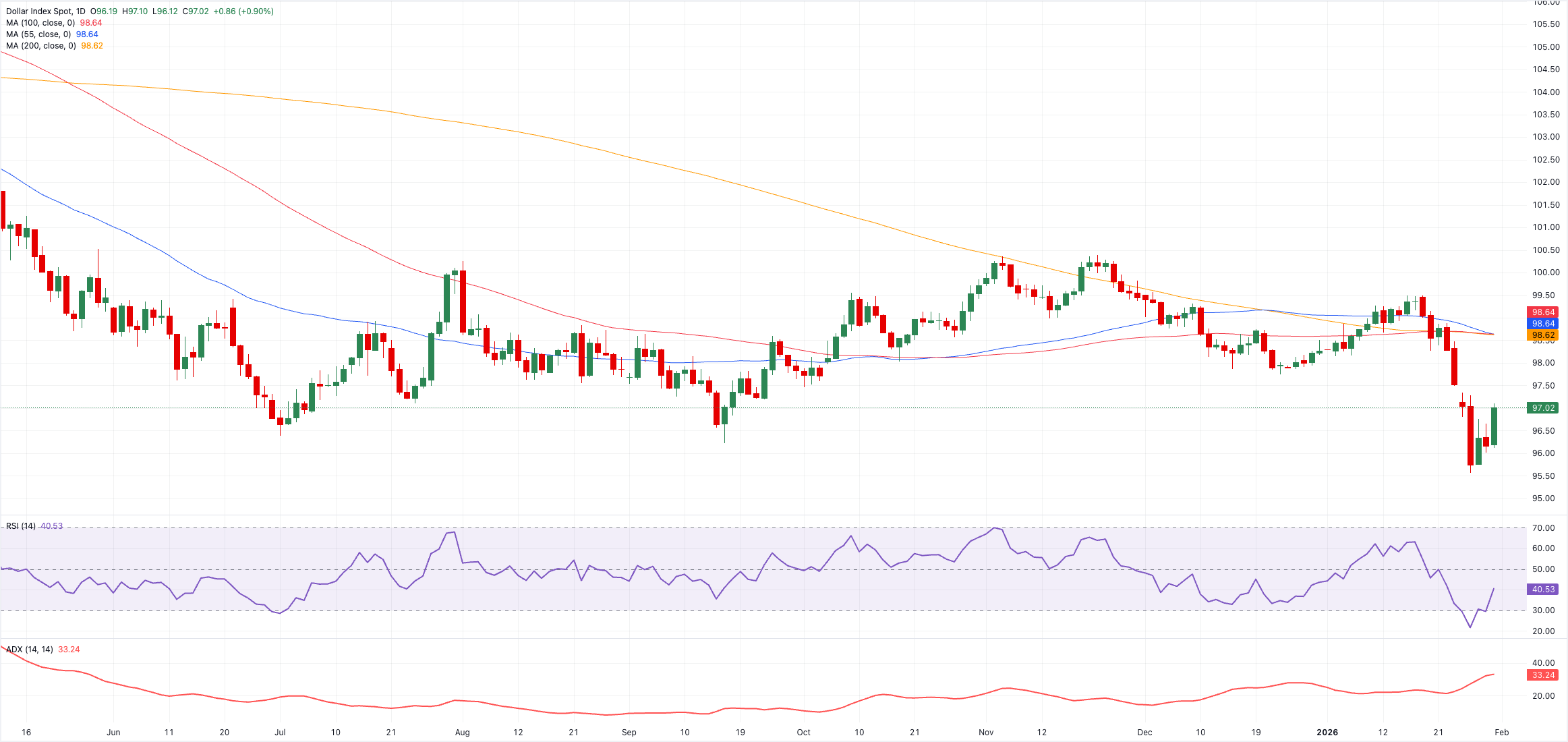
After climbing to the area of yearly highs around 99.50 earlier in the month, the US Dollar Index (DXY) has come under fresh and quite persistent selling pressure. That said, the index returned to the 95.50 area following a severe sell-off in the first half of the week, just to almost fully retrace that move in the last couple of days.
In the meantime, the index broke below its critical 200-day SMA around 98.60, exposing the continuation of the downward trend for now. Down from here, the next support sits at the 2026 bottom of 95.55. A deeper pullback could put the February 2022 base at 95.13 back on the radar ahead of the 2022 valley at 94.62 (January 14).
On the other hand, bulls would need to surpass the 200-day SMA once more, potentially leading to a test of the 2026 ceiling at 99.49 (January 15). Further up sits the November 2025 top at 100.39 (November 21) before the May 2025 high at 101.97 (May 12).
Additionally, momentum indicators continue to lean bearish. That said, the Relative Strength Index (RSI) bounces to the 40 zone, while the Average Directional Index (ADX) just above 32 indicates a robust trend.
Bottom line
Much of the recent softness in the Greenback appears to be politically driven, with markets paying closer attention to headlines and uncertainty around President Trump than to the hard data.
In the meantime, the labour market remains the key focus for the Fed. Policymakers are watching closely for any clear signs of weakening, but inflation is still very much part of the equation. Price pressures remain uncomfortably high, and if progress on disinflation starts to stall, expectations for early or aggressive rate cuts could quickly be pared back.
Against that, the Fed would likely stick with a more cautious policy stance and, over time, make the case for a firmer buck, political noise aside.
Nonfarm Payrolls FAQs
Nonfarm Payrolls (NFP) are part of the US Bureau of Labor Statistics monthly jobs report. The Nonfarm Payrolls component specifically measures the change in the number of people employed in the US during the previous month, excluding the farming industry.
The Nonfarm Payrolls figure can influence the decisions of the Federal Reserve by providing a measure of how successfully the Fed is meeting its mandate of fostering full employment and 2% inflation. A relatively high NFP figure means more people are in employment, earning more money and therefore probably spending more. A relatively low Nonfarm Payrolls’ result, on the either hand, could mean people are struggling to find work. The Fed will typically raise interest rates to combat high inflation triggered by low unemployment, and lower them to stimulate a stagnant labor market.
Nonfarm Payrolls generally have a positive correlation with the US Dollar. This means when payrolls’ figures come out higher-than-expected the USD tends to rally and vice versa when they are lower. NFPs influence the US Dollar by virtue of their impact on inflation, monetary policy expectations and interest rates. A higher NFP usually means the Federal Reserve will be more tight in its monetary policy, supporting the USD.
Nonfarm Payrolls are generally negatively-correlated with the price of Gold. This means a higher-than-expected payrolls’ figure will have a depressing effect on the Gold price and vice versa. Higher NFP generally has a positive effect on the value of the USD, and like most major commodities Gold is priced in US Dollars. If the USD gains in value, therefore, it requires less Dollars to buy an ounce of Gold. Also, higher interest rates (typically helped higher NFPs) also lessen the attractiveness of Gold as an investment compared to staying in cash, where the money will at least earn interest.
Nonfarm Payrolls is only one component within a bigger jobs report and it can be overshadowed by the other components. At times, when NFP come out higher-than-forecast, but the Average Weekly Earnings is lower than expected, the market has ignored the potentially inflationary effect of the headline result and interpreted the fall in earnings as deflationary. The Participation Rate and the Average Weekly Hours components can also influence the market reaction, but only in seldom events like the “Great Resignation” or the Global Financial Crisis.
Author

Pablo Piovano
FXStreet
Born and bred in Argentina, Pablo has been carrying on with his passion for FX markets and trading since his first college years.

















