USD/JPY Price Forecast: Potential US-China trade deal offsets BoJ rate hike bets
- USD/JPY attracts fresh buyers as hopes for a US-China trade deal weigh on the safe-haven JPY.
- A modest USD uptick lends additional support to spot prices and contributes to the move up.
- The divergent BoJ-Fed policy expectations and geopolitical risks might cap gains for the major.

The USD/JPY pair regains positive traction following the previous day's modest downfall and trades near a two-week top, just below the 144.00 mark during the early European session on Friday. Spot prices remain on track to register strong weekly gains and snap a three-week losing streak amid the potential de-escalation of US-China trade tensions. The latest optimism remains supportive of a positive risk tone and is seen weighing on traditional safe-haven assets, including the Japanese Yen (JPY). Apart from this, the emergence of some US Dollar (USD) buying acts as a tailwind for the currency pair.
US President Donald Trump told reporters that the US and China held discussions on Thursday to help resolve the trade war between the world’s two largest economies. Moreover, a White House official said that lower-level in-person talks as well as a phone call between US and Chinese staff had taken place this week. Adding to this Bloomberg reported this Friday, citing sources familiar with the matter, that China is mulling suspending its 125% tariff on some US imports. This, in turn, fuels hopes for a quick resolution to the US-China standoff, which further boosts investors' confidence and undermines the JPY.
Meanwhile, receding safe-haven demand overshadowed government data, which showed that consumer inflation in Tokyo – Japan's capital city – accelerated sharply in April and reaffirmed bets for more interest rate hikes by the Bank of Japan (BoJ). In fact, the headline Tokyo Consumer Price Index (CPI) grew 3.5% year-on-year in April from 2.9% in the prior month. Adding to this, Tokyo core CPI, which excludes volatile fresh food prices, rose 3.4% YoY, or a two-year high, sharply higher from the 2.4% in March. Furthermore, a gauge that excludes both fresh food and fuel costs rose 3.1% after a 2.2% rise in March.
This comes on top of BoJ Governor Kazuo Ueda's remarks on Thursday that the central bank will continue to raise interest rates if underlying inflation converges toward its 2% inflation target as projected. In contrast, a couple of Federal Reserve (Fed) officials discussed the willingness for potential interest rate cuts soon. Fed Governor Christopher Waller said that he would support an interest rate cut if tariffs start weighing on the job market. Separately, Cleveland Fed President Beth Hammack stated that a rate cut as soon as June could be possible if clear evidence of economic direction is obtained.
Moreover, traders are still pricing in the possibility that the Fed will lower borrowing costs at least three times by the end of this year, which might hold back the USD bulls from placing aggressive bets. Meanwhile, China's Foreign Ministry clarified that “China and the US are not having any consultations or negotiations on tariffs”. The conflicting statements underscore the uncertainty and cap the optimism. Furthermore, the protracted Russia-Ukraine war keeps the geopolitical risk premium in play. This could support the safe-haven JPY and keep a lid on any meaningful appreciating move for the USD/JPY pair.
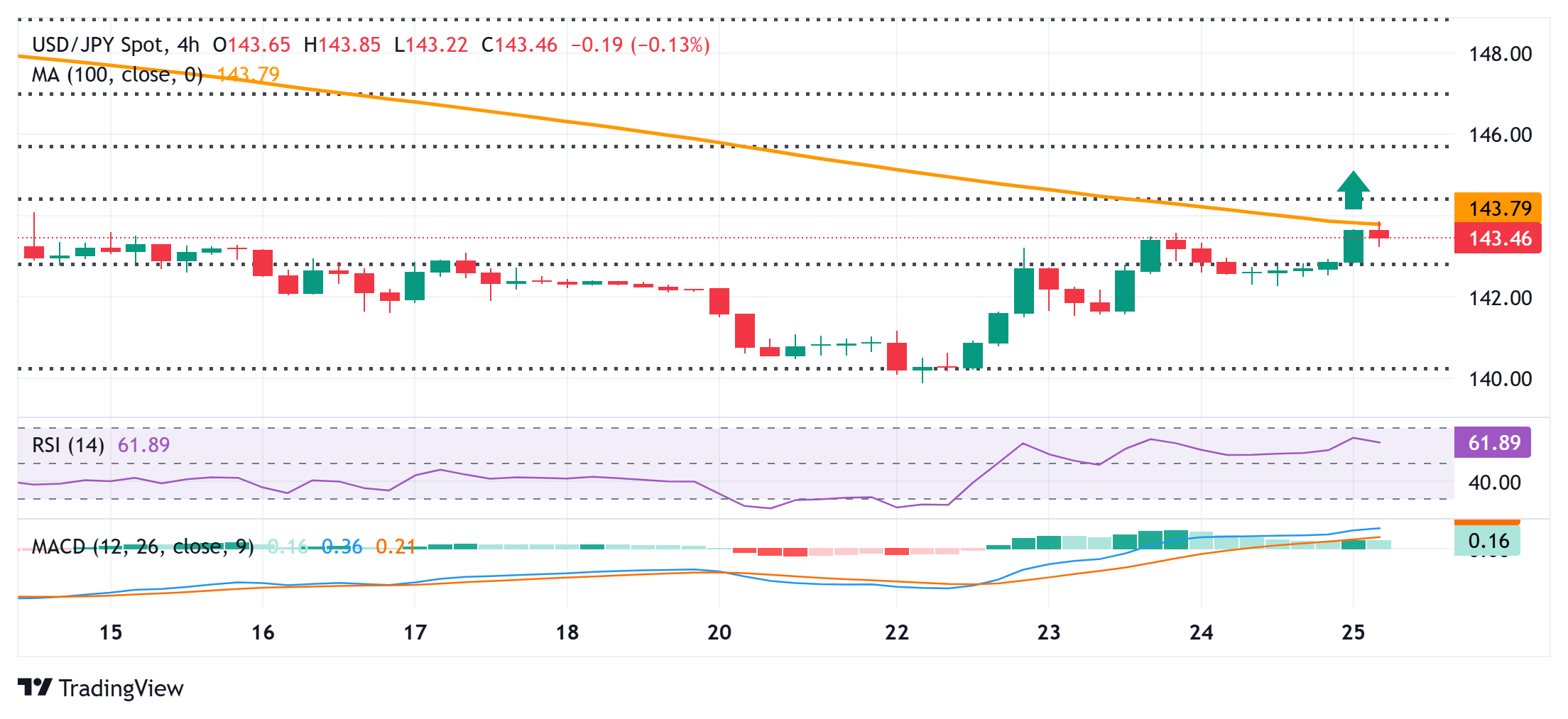
USD/JPY 4-hour chart
Technical Outlook
From a technical perspective, the overnight resilience below the 23.6% Fibonacci retracement level of the March-April downfall and the subsequent strength beyond the previous weekly high favor bulls. Moreover, oscillators on hourly charts have been gaining positive traction and support prospects for additional gains. However, technical indicators on the daily chart – though they have been recovering – are yet to confirm a positive bias. Hence, any further move up beyond the 144.00 mark might confront stiff resistance near the 38.2% Fibo. level, around the 144.35-144.40 region. Some follow-through buying, however, might negate the negative bias and pave the way for an extension of this week’s goodish recovery from a multi-month low.
On the flip side, weakness back below the 143.00 mark now seems to find decent support near the 23.6% Fibo. level, around the 142.60-142.55 region. Any subsequent slide might continue to attract some dip-buyers near the overnight swing low, around the 142.30-142.25 region. This is followed by the 142.00 round figure, below which the USD/JPY pair could slide to mid-141.00s en route to the 141.10-141.00 region. The downward trajectory could extend further towards intermediate support near the 140.50 area and expose the multi-month low – levels below the 140.00 psychological mark touched on Tuesday.
Author

Haresh Menghani
FXStreet
Haresh Menghani is a detail-oriented professional with 10+ years of extensive experience in analysing the global financial markets.