|

USD/JPY Forecast: Consolidating at the upper end of its latest range

USD/JPY Current price: 107.70

  • Holidays in the US and the UK keep majors confined to tight intraday ranges.
  • Japan announced it will lift the state of emergency in all the country this Monday.
  • USD/JPY is technically neutral in the short-term, its downside potential is limited.
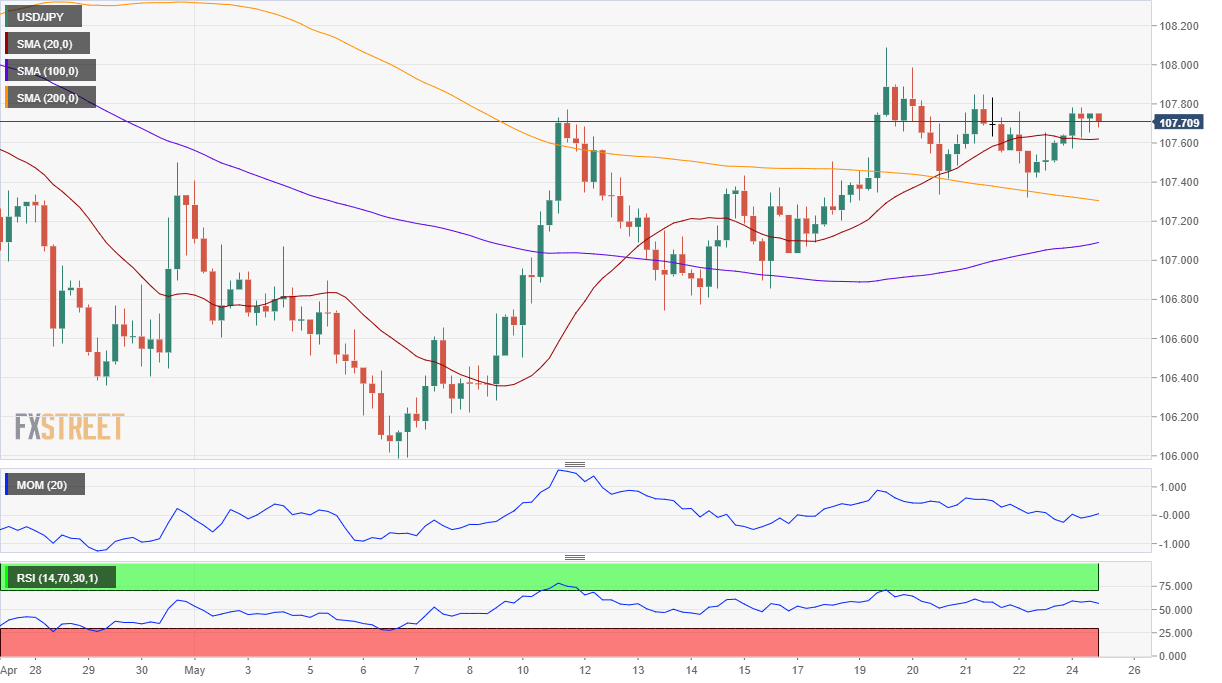
The FX board is showing little life this Monday, as both, the UK and the US, celebrate holidays, with major markets closed today and no data out of those countries. The market’s sentiment continues to lead the way, with investors concerned about mounting tensions between Washington and Beijing, engaged in a rhetorical war over trade, Hong Kong, and COVID-19. The USD/JPY pair trades around 107.70, unable to attract investors.

In the data front, Japan released the final version of the March Leading Economic Index, which came in at 84.7, better than the previously estimated 83.8. The Coincident Index for the same month was downwardly revised to 90.2. On a positive news, Japan has announced it will lift the state of emergency in all the country this Monday.  Given that US markets will remain closed, there’s no data scheduled for release in the country.

USD/JPY short-term technical outlook

The USD/JPY pair is neutral in the short-term and according to the 4-hour chart. The pair, in the mentioned time-frame, holds just above a flat 20 SMA, which develops above the larger ones, as technical indicators hover directionless around their midlines. Being at the upper end of its latest range, chances of a downward move seem limited. To gain bullish traction, the pair would need to accelerate above 108.08, last week’s high.

Support levels: 107.30 106.90 106.65

Resistance levels: 108.10 108.45 108.80

View Live Chart for the USD/JPY

Author

Valeria Bednarik

Valeria Bednarik was born and lives in Buenos Aires, Argentina. Her passion for math and numbers pushed her into studying economics in her younger years.


More from Valeria Bednarik
Share:

Editor's Picks

British Pound eases to 1.3450 area following downwardly revised Manufacturing PMI data

The British Pound is trimming previous gains against the US Dollar on Monday, returning to the mid-range of the 1.3400s down from fresh seven-week highs, above 1.3500 earlier on the day. Weaker-than-expected UK manufacturing data added pressure on the Pound, which rallied at the Asian session opening, amid news of a halt to the hostilities in Iran.

EUR/USD remains under pressure; looks at 1.1500 on firm US ISM

EUR/USD now accelerates its downtrend and trades in the low 1.1500s on the back of the marginal improvement in the US Dollar, all in the wake of solid US ISM Manufacturing data on Wednesday. The Greenback, in the meantime, remains far from a sustainable rebound in the current context of cooling geopolitical tensions.

Gold remains supported near $4,000

Gold adds to Friday’s pullback, although it remains well underpinned by the key $4,000 threshold per troy ounce on Monday. The US Dollar’s inconclusive price action seems enough to cap the yellow metal’s potential upside, although renewed hopes for a US-Iran peace deal and fading expectations of a Fed rate hike could limit the Greenback’s recovery.

Week ahead: US payrolls report and AI earnings to keep investors on edge

After the Fed decision, NFP report awaited for more rate hike clues. Employment also on the agenda in Canada and New Zealand. Chinese trade and Japanese wage data to be watched too. But Iran and AI headlines to remain in driver’s seat for risk sentiment.

The Bitcoin futures yield collapse: Once over 20%, now less than Treasury notes
Once a goldmine for carry traders, Bitcoin futures have flipped, consistently underperforming plain‑vanilla U.S. Treasuries every month since February. Carry trades consistently yielded 20% or more across regulated and unregulated crypto exchanges during the 2021 bull market. The strategy involved shorting Bitcoin futures while simultaneously buying a spot exchange-traded fund (ETF).
9-3: Is the Federal Reserve’s vote tally Warsh's new forward guidance?
The rate did not move. Neither did the statement, and that’s the more interesting fact. Set the July 29 Federal Open Market Committee (FOMC) statement beside the one issued on June 17, and the two documents are identical apart from a single verb and a paragraph at the bottom naming three dissenters.















