USD/JPY Forecast: The trading pause is temporary
- China-US tensions impact pair at week end.
- Yen could benefit from China HK security bill as traditional regional safety play.
- US to revoke Hong Kong's most favored trade status.
- Tariffs on Chinese goods may be extended to Hong Kong.
- First quarter Japanese recession will extend to mid-year.
- Japan’s April 2.6% unemployment rate to rise as economy shrinks.

The two-week old USD/JPY consolidation appeared increasingly unstable as markets confront the possibility that the recent accusations between the US and China over the pandemic and the American criticism of the new Hong Kong security law will jeopardize the trade agreement signed in January between the world’s two largest economies.
On Wednesday US Secretary of State Pompeo reported to Congress that Hong Kong was no longer autonomous from China, as has been true under its one nation, two systems policy since the mainland reigned control of the former British colony in 1999. The State Department was required to rule on Hong Kong’s autonomy by Congress last year.
This change in Hong Kong’s status jeopardizes its US trade relationship. Thus far the city has not been included in the tariffs that are a prominent part of Washington’s trade war with China.
The USD/JPY has been pinioned between the retreating pandemic risk premium of the dollar and the rapidly deteriorating Japanese economy which entered its fourth post-financial crisis recession last quarter, a downturn that will likely worsen if the US-China trade relationship goes off the rails.
President Trump will have a difficult balance to retain the trade deal advantages while answering China’s rhetoric on the pandemic and her aggressive security measures in Hong Kong.
US removes Hong Kong favored trade status
President Trump announced that the US will begin steps to remove Hong Kong's most favored trade status in response to Beijing's new security law for the former British colony which effectively bans political protest.
"I am directing my administration to begin the process of eliminating policy exemptions that give Hong Kong different and special treatment," said Mr Trump. Hong Kong has been exempted from the tariffs imposed by the US on Chinese goods but Mr. Trump did not specify which steps would be taken or when and the future statius of the duties was not clear.
"We will take action to revoke Hong Kong's preferential treatment as a separate customs and travel territory from the rest of China."
Financial markets reacted favorably to the announcement, relieved that the US did not take more punitive measures that might have included additional tariffs on Chinese goods or even withdrawing from the trade pact.
USD/JPY outlook
This week’s minimal range and lack of direction in trading is unlikely to last much longer. Daily ranges averaged just under 50 points and the USD/JPY opened at 107.63, nearly identical to the 107.82 close.
The world economy is set to recover with increasing speed from the pandemic. But Japan’s current economic weakness and greater export dependence means its return to form will be slower and more difficult than that of the US whose consumer dominated internal market is ready for a burst of deferred consumption as the shuttered economy reopens.
The waxing and waning US-China trade dispute was one of the chief drivers of currency movements over the last two years. How a revival of that argument affects the global economy depends on its impact on the trade pact.
If the disagreement is limited to international political questions and the agreement is implemented, then the economic effect of the political competition will also be limited. Even the extension of US tariffs to Hong Kong need not derail the trade pact as it was probably foreseen by Beijing and Hong Kong’s role was a facilitator of trade rather than an entrepot.
Beijing and Washington may be at odds over many topics but they are united in the need to revive their economies. The political strength of Xi Jinping and Donald Trump depend to a great degree on their economic success. That reality should keep the relationship intact if not cordial.
Provided the Hong Kong dispute does not derail the trade pact the risk-aversion retreat of the USD/JPY has probably run its course. The pair is already below its 108.00-110.00 fourth quarter range and the likely differential between the economic recoveries in United States and Japan should favor the US dollar.

Japanese statistics summary May 25-May 29
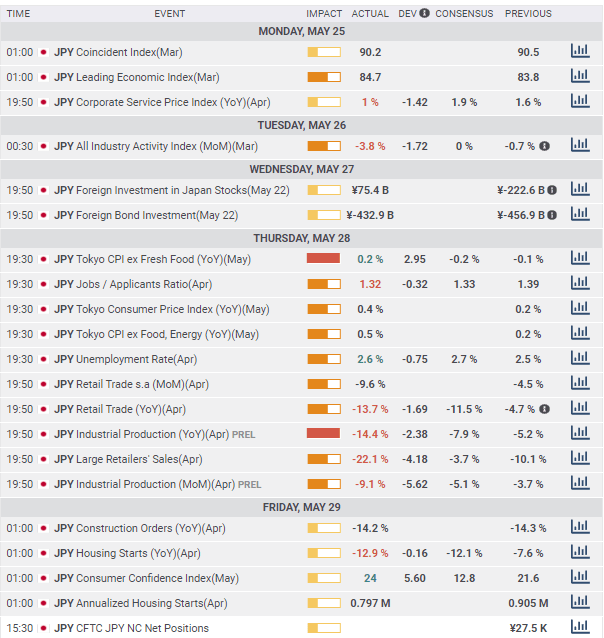
The Japanese economy was weaker in March than expected. The All Industry Activity Index which measures production across all Japanese industries fell 3.8% below the flat forecast and February 0.7% decline.
April’s numbers chronicled the impact of the pandemic. Retail trade fell 13.7%, worse than the -11.5% forecast and March’s 4.7% drop. Sales at large retailers tumbled 22.1% far greater than the -3.7% prediction and followed the 10.1% drop in March. Industrial production on the month shrank 9.1% almost double the -5.1% estimate and nearly triple the March 3.7% decline. For the year production was down 14.4%, also much worse than the -7.9% prediction and the prior 5.2% decrease.
Construction orders fell 14.2% in April slightly less than the 14.3% drop in March. Housing starts were off 12.9% on a -12.1% forecast. They slipped 7.6% in March.
The only bright spot, interestingly enough as in the US as well, was the consumer. The May consumer confidence index from the Cabinet office rose to 24 from 21.8 almost twice the 12.8 estimate.
US statistics summary May 25-May 29
In the US the April figures were dismal though there were spots of encouragement.
New home sales in April rose 0.6% far outstripping the projected 21.9% decline and March’s revised 13.7% drop.
Consumer confidence from the Conference Board, the longest running tracker of American attitudes rose in May to 86.6 from 85.7 in April and the Michigan survey edged higher to 72.3 from 71.8.
First quarter GDP was revised to -5% from -4.8% as the March trade deficit was wider than first recorded.
Durable goods orders fell 17.2% in April a bit better than the -19% forecast though the March figure was revised to -16.6% from -14.4%. Orders ex-transport dropped 7.4%, half the -14% prediction though again the March result was adjusted to -1.7% from -0.2%. Non-defense capital goods orders, the business investment proxy, decreased 5.8%, barely half the -10% forecast. Mach was revised to -1.1% from 0.1%.
Initial jobless claims added 2.1 million filers in the May 22 week bringing the total 40.747 million worker furloughs since the middle of March.
However, in the first sign that the reopening economy may be pulling people back to work, continuing claims fell 3.86 million to 21.052 million. They had been forecast to rise to 25.75 million from 24.912 million.
Personal spending in April dropped 13.6%, twice the March 6.9% decline. Personal income soared 10.5% far beyond the -6.5% forecast as government transfer payments, largely from the coronavirus relief bill passed by Congress in March shot up 89.6%.
Prices fell more than forecast as well. Core PCE plunged 0.4%, its greatest single month fall on record* and annual changes dropped to 1% from 1.7% in March also the largest one month drop on record.
The gain in consumer sentiment in both countries in May, small as it was, probably holds more predictive value than the flailing production and consumption figures for April.
As the two economies resume normal though somewhat restricted activity consumers will likely play an important role in rebuilding business confidence shattered by the pandemic and, especially in the United States, the draconian and unnecessarily harsh economic restrictions.


Japan statistics June 1-June 5

US statistics June 1-June 5


USD/JPY technical outlook
The relative strength index was pulled to higher on Friday by the cumulative impact of the gains of the last two weeks gains and the relative stability of the USD/JPY since the break higher on May 11.
The 21-day average at 107.20 was briefly crossed on Friday but ended reinforcing the 107.00 support line as the pair rebounded to close at 107.84. The 100-day and 200-day averages are unusually conjoined at 108.35 providing a spot of moderate resistance.
Resistance: 108.00; 108.35; 108;60; 109.20; 109.72
Support: 107.30; 107.00; 106.80; 106.30; 106.00
 USD/JPY sentiment poll

The universal expectation for a decline in the USD/JPY out to one quarter, is, like the bearish view last week, without strong conviction. The forecasts tell the story, none break 107.00 or show an accelerating trend lower. The view is more a product of the USD/JPY's inability to carry the trend break two weeks ago above 108.00. The bearish view will not survive a fundamental backed push through the immediate resistance at 108.00.
Author
Joseph Trevisani
FXStreet
Joseph Trevisani began his thirty-year career in the financial markets at Credit Suisse in New York and Singapore where he worked for 12 years as an interbank currency trader and trading desk manager.

















