|

USD/JPY analysis: flat amid limited demand for safe-havens

USD/JPY Current price: 111.12

  • Japanese economic growth beat the market's expectations in Q2.
  • The USD/JPY pair continues ranging as both currencies are treated equally in its relation to risk.
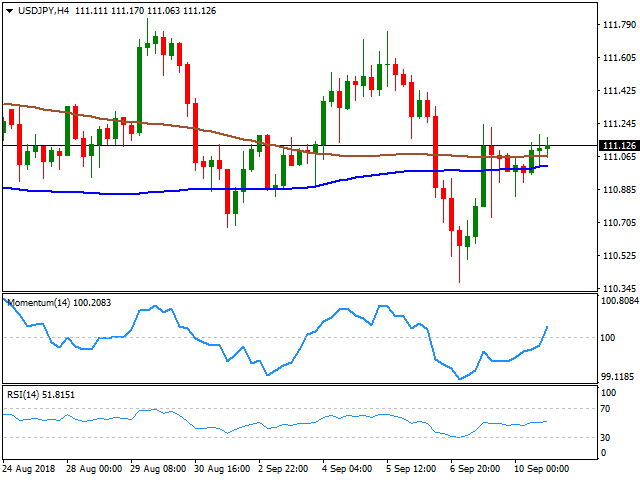
The USD/JPY pair has spent the day confined to a well-limited range around the 111.00 figure, as safe-haven assets fell outside investors' interest at the beginning of the week. Data coming from Japan was unable to affect the pair, as usual, but the country released Q2 GDP which was up yearly basis 3.0%, beating market's forecast for 2.6%, and well above the previous 1.9%. Quarterly basis, economic growth was of 0.7%, as expected. Meanwhile, US Treasury yields hovered around their Friday's closing levels, failing to provide fresh directional clues to USD/JPY, while European and US indexes hovered around their opening levels all through the sessions.  The upcoming Asian session won't bring much of relevance, as the Asian country will release money figures and Machine Tool Orders for August.

The technical picture is neutral, as the pair has been ranging pretty much since mid-August. The short-term picture is neutral-to-bullish, as, in the 4 hours chart, the price continues moving around horizontal and parallel 100 and 200 SMA, both indicating the absence of a clear directional trend, while technical indicators entered positive ground, the Momentum heading north but the RSI now flat around 51. The pair would need to clear the resistance area between 111.40 and 111.50 to be able to extend its gains up to 112.14, August high and a key breakout point.

Support levels: 110.90 110.65 110.25   

Resistance levels: 111.45 111.80 112.15

View Live Chart for the USD/JPY

Author

Valeria Bednarik

Valeria Bednarik was born and lives in Buenos Aires, Argentina. Her passion for math and numbers pushed her into studying economics in her younger years.


More from Valeria Bednarik
Share:

Editor's Picks

AUD/USD consolidates above 0.7200 after hot Chinese CPI data

AUD/USD is extending its consolidative price action above 0.7200 during the Asian session on Wednesday, uninspired by hot Chinese CPI and PPI data. Meanwhile, rising RBA rate-hike bets act as a tailwind for the Aussie amid Yen-inspired US Dollar weakness. Traders await the release of US inflation figures later in the week for fresh impetus.

USD/JPY rises above 153.50 on renewed USD strength

USD/JPY shakes off the bearish pressure and trades above 153.50 in the American session on Wednesday. The US Dollar (USD) stages a rebound following the US Treasury buyback announcement and helps the pair gain traction. Nevertheless, solid Japanese data reinforce expectations that the BoJ will continue normalising monetary policy, lending further support to the Yen and capping the pair's upside for now.

Gold regains balance above $4,400

Gold rebounds on Wednesday, snapping a three-day losing streak and reclaiming the are beyond the key $4,400 mark per troy ounce. The precious metal’s bounce comes amid further selling pressure on the US Dollar and steady uncertainty on the geopolitical front.

XRP extends recovery as ETF inflows, futures interest stabilize
Ripple (XRP) ticks higher, trading at $1.42 on Wednesday while building on a recently confirmed support range between $1.30 and $1.35. The token also sits above major moving averages, reinforcing the bullish outlook. However, upside could remain capped unless the psychological barriers at $1.50 and $1.70 are cleared, paving the way for an extended recovery above $2.00.
Venezuela’s 65-billion-barrel Oil deal could reshape America’s inflation fight
The United States (US) has secured unprecedented access to part of Venezuela’s vast Oil reserves. The timing is particularly significant as the war with Iran is disrupting Middle Eastern supplies, keeping energy prices elevated and reviving concerns about inflation.
Venezuela’s 65-billion-barrel Oil deal could reshape America’s inflation fight
The United States (US) has secured unprecedented access to part of Venezuela’s vast Oil reserves. The timing is particularly significant as the war with Iran is disrupting Middle Eastern supplies, keeping energy prices elevated and reviving concerns about inflation.