|

USD/JPY analysis: critical support at around 111.50

USD/JPY Current price: 111.79

  • Yen appreciated on risk aversion, holding on to gains post-US weak retail sales.
  • Lower lows daily basis maintain the risk skewed to the downside, poised to test 100 DMA.
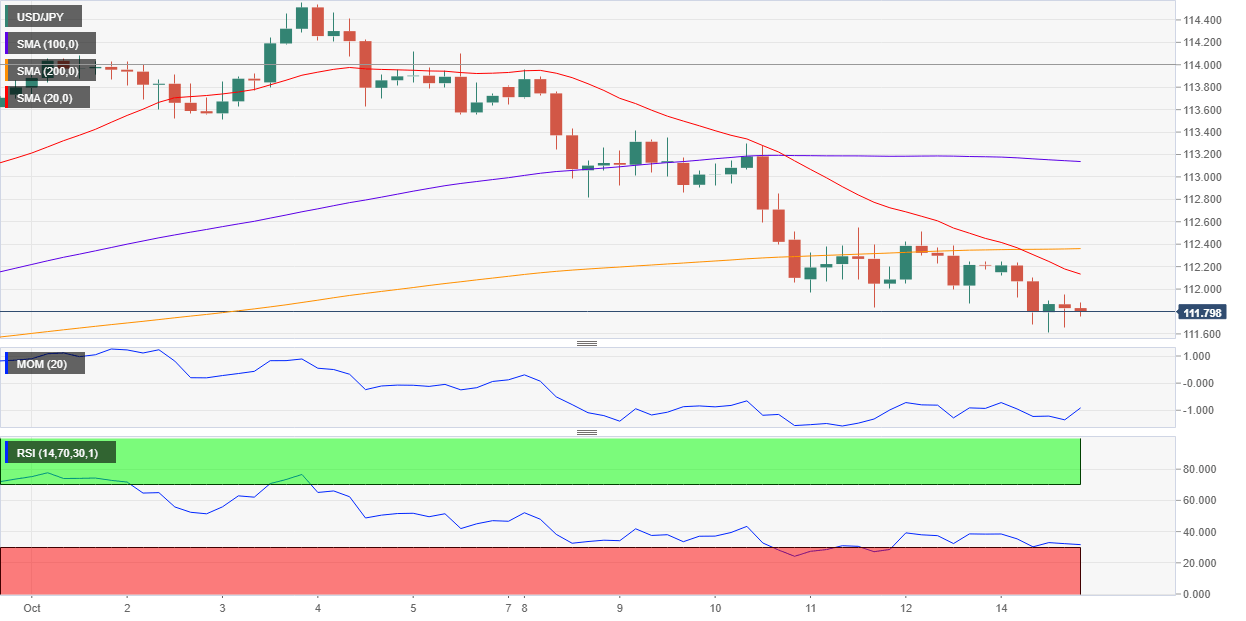
The USD/JPY pair fell to a fresh 1-month low of 111.62 as risk aversion dominated the first half of the day, ending it some 20 pips above the level, as poor US data and broad dollar's weakness prevented the pair from recovering ground, despite a better market mood later in the day. Japanese data released at the beginning of the day failed to impress as Industrial Production rose 0.2% MoM in August, after a 5.3% increase in July, while it came in up by 0.2% when compared to a year earlier. Capacity Utilization in the same month rose a healthy 2.2%, up from -0.6% in the previous month. Japan has no macroeconomic news scheduled for this Tuesday. US Treasury yields, meanwhile, offered little clues, with no relevant changes in the bond market.

From a technical point of view, and according to the 4 hours chart, the pair is bearish, as it further  fell below its 100 and 200 SMA,  both lacking directional strength well above the current level, while technical indicators have managed to correct partially from their daily lows, but have lost directional strength, settling well into the red. A key support for the upcoming sessions is the 100 DMA, which stands a few pips below the daily low, around 111.50, providing a strong dynamic support that once broken, should lead to a steeper decline during the upcoming sessions.

Support levels: 111.50 111.20 110.85

Resistance levels: 111.90 112.25 112.60  

View Live Chart for the USD/JPY

Author

Valeria Bednarik

Valeria Bednarik was born and lives in Buenos Aires, Argentina. Her passion for math and numbers pushed her into studying economics in her younger years.


More from Valeria Bednarik
Share:

Editor's Picks

USD/JPY consolidates near 160.50 intervention zone ahead of FOMC decision

USD/JPY remains close to the 160.50 intervention zone during the Asian session on Wednesday. Despite the BoJ's rate hike to its highest level since 1995, Japan's borrowing costs remain significantly lower than those of peer nations such as the US. Moreover, the BoJ's more cautious stance on bonds undermines the Japanese Yen and supports the currency pair. Meanwhile, the US Dollar remains on the back foot amid the optimism over the US-Iran peace deal and ahead of the Fed policy decision, capping spot prices.

AUD/USD holds steady above 0.7050; looks to Fed decision for fresh impetus

AUD/USD is seen consolidating above mid-0.7000s during the Asian session as traders await the outcome of a two-day FOMC meeting later this Wednesday. In the meantime, the optimism over an interim peace deal between the US and Iran keeps the US Dollar bulls on the defensive. This, along with the RBA's hawkish pause on Tuesday, acts as a tailwind for the currency pair.

Gold remains below 200-SMA as traders await FOMC rate decision

Gold preserves weekly gains registered over the past two days, though it remains below a technically significant 200-day SMA through the Asian session on Wednesday. Traders now seem hesitant and are keenly awaiting the highly anticipated Fed rate decision before placing fresh directional bets. In the meantime, the US-Iran interim peace agreement keeps the US Dollar bulls on the defensive, which might continue to act as a tailwind for the bullion.

Coinbase outlines 'Everything Exchange' vision with planned tokenized stocks and AI advisor

Crypto exchange Coinbase unveiled a broad slate of new products on Tuesday, outlining plans to expand into tokenized equities and AI-powered investment tools in its pursuit of becoming an "Everything Exchange." A centerpiece of the roadmap is Coinbase's planned launch of tokenized US equities for customers outside the United States.

1% rate, 160 Yen: Why Japan’s historic hike changed little
The Bank of Japan (BoJ) pushed its short-term policy rate to 1% on Tuesday, the highest setting since 1995 and a 31-year milestone in a normalization cycle barely two years old. It is the kind of number that should mark a turning point for the Yen, and it did almost nothing.
Why a hawkish RBA is no longer enough to lift the Australian Dollar

The Reserve Bank of Australia delivered more than what markets expected: a hawkish hold that should have supported the Aussie. But markets widely ignored it, focusing instead on slowing economic growth and proving that central bank messaging alone isn’t always enough to drive currencies.