|

USD/JPY analysis: bouncing from 100 DMA, but upside still limited

USD/JPY Current price: 112.24

  • Equities underpinned the pair, but bulls cautious after last week's rout.
  • Japanese yen to keep depending on equities and yields.
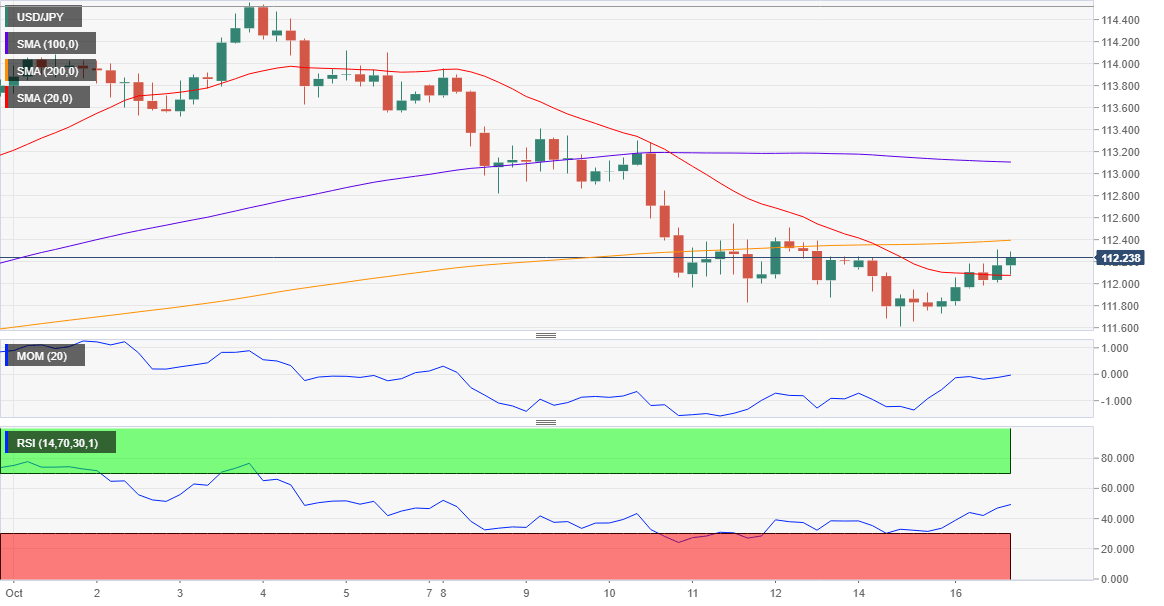
The USD/JPY pair trimmed most of its early week losses and settled around 112.20, recovering alongside worldwide equities. Ebbing political concerns and solid earnings reports played against the safe-haven yen, also weighed by an uptick in US Treasury yields, as the benchmark for the 10-year Treasury note reached 3.18% intraday. Positive US data, however, fell short of boosting the pair, as market players remain extremely cautious after equities rout last week. The Japanese macroeconomic calendar had nothing to offer on Tuesday and will remain empty this Wednesday, leaving the pair in the hands of equities and government bond yields.

The pair neared the 100 DMA Monday, but remains above the indicator, putting a halt to a two-week decline. Not yet out of the woods, the pair is struggling around last week's close, still unable to enter bullish ground for this one. In the short term, and according to the 4 hours chart, the upside seems limited, as the pair is developing for a third consecutive day below its 200  SMA, while the 100 SMA stands some 100 pips above the current level, as technical indicators head nowhere around their midlines, leaving a neutral-to-negative stance in the short term.

Support levels: 111.90 111.50 111.20 

Resistance levels: 112.30 112.60 113.00

View Live Chart for the USD/JPY

Author

Valeria Bednarik

Valeria Bednarik was born and lives in Buenos Aires, Argentina. Her passion for math and numbers pushed her into studying economics in her younger years.


More from Valeria Bednarik
Share:

Editor's Picks

USD/JPY hovers below 160.50 intervention zone ahead of FOMC decision

USD/JPY remains below the 160.50 intervention zone in the Asian session on Wednesday. Despite the BoJ's rate hike to its highest level since 1995, Japan's borrowing costs remain significantly lower than the US, undermining the Japanese Yen. However, thpair US Dollar remains on the back foot amid the optimism over the US-Iran peace deal and ahead of the Fed policy decision, weighing on the pair.

AUD/USD holds steady above 0.7050; looks to Fed for fresh impetus

AUD/USD is consolidating above mid-0.7000s in the Asian session on Wednesday as traders await the outcome of a two-day FOMC meeting due later in the day. In the meantime, the optimism over an interim peace deal between the US and Iran keeps the US Dollar bulls on the defensive. This, along with the RBA's hawkish pause on Tuesday, acts as a tailwind for the pair.

Gold consolidates above $4,300 as traders look to Fed rate decision for fresh impetus

Gold struggles to capitalize on its weekly gains, though it holds above the $4,300 mark through the Asian session. The latest optimism over an interim US-Iran peace deal keeps the US Dollar on the defensive, which is seen supporting the bullion. The commodity remains below the weekly swing high set on Monday and a technically significant 200-day SMA level.

Bitcoin holds $65,000 as Uniswap and Worldcoin extend rally
Bitcoin (BTC) is experiencing headwinds above $65,000 following the Bank of Japan’s rate hike to 1% on Tuesday. Still, Uniswap (UNI) and Worldcoin (WLD) continue to rally amid rising retail interest, while Bitcoin’s recovery grows heavy. Bitcoin edges higher at press time on Wednesday, inching closer to $66,000 as it maintains a mixed near-term tone following the recent rebound from $60,000.
The most important event will be the Fed meeting with Mr. Warsh now in charge

The most important event will be the Fed meeting on Wednesday, with Mr. Warsh now in charge. As more than one analyst points out, the case for holding rates the same is strengthened by the Iran deal and the prospect of the Strait re-opening, although nobody thinks Warsh can marshal enough doves to do a cut this time.

Why a hawkish RBA is no longer enough to lift the Australian Dollar

The Reserve Bank of Australia delivered more than what markets expected: a hawkish hold that should have supported the Aussie. But markets widely ignored it, focusing instead on slowing economic growth and proving that central bank messaging alone isn’t always enough to drive currencies.