USD/CHF is falling hard: A clear breakdown of the fundamental and technical bear case

Why USD/CHF is moving lower
USD/CHF has been trending lower, and this move is not random. Both fundamental forces and technical structure are aligned to the downside. When macro drivers and chart patterns point in the same direction, trends often persist longer than many traders expect.
In simple terms, USD/CHF is falling because US monetary policy is turning more accommodative, the Swiss franc is benefiting from safe-haven demand, and the chart has rolled over from a key resistance level. Below, we break this down step by step—starting with fundamentals and finishing with a clear technical roadmap.
1. A weaker US Dollar is setting the tone
The primary driver behind the USD/CHF decline is a broad weakening of the US dollar.
The Fed has shifted direction
- The Federal Reserve has cut interest rates and signalled it is likely finished with tightening.
- Markets are now focused on the timing and pace of further rate cuts.
- Lower interest rates reduce the appeal of holding US dollars.
Why that matters for USD/CHF
Currencies are heavily influenced by yield differentials. When US yields fall, global investors have less incentive to hold USD, particularly against traditionally stable currencies like the Swiss franc.
Result: When the dollar weakens broadly, USD/CHF typically comes under pressure.
2. Risk sentiment favours the Swiss Franc
The Swiss franc (CHF) remains one of the world’s most trusted safe-haven currencies.
Mild uncertainty is enough
- Investors do not need panic to buy CHF.
- Slower growth signals, mixed economic data, or geopolitical uncertainty can trigger defensive positioning.
- Even modest uncertainty tends to favour the Swiss franc.
Capital flows matter
As investors seek safety:
- Demand for CHF increases
- Demand for USD softens
- USD/CHF moves lower
This dynamic has been quietly supporting CHF in recent weeks.
3. The US interest-rate advantage is shrinking
For much of the previous cycle, the US dollar enjoyed a clear yield advantage over Switzerland.
That gap is closing
- US interest rates are now falling.
- Swiss rates remain low, but the relative advantage is narrowing.
- FX markets respond more to changes in direction than absolute levels.
As the US rate premium fades, holding USD versus CHF becomes less attractive, removing a key support for USD/CHF.
4. The technical breakdown: Failure at a key level
Fundamentals provide the backdrop—but price action confirms the narrative.
Rejection near 0.8000
- USD/CHF failed to sustain a move above the 0.80 psychological level.
- Multiple attempts to reclaim higher ground were rejected.
- This failure triggered momentum-based selling.
Once a major level fails, it often flips from support into resistance—and that is exactly what the chart is showing.
5. Bear flag structure: Continuation, not reversal
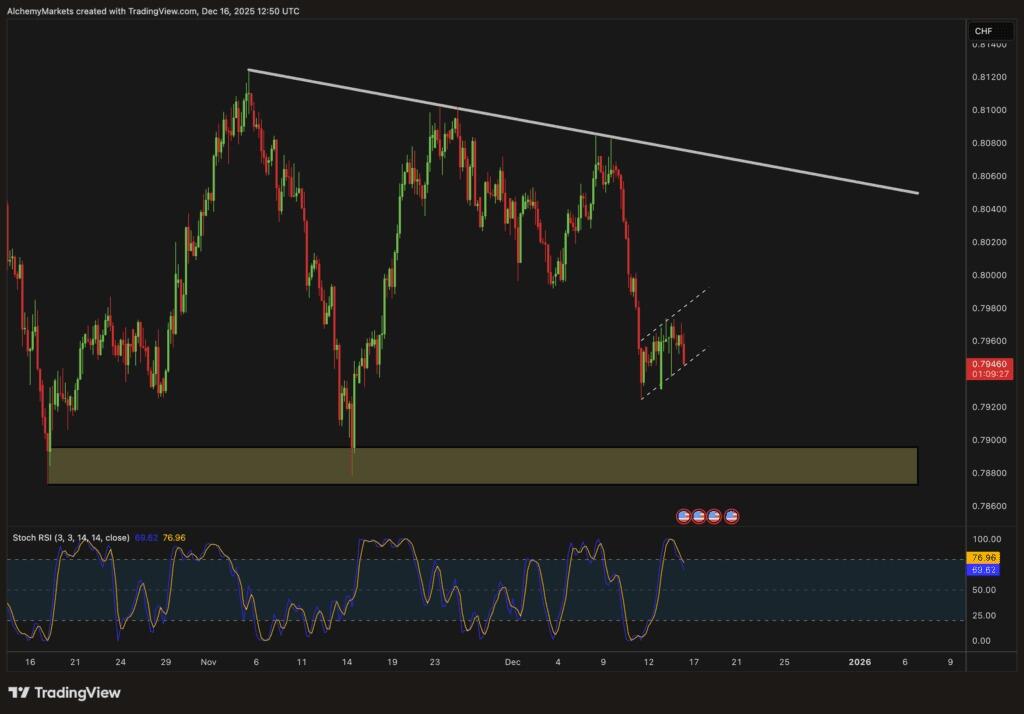
From a technical perspective, USD/CHF is forming a classic bear flag pattern.
What is a bear flag?
- A sharp impulsive decline (the “flagpole”)
- Followed by a shallow, upward-sloping consolidation
- Typically resolves with trend continuation to the downside
Why this matters here
- The consolidation is orderly and corrective, not impulsive.
- Momentum remains subdued during the bounce.
- This suggests selling pressure is pausing, not disappearing.
In trending markets, bear flags most often break in the direction of the prevailing trend—which, in this case, is lower.
6. Stochastic RSI: Momentum still has room to fall
Momentum indicators continue to support the bearish bias.
What the stochastic RSi is showing
- The Stochastic RSI is not deeply oversold.
- Previous sell-offs pushed momentum to much lower readings.
- This indicates sellers are not yet exhausted.
When price consolidates while momentum resets from overbought conditions, it often prepares the market for another leg down.
7. The next support region to watch
Below current price, the chart highlights a well-defined demand zone from previous reactions.
Why this area matters
- It has acted as strong support in the past.
- Buyers previously stepped in aggressively from this region.
- Markets often retest such zones after a breakdown.
If the bear flag resolves lower, this support region becomes the logical downside target before any meaningful rebound can develop.
The one-line narrative
USD/CHF is falling because US interest rates are declining, the dollar is weakening, investors are seeking safety, and the chart has rolled over into a bearish continuation pattern.
What could stop or reverse the move?
No trend lasts forever. A sustained reversal would likely require more than one catalyst.
Key bullish risks
- Strong US economic data (employment or inflation) that forces the Fed to adopt a less dovish stance
- A sudden risk-on rally, prompting investors to exit safe-haven assets
- Broad-based US dollar strength, with the DXY breaking decisively higher
Absent these developments, rallies in USD/CHF are more likely to remain corrective pullbacks rather than trend reversals.
Frequently asked questions (FAQs)
1. Is USD/CHF bearish in the short term?
Yes. Both the fundamental backdrop and technical structure point towards further downside.
2. What technical pattern is USD/CHF forming?
A bear flag, which typically signals continuation of the prevailing downtrend.
3. Why does the Swiss franc strengthen when markets are nervous?
Switzerland is viewed as financially and politically stable, making CHF a safe-haven currency.
4. Does the stochastic RSI support more downside?
Yes. Momentum is not oversold, suggesting room for another decline.
5. Which level triggered the latest selling pressure?
The failure to hold above the 0.80 psychological level.
6. What would invalidate the bearish setup?
Stronger US data, renewed Fed hawkishness, or broad-based US dollar strength.
Conclusion: When fundamentals and technicals align
USD/CHF currently offers a textbook example of macro fundamentals and technical structure aligning. Falling US interest rates, a softer dollar, increased demand for CHF, and a clean bearish chart pattern are all pointing in the same direction. Until those conditions change, downside pressure remains the path of least resistance.
Markets do not need dramatic headlines to trend—sometimes, steady fundamentals and clear technicals are more than enough.
Author

Zorrays Junaid
Alchemy Markets
Zorrays Junaid has extensive combined experience in the financial markets as a portfolio manager and trading coach. More recently, he is an Analyst with Alchemy Markets, and has contributed to DailyFX and Elliott Wave Forecast in the past.














