USD/CAD Forecast: Oil brings modest relief to the Canadian dollar
- Crude oil’s price rise aids Canadian dollar.
- US President Trump says Saudis and Russians will end price war with production cuts.
- American dollar retains its safety edge in global markets.

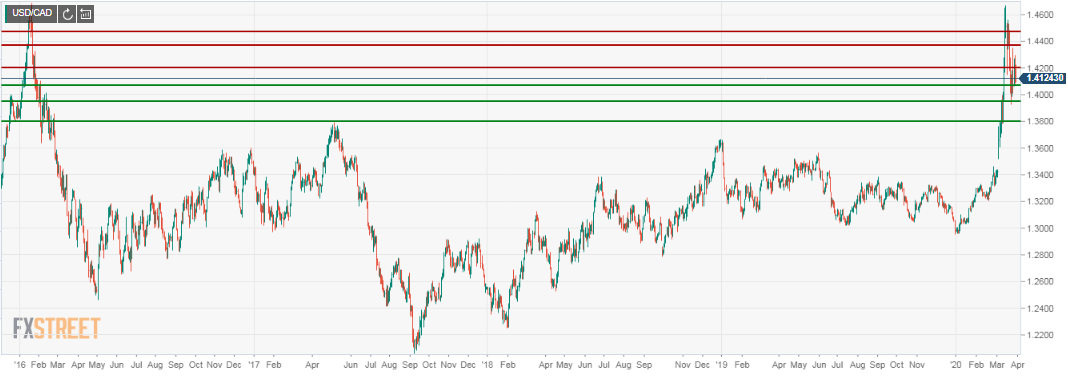
The USD/CAD consolidated its gains after Monday’s two figure run higher keeping to a tight range between 1.4100 and 1.4200 for the balance of the week.
Thursday’s all-time 24.67% one day jump in the price for West Texas Intermediate (WTI, Clc1), prompted by US President Trump’s assertion that the Saudis and the Russians would shortly end their price war with an agreement to cut production between 10 and 15 million barrels, gave a modest boost to the loonie which finished at 1.4139 up from its close at 1.4183. Wednesday’s WTI intra-day price of $20.06 was the lowest trade in 18 years. In late morning trading in New York on Friday oil was at $26.79 (10:28 EDT), up 32.5% over the Wednesday close at $20.31.
On the week the USD/CAD gained 1% as safe-haven flows played to the US dollar and the global pandemic continued to wreak havoc with national economies.
Even the phenomenal 6.648 million US jobless applications filed last week and 3.283 million the week before, each, by factors of 4.7 and 9.6, more than had ever been filed in a single week failed to dent the US dollar.
Non-farm payrolls shed 701,000 jobs in March, far more than the estimate of -100,000 that had not been expected to capture the swift moving job losses. April’s numbers and revision to March are predicted to be worse, incorporating the claims numbers above.
Market judgement was again plain, the US dollar rose after the NFP results. Whatever damage has been inflicted on the Canadian economy there is no alternative to the United States and the US dollar for safety.
Canadian statistics were of little significance this week. Gross domestic product in January rose 0.1% as forecast after December’s 0.3% increase. The Markit manufacturing PMI for March fell into contraction at 46 well below the February 51.8 score. The consensus estimate of 53.3 was considerably out of date.
USD/CAD outlook
As was true last week the future for the Canadian dollar remains weak.
Assumptions about the damage to the US economy from the public health crisis as embodied in the estimates for jobless claims over the past two weeks, 1 million and 3 million were discovered to be wholly inadequate with a total of nearly 10 million claims filed. Payrolls were far worse than predicted yet the US dollar improved. As more information slowly becomes available the economic picture for both nations is very likely to darken.
One lamp for the loonie might be crude oil if President Trump’s notice of a pending production deal between Russia and Saudi Arabia is accurate. But even here, US and Canadian shale producers struggling to stay afloat might take advantage of the price increase to increase their output.
There is support for the USD/Cad at 1.4070, 1.3955 and 1.3800. Moderate resistance lies at 1.4200, 1.4365 and 1.4470. But as long as the pandemic lasts the loonier will be at a specific disadvantage as a resource currency and a global one because it is not the US dollar.
Canadian statistics April 6-10
Tuesday
Ivey PMI for March, February registered 53.2.
Wednesday
Housing starts for March are expected to be 205,000 on the year a bit lower than 210,000 in February. Building permits in February were 4% higher than January.
Thursday
The employment report from Statistics Canada March is forecast to contain a 5.6% unemployment rate, unchanged from February. Estimates for the change in employment and average hourly wages were unavailable at this writing. In February the Canadian economy added 30,300 jobs and wages rose 4.33% on the year.

FXStreet
Canadian statistics conclusion
The Canadian statistical picture, like that in the US is slowly starting to show the horrendous impact of the Coronavirus pandemic which remains the overriding input for trading. Until that fact changes, the US dollar retains its edge, regardless of statistics in either country.
US statistics March 30-April 1
Tuesday
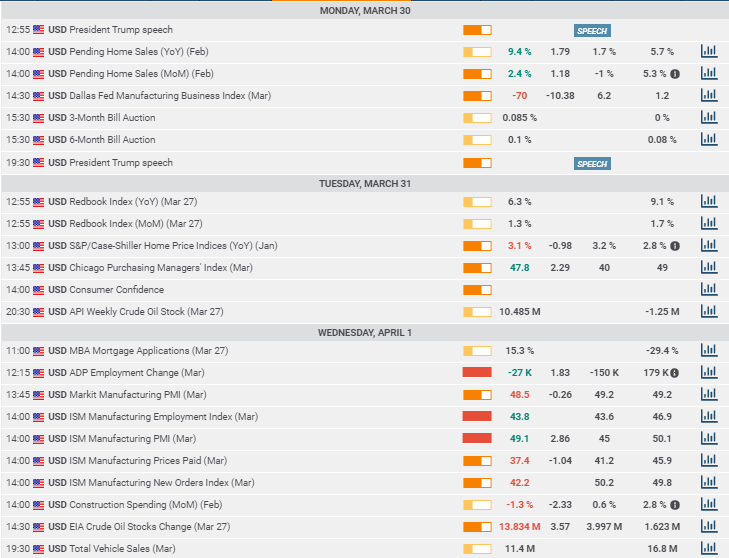
Redbook index for the week of March 27 rose 6.3% on the year and 1.3% on the month from 9.1% and 1.7% in February.
Conference Board consumer confidence fell to 120 in March from 132.6 in February, beating the 110 estimate but the Conference Board warned of likely future declines.
Wednesday
ADP private payrolls shed 27,000 positions, less than the -150,000 forecast but the discrepancy was attributed to delayed reporting.
Manufacturing PMI was better than expected in March at 49.1, 45 had been predicted, but returning the sector to contraction. New orders dropped to 42.2 from 49.8 and employment slipped to 43.8 from 46.9.
Thursday
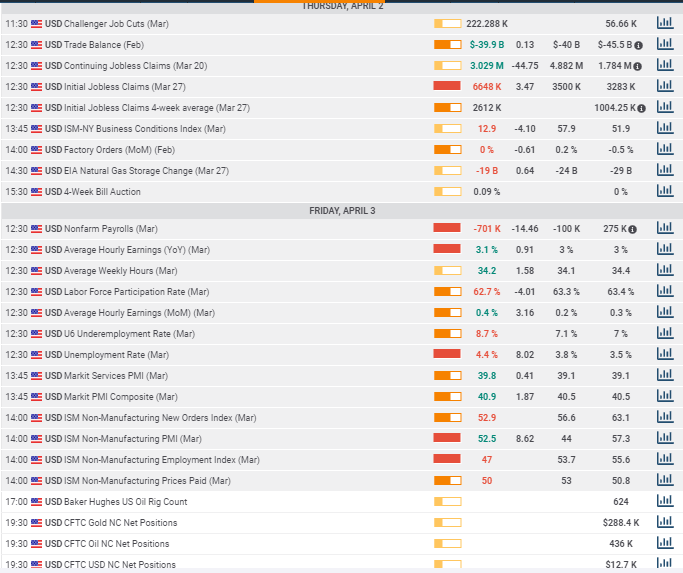
Challenger announced layoffs for March surged to 222,288 from 56,660 in February.
Initial jobless claims for the week of March 27 shredded all expectations at 6.648 million almost doubling the 3.5 million estimate and making the two-week total 9.931 million.
Friday
Non-farm payrolls dropped 701,000, capturing more of the last month’s layoffs than had been expected and the surge is projected to continue in April and in March revisions. The unemployment rate (U-3) rose to 4.4% from 3.5% and the underemployment rate (U-6) climbed to 8.7% from 7.1%. Annual average hourly earnings added 0.1% to 3.1%.
FXStreet
US statistics April 6-10
Tuesday
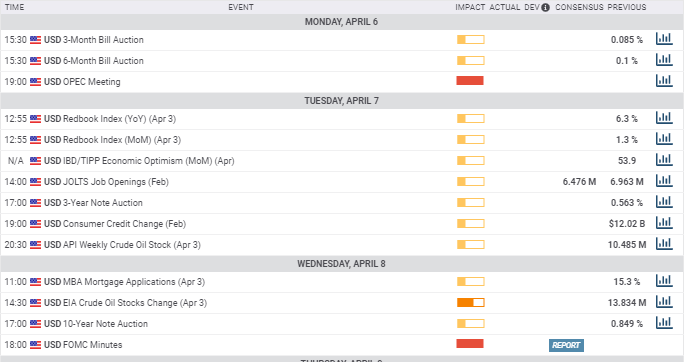
Redbook index of large retail same store sales in the April 3 week.
Wednesday
FOMC minutes of the unscheduled March 15 meeting which cut the fed funds rate by 1% to 0.25%.
Thursday
Initial jobless claims for the week of April 3. After two weeks totaling 9.931 this is the statistic to watch.
Michigan consumer sentiment index preliminary for April, 75 is expected down from 89.1 in March.
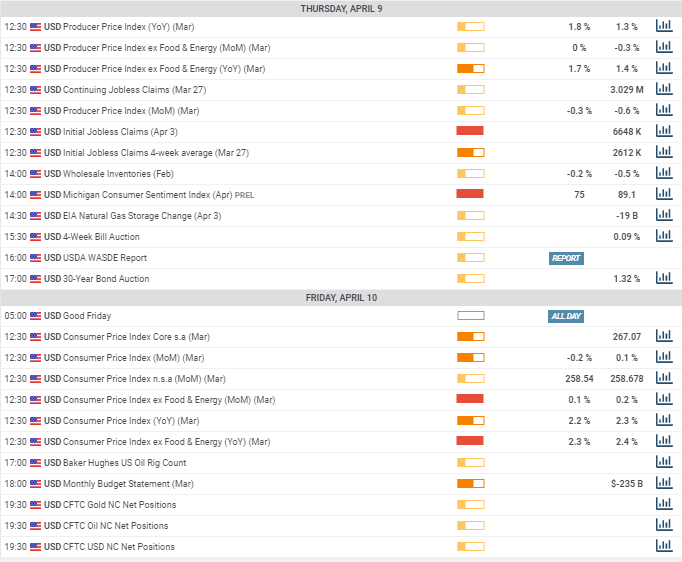
US statistics conclusion
The speed of the labor market collapse has left most statistics wholly out of date. For the week ahead the FOMC minutes will give an indication of the Fed governors information and concerns at mid-month. Initial jobless claims will be the most indicative of the depth of the job market pain and an indication of the statistical debacles likely to follow.
USD/CAD statistical outlook
The relative strength index remains mildly positive as the week's action favored the US dollar but Thursday's and Friday's tilt to the Canadian blunted the advantage.
All three moving averages reflect the March safety trade toward the US dollar. With the economic effects of the pandemic paramount differentiation based on national performance is at best several weeks away. Markets will continue their US dollar and asset bias until that overriding concern begins to fade.
Resistance: 1.4200, 1.4367, 1. 4469
Support: 1.4069, 1.3950, 1.3801
 USD/CAD sentiment poll
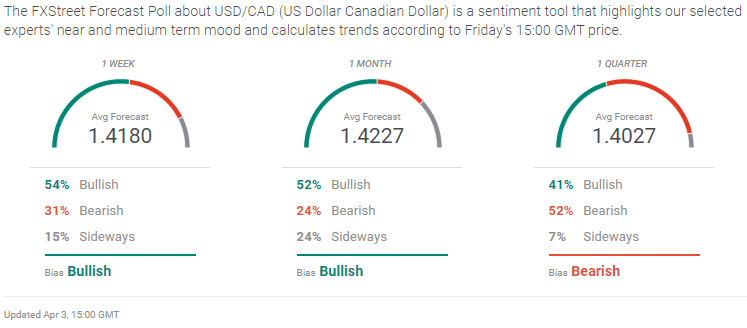
The bullish case adds the one month outlook as the the USD/CAD spends another week above 1.4000 and the economic impact of the pandemic begins to show up in statistics. Even the remaining bearish view at the one quarter limit predicts a minor drop to 1.4027 far from the pre-Corona days 10 big figures lower.
Author

Joseph Trevisani
FXStreet
Joseph Trevisani began his thirty-year career in the financial markets at Credit Suisse in New York and Singapore where he worked for 12 years as an interbank currency trader and trading desk manager.