US Nonfarm Payrolls September Preview: How far will markets go when the Fed tapers?
- Payrolls expected to add 488,000 in September, ADP outperforms.
- Economy reports good statistics despite August’s weak NFP.
- Federal Reserve November taper may turn on September payrolls.

Will the September US payroll report be the final permission for the Federal Reserve to begin its long-awaited bond taper?
Treasury yields and the dollar have been rising for three weeks. Equities have been falling since early September. Markets are anticipating an announcement at the November 3 or December 15 Federal Open Market Committee (FOMC) meeting.
In late August, Fed Chair Jerome Powell indicated that the bank was likely to begin reducing its $120 billion of monthly bond purchases before the end of the year.
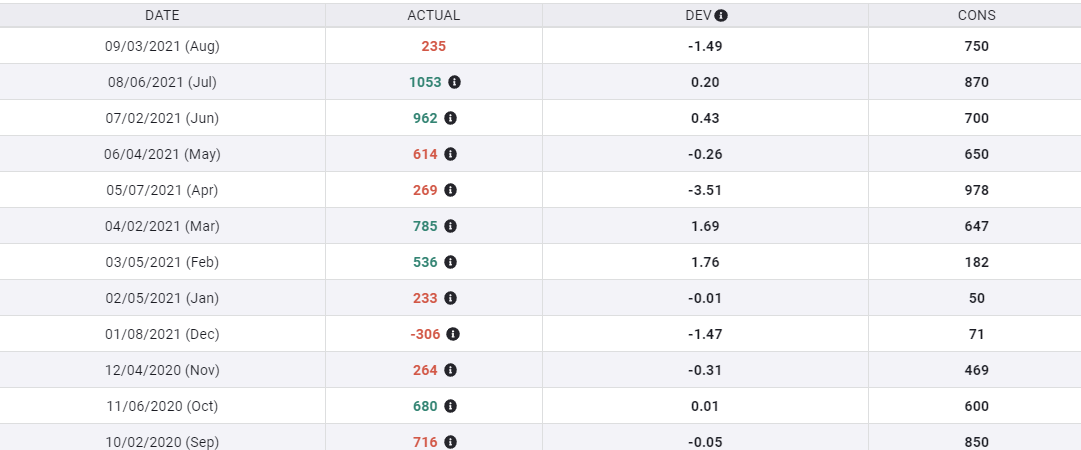
When he made that observation on August 27 in Jackson Hole, Wyoming, Nonfarm Payrolls had averaged nearly 1 million new positions in June and July. August was expected to add another 750,000.
Reality intervened on September 3 with just 235,000 new jobs.The addition of 110,000 hires to July’s total did not mitigate the problem for the Fed which has stressed labor market recovery as its main policy goal.
The September 22 Fed meeting produced no taper announcement, though the statement noted, “If progress continues broadly as expected, the Committee judges that a moderation in the pace of asset purchases may soon be warranted.”
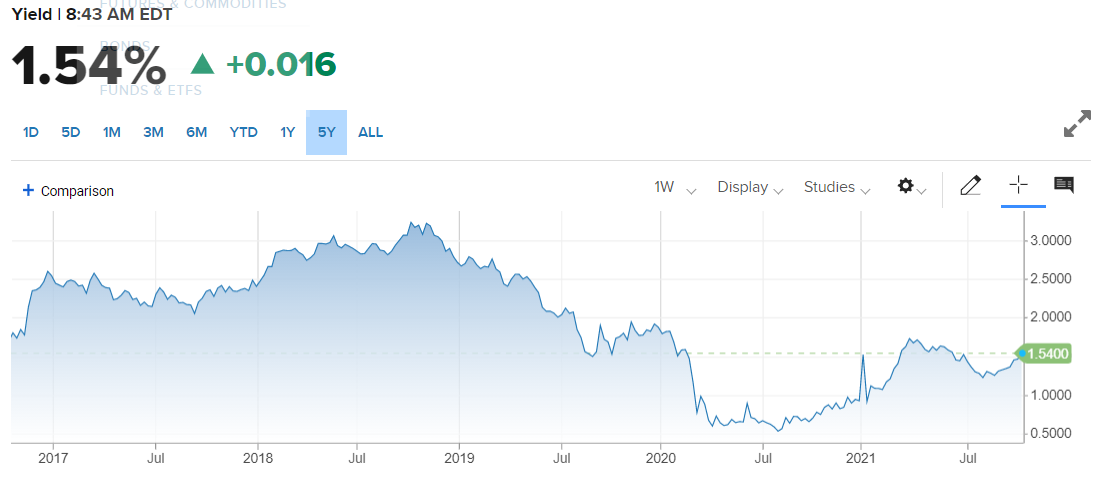
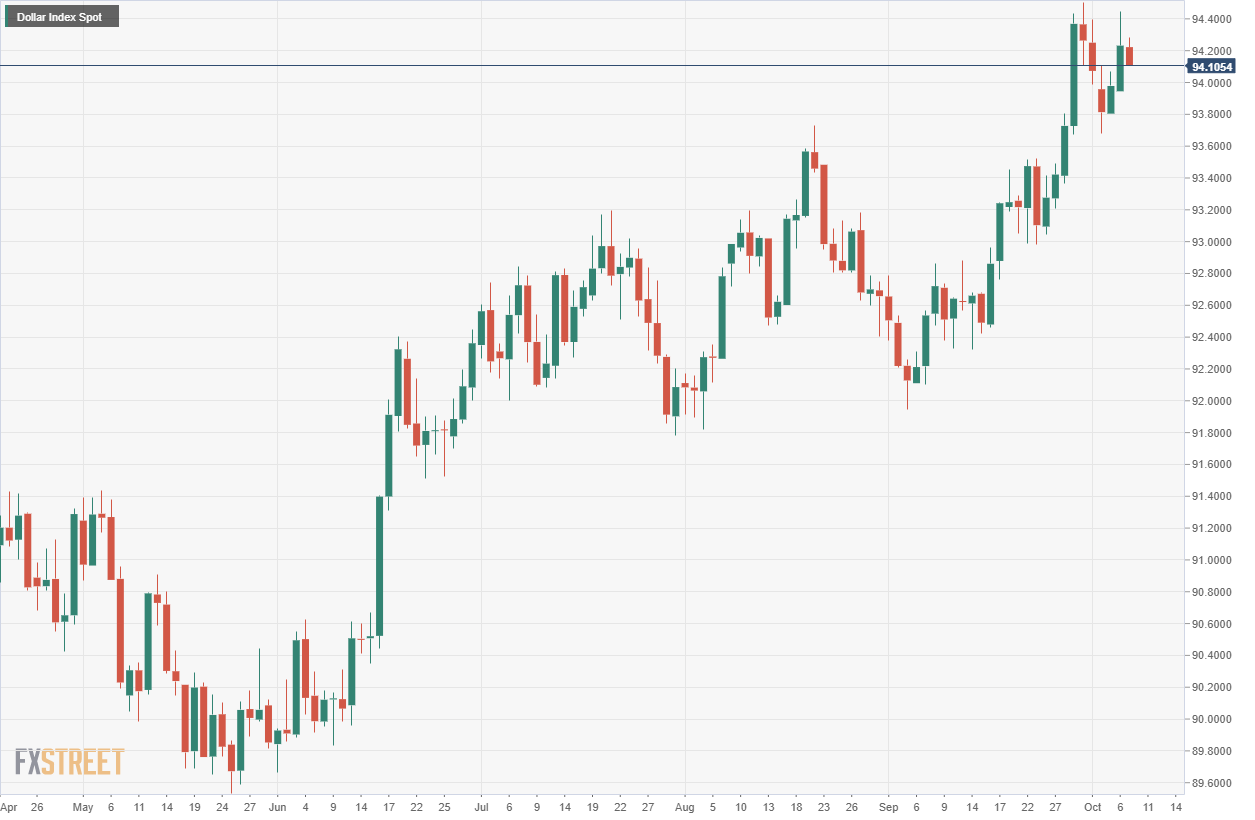
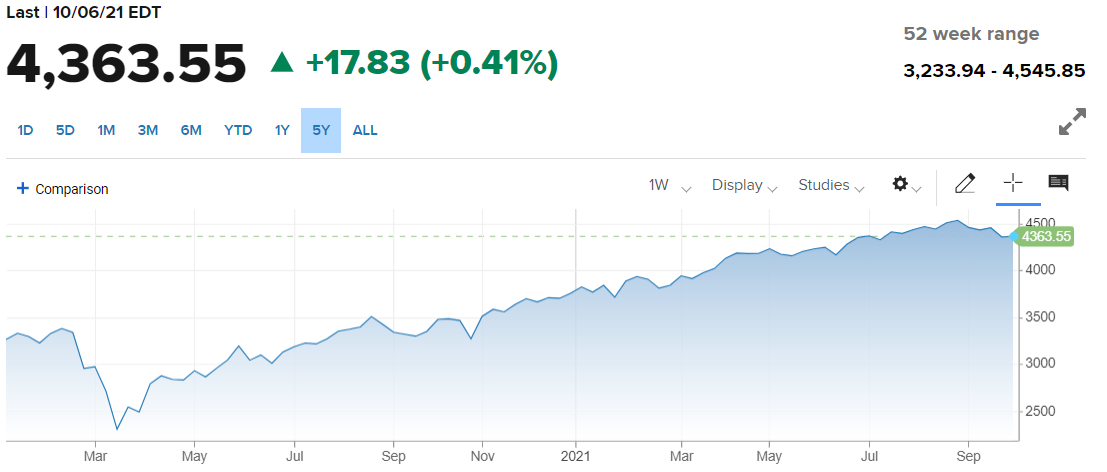
Progress is in the eye of the Fed governors of course, but since that meeting the 10-year Treasury yield has added 20 basis points to 1.522% and the Dollar Index has gained 1%. The S&P 500 is off 2% since its September 24 close of 4455.48 and 4% from its all-time record three weeks earlier.
All three markets have considerable room to move if the Fed does enact its promised policy change.
The 10-year yield is 20 points below its March 31 high of 1.746% and far from its range in the two years before the pandemic.
US 10-year Treasury yield
CNBC
Likewise the Dollar Index averaged 96 and higher for most of 2019.
The major US equity averages have not had a substantial correction in over a year and have set all-time records within the past two months.
S&P 500
CNBC
Nonfarm Payrolls
The consensus estimate for September's Nonfarm Payrolls is 488,000. The unemployment rate (U-3) is expected to drop 0.1% to 5.1%. The underemployment rate was 8.8% in August. Average Hourly Earnings are projected to rise 0.4% on the month and 4.6% on the year. Average Weekly Hours should be unchanged at 34.7. The Labor Force Participation Rate was 61.7% in August.
Nonfarm Payrolls
FXStreet
Labor economy
Indicators from the labor economy have been generally good but not without difficulties.
The Employment Change Report form Automatic Data Processing listed 568,000 hies in September, well above the 428,000 estimate and the best total since June.
The Job Openings and Labor Turnover Survey (JOLTS) had almost 11 million unfilled positions in July, a record, and with August’s anemic hiring that will probably run higher in subsequent months.
Purchasing Managers Indexes (PMI) for the manufacturing and service sectors were strong in September with all categories performing above expectations, with the important exception of the employment indexes.
For manufacturing, Employment PMI came in at 50.2, below the 50.9 prediction though above the 50 division between expansion and contraction. The index hit a pandemic high of 59.6 in March and has been slipping since with factories beset by supply-chain problems and labor shortages.
The services Employment PMI slipped to 53 in September missing its 53.7 forecast and August's score.
The slightly weaker employment indexes seem to reflect the difficulty of finding workers, not a lack of business or an overall optimistic view of the economy.
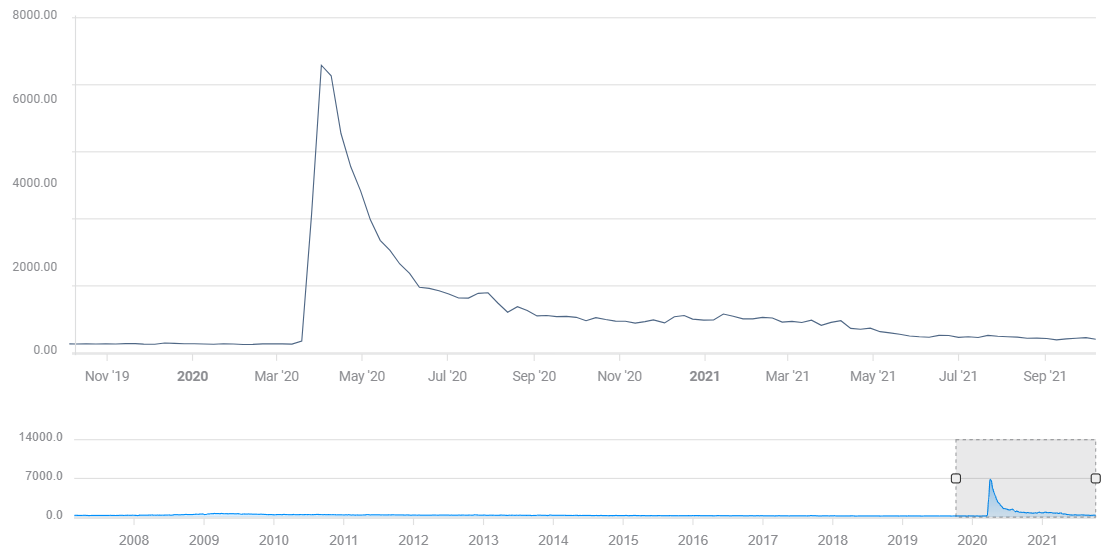
Initial Jobless Claims are another warning that the job market is not accelerating as might be expected. Claims rose for three straight weeks, moving from 312,000 in the September 3 week to 362,000 on September 24 but then reversed to 326,000 in the latest week.
The rise in claims was probably not an indicator of deeper problems in the labor market. Claims have been varied throughout the recovery, rising for several weeks a number of times, only to resume their general decline.
Initial Jobless Claims
Conclusion
The Fed’s evident desire to begin tapering its bond program means that September Nonfarm Payrolls at or better than forecast, is a green light for a November announcement. October’s job numbers are not reported until Friday November 5, two days after the Fed meeting.
Barring negative economic developments in the next four weeks this NFP data is the best hint for the Fed’s November taper decision.
Markets will certainly react on those lines. The larger the payrolls total, the better for Treasury yields and the dollar and the more likely equites will begin that considering that long-delayed correction.
Author

Joseph Trevisani
FXStreet
Joseph Trevisani began his thirty-year career in the financial markets at Credit Suisse in New York and Singapore where he worked for 12 years as an interbank currency trader and trading desk manager.