US Natural Gas crashes as warm weather erases winter premium

US Natural Gas futures suffered a historic one day collapse, reminding traders that the gas market is often driven less by long term energy narratives and more by short term weather expectations and positioning. The front month contract fell 25.7% in a single session, the steepest daily percentage loss since 1995, after forecasts shifted abruptly toward much milder temperatures across most of the United States through mid February.
The move was not triggered by a sudden breakdown in production capacity or a structural collapse in demand. It was triggered by a rapid repricing of heating demand expectations, amplified by leverage and the mechanical nature of futures markets.
Weather remains the dominant driver in winter pricing
Natural gas is one of the most weather sensitive commodities in the world. In winter, the marginal driver of price is not industrial consumption or long term LNG strategy, but space heating demand. A small change in temperature expectations can translate into a large change in projected storage withdrawals, which then translates into a sharp price adjustment.
That is exactly what happened. Forecast models pivoted from a colder outlook to a much more benign temperature profile, pushing the market to erase a large portion of the premium that had been built during the preceding cold spell.
This explains why the decline looked disproportionate. The market was not slowly digesting new fundamentals. It was rapidly repricing the most important variable in winter, the expected path of degree days.
A violent reset after a crowded cold weather rally
The selloff also needs to be viewed in context. The drop came after a sharp weather driven rally earlier in the season, when extreme cold boosted demand and tightened near term balances. In that environment, speculative positioning tends to build quickly because weather narratives are easy to trade and liquidity is deep.
But crowded positioning cuts both ways. When weather flips, the exit becomes narrow. Stops trigger, margin usage spikes, and traders de risk mechanically. That sequence often produces moves that feel like liquidation rather than valuation.
The fact that prices stabilized around the low three dollar area after the collapse supports the view that the move was a reset of the winter weather premium rather than a signal that gas has entered a structurally depressed regime.
Storage and the seasonal narrative
The weather repricing matters because it directly affects expected storage dynamics. In winter, the market constantly re calibrates how quickly inventories will be drawn down. When forecasts shift warmer, expected withdrawals decline and the urgency premium fades.
The US Energy Information Administration has also emphasized how temperature assumptions can materially alter near term pricing expectations, including downward revisions to Henry Hub forecasts when winter demand is expected to underperform seasonal norms.
That said, storage is not the whole story. LNG exports, production disruptions during freezes, and regional basis constraints can still create volatility. Recent winter storms have shown how quickly production and infrastructure can be disrupted and then recover, feeding sharp swings in short term balances.
This is why gas remains a two speed market. It is fundamentally seasonal, but it is structurally volatile.
The Europe link and why US gas still matters globally
Even though the price collapse was driven by US weather, it still matters for global energy narratives. The US remains a key LNG supplier to Europe, and shifts in US pricing can influence cargo economics, hedging behavior, and broader sentiment in global gas markets. Reuters has noted the continued importance of US LNG flows to Europe during winter conditions, even as extreme weather can temporarily disrupt export operations.
Europe’s own storage situation has been tighter compared to the previous year, keeping the region sensitive to winter weather and LNG availability. That backdrop can create periods when global gas markets feel more interconnected, even if the immediate trigger is domestic US temperatures.
The key takeaway is that a US weather driven crash does not automatically translate into a European price collapse. However, it can shift the global risk mood, particularly when it signals that winter risk premiums are fading at the same time on both sides of the Atlantic.
Renko structure shows capitulation and stabilization
The Renko chart helps explain the character of the move. Renko filters time and focuses purely on price structure, which makes it well suited to identifying when a market is trending versus when it is simply reacting.
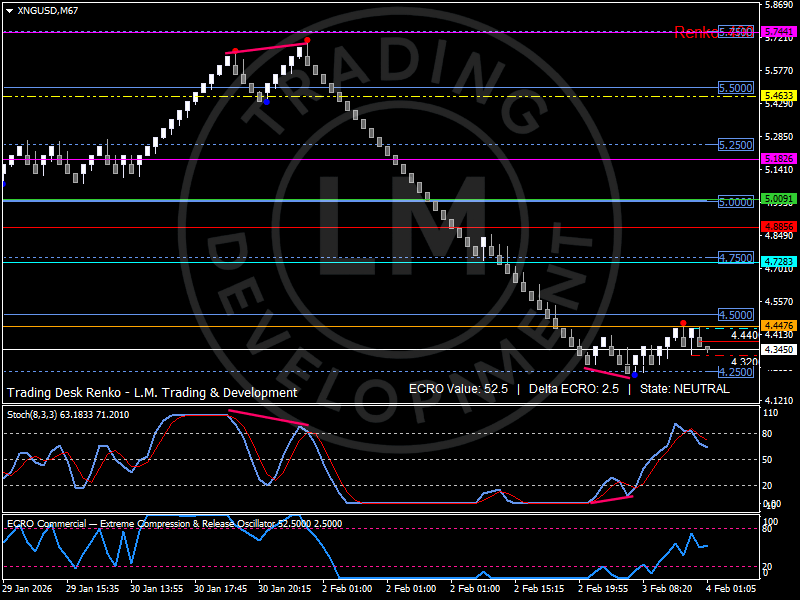
The current Renko structure shows a long, persistent bearish sequence following the breakdown from the upper range, consistent with capitulation rather than a slow grind lower. After the decline, price action compresses into a tighter sideways band, suggesting stabilization and a transition away from panic selling.
Momentum indicators align with that shift. The ECRO reading sits near the mid range with a positive delta, while the state reads neutral. That combination is consistent with a market that has already released much of the downside energy and is now attempting to re balance rather than extend the crash immediately. The Stochastic profile also reflects cooling momentum after the rebound attempt, which fits a consolidation phase following an extreme move.
In practical terms, the technical picture suggests the market has moved from trend liquidation into a stabilization regime, where the next catalyst is likely to come from the next weather forecast cycle, storage data, or changes in LNG flows rather than from pure momentum continuation.
What to watch next
Three factors will shape the next phase.
First, weather model consistency. If forecast warmth remains stable across models, the market is more likely to trade sideways or drift lower as risk premium continues to bleed out. If cold risks return, volatility can re ignite quickly.
Second, storage signals and withdrawal expectations. The market will react not only to the reported numbers but to whether they confirm the new demand profile.
Third, positioning and volatility. A historic drop tends to flush leverage, which can reduce immediate cascade risk. But it can also increase sensitivity to surprises because liquidity providers widen risk limits after extreme sessions.
The core message is simple. Natural gas remains the most weather dominated major commodity. When forecasts flip, price can move faster than fundamentals can be debated.
Author
Luca Mattei
LM Trading & Development
Luca Mattei is a market analyst focusing on FX, metals, and macroeconomic trends. He develops trading tools for retail and professional traders, coding indicators and EAs for MT4/MT5 and strategies in Pine Script for TradingView.