US Markit Purchasing Managers’ Index May Preview: Is the bottom in?
- Manufacturing and service PMIs expected to rise in May.
- Precursor to the better known May ISM report in early June.
- Markets will notice but wait for ISM confirmation before moving.
- Improvement in PMI will undermine the dollar’s risk premium.

Is the fastest and most devastating collapse in employment and GDP in US history reaching its bottom?
That is one conclusion from the expected bounce in May purchasing managers’ indexes from the UK firm IHS Markit.
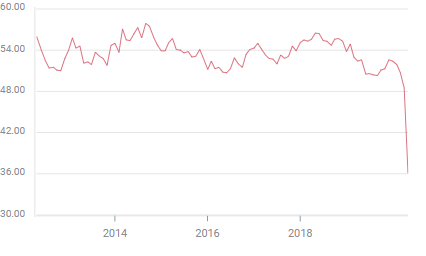
The manufacturing index is forecast to rise to 38 from 36.1 in April and the services to climb to 30 from 26.7. Last month’s scores were the lowest in the series brief record that started in April 2012 for manufacturing and November 2013 in services.
Markit and ISM
Brevity, in this case, does not detract from the accuracy of the survey which polls purchasing managers on various aspects of their businesses in the manner pioneered by the Institute for Supply Management beginning in 1948.
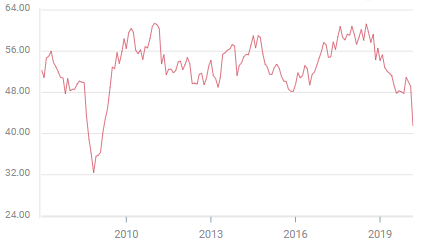
The ISM April scores in manufacturing, 41.5, and services, 41.8, were not the lowest in its series, both were weaker in the 2008 recession at 34.5 and 37.8 respectively.
IHS Markit manufacturing PMI
FXStreet
The February through April declines were the steepest on record for both the Markit and ISM series and though the collapse was historic for the data it paled in market impact to the initial jobless claims figures that that initiated the economic reality of the coronavirus shutdowns.
ISM manufacturing PMI
Conclusion and the dollar
Unemployment in the US has continued to rises sharply each week.
The decline in initial jobless claims to 2.981 million in the week of May 8 and the expected drop to 2.4 million on Thursday is progress only in the extreme current circumstances.
The lowest figure in that record, last week, is 4.5 times the prior high of 665,000 in March 2009. There is no equivalent in US history to almost 40 million American being thrown out of work in two months.
Many states have started to lift the most stringent business restrictions and permitting partial reopening for many types of enterprises with continued liberalization expected but also contingent on improving infection rates.
So far in the states farthest along in normalization, Texas, Georgia and Florida infection and fatality rates have continued to decline.
Will the release of the economic straight jacket encourage a rapid return to normal life with workers rehired, consumers in the stores and malls and an economic recovery underway by the end of the second quarter?
Or has the damage been so great and the fear so pervasive that even if permitted it will take months or years for normal consumption patterns to emerge, with the concomitant painfully slow return of employment.
The uncertainty is great. Every projection is by necessity based on never proven assumptions.
One thing is certain if purchasing managers sense improvement markets will too.
Author

Joseph Trevisani
FXStreet
Joseph Trevisani began his thirty-year career in the financial markets at Credit Suisse in New York and Singapore where he worked for 12 years as an interbank currency trader and trading desk manager.