US labor market reels as initial jobless claims soar far beyond previous record
- 3.283 million workers file for unemployment insurance.
- Layoffs may increase as shutdowns spread across the economy.
- Congress to pass $2.2 trillion stimulus and support package.
- Negative US GDP expected in the second quarter.

The decade long job boom came crashing to a halt this week when a record 3.283 million Americans applied for unemployment insurance as the Coronavirus pandemic shuttered large swaths of the US economy.
Many of the job losses were ordained by state and local government ordered closings of nonessential business and others by voluntary elimination of travel and other public activity.
Initial Jobless Claims
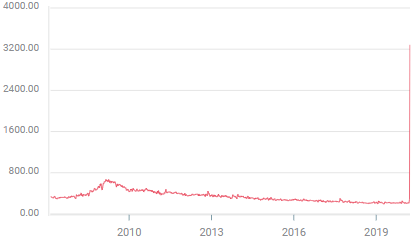
Job losses and initial jobless claims
The travel hospitality and leisure sectors alone employ 15.8 million people many who have been fired as the cash flow from operations has vanished. Restaurants are another hard hit area with a potential for 5-7 million job losses according to industry representatives.
Prior to last week the record for claims was 695,000 in October 1982 followed by 665,000 in March 2009, both of which came as the US economy was mired in deep recessions as calculated by the Bureau of Economic Analysis.
Heading into this crisis the US labor market had been in good shape having created an average 177,750 jobs per month last year with unemployment and initial claims near five decade lows and hourly earnings at the best level in a decade.
Economic impact
The US economy was not in recession in the first quarter. Growth in the first two months of the year prior to the viral onset had been estimated at 3.1% by the Atlanta Fed GDPNow model.
The current economic situation is unique. A normally functioning fully employed modern industrial economy has never been cast into recession essentially overnight. Estimates for the decline in US GDP in the second quarter range from 5% to 10% with unemployment rising from 3.5% to 7% or higher. About 40% of the US population is under some form of voluntary or government mandated restriction.
The most vulnerable employees, hourly workers in the hospitality and restaurant industries probably made up the bulk of this week's claims. With their cash flow decimated few restaurants could make payroll. In the hotel business, if the rooms are empty they hardly need to be cleaned.
Beyond this there is a vast group of small to medium size businesses, retail stores, plumbers, electricians and the like whose employees have substantial and necessary skills and who would be hard to replace.
It is a fair assumption that all of these business owners plan to continue and their employees are key to resumption. How these business owners handle the slowdown is the economic question of the moment.
Much of the economic outcome depends on the success of efforts to reduce the spread of the virus. The longer its takes to contain the illness the more prevalent will become business closures and unemployment. In the US where economic activity is largely the product of consumer spending, any substantial decline in consumption translates quickly into lost employment and production.
The more than $2 trillion support package expected to be passed by Congress on Friday and signed by President Trump on Saturday will help to mitigate the economic impact by providing assistance to businesses large and small and a $1200 grant to many Americans.
Next week’s initial jobless claims on Thursday and non-farm payrolls on Friday will be a second window into the economic carnage of the viral outbreak. Payrolls are predicted to fall 293,000 and the unemployment rate to jump 0.5% to 4%. Expectations for the jobs report will be conditioned by the claims numbers the prior day.
Market response
Equites continued their rally after the claims numbers, with the Dow rising by more than 1,000 point in the late morning but that was largely due to the completion of the rescue package in Washington. Oddly, despite the enormous job losses, markets finally have some concrete numbers and that is better than the unknown.
The dollar saw moderate losses against the majors with the euro rising above 1.1000 for the first time in six session and the dollar yen falling through 110.00 as the crisis demand for the currency ebbed.
US Treasury were stable with the 10-year yield holding at 0.81% and the 2-year at 0.28%. The 3-month remained slightly negative at -0.03% after falling below zero for the first time yesterday.
West Texas Intermediate was down 4.65% at $23.35, ( 12:15 pm NY)
Author

Joseph Trevisani
FXStreet
Joseph Trevisani began his thirty-year career in the financial markets at Credit Suisse in New York and Singapore where he worked for 12 years as an interbank currency trader and trading desk manager.