Gold Analysis: XAU/USD surges to fresh all-time high as safe-haven flows boost demand
- Gold kicks off the new week on a strong positive note and jumps to a fresh record peak.
- Rising geopolitical tensions revive safe-haven demand and boost the precious metal.
- Dovish Fed expectations cap the recent USD bounce and also underpin the commodity.

Gold (XAU/USD) catches aggressive bids at the start of a new week and touches a fresh all-time peak, closer to the $4,400 mark, during the Asian session. Concerns about renewed Israel-Iran conflict, along with rising tensions between the US and Venezuela, and the protracted Russia-Ukraine war, keep geopolitical risks in play. Furthermore, dovish Federal Reserve (Fed) expectations turn out to be key factors that boost demand for the non-yielding yellow metal.
US President Donald Trump last week ordered a blockade of sanctioned tankers entering and leaving Venezuela. The US Coast Guard intercepted a Venezuelan oil tanker over the weekend and is in active pursuit of a third in less than two weeks. From the Middle East, Israel's Prime Minister Benjamin Netanyahu said that officials are concerned that Iran is reconstituting nuclear enrichment sites and are preparing to brief Trump on options for attacking the missile program again. Moreover, Russian President Vladimir Putin’s top foreign policy aide said on Sunday that changes made by the Europeans and Ukraine to US proposals did not improve prospects for peace. This, in turn, boosts demand for the traditional safe-haven Gold.
Meanwhile, the mixed US Nonfarm Payrolls (NFP) report released last week pointed to signs of softening labor market conditions. Adding to this, last Thursday's softer US consumer inflation figures reaffirmed market bets for further policy easing by the Fed. According to the CME Group's FedWatch Tool, traders are currently pricing in two more Fed rate reductions in 2026. This, in turn, fails to assist the US Dollar (USD) in building on last week's goodish rebound from its lowest level since early October and provides an additional boost to the Gold price. The strong move up takes along short-term trading stops placed around the $4,345-4,350 static hurdle amid relatively thin trading volumes on the back of the year-end holiday season.
This, in turn, backs the case for a further near-term appreciating move amid a supportive fundamental backdrop. Traders now look forward to Tuesday's US economic docket, featuring the delayed release of the prelim Q3 GDP report and Durable Goods Orders. Apart from this, speeches from influential FOMC members will play a key role in driving the USD demand and producing short-term trading opportunities around the Gold price.
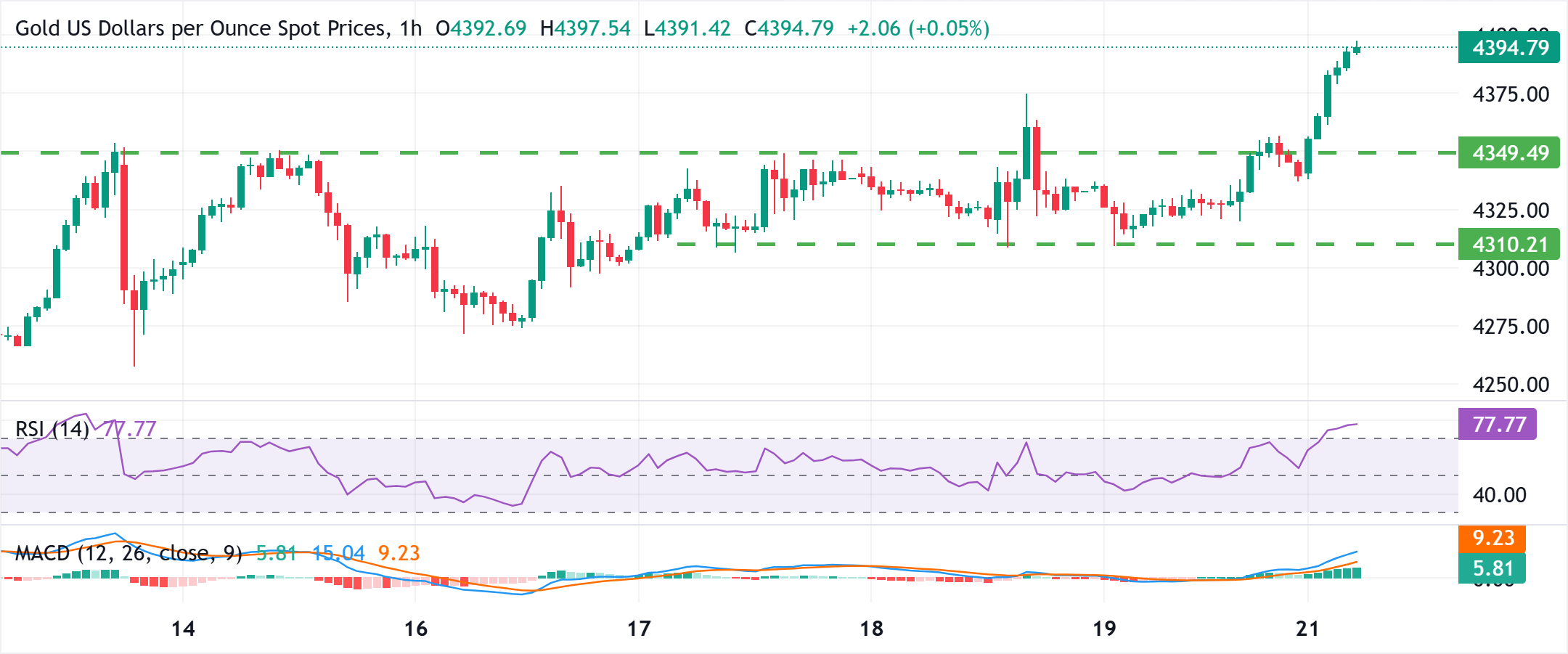
Gold 1-hour chart
Technical Outlook.
Against the backdrop of back-to-back rebounds from the $4,310-$4,305 area over the past two days, a convincing breakout through the $4,345-4,3450 region could be seen as a key trigger for bullish traders. However, the Relative Strength Index (RSI) is flashing overbought conditions on hourly and daily charts. This, in turn, makes it prudent to wait for some near-term consolidation or a modest pullback before positioning for any further appreciating move.
That said, any meaningful corrective slide is more likely to attract fresh buyers and find decent support near the $4,350-4,345 region. Some follow-through selling would expose the $4,310-4,305 support, which, if broken decisively, could pave the way for a fall towards last week's swing low, around the $4,272-4,271 region, en route to $4,260-4,255 support. The Gold price could extend the fall further and eventually drop to the $4,200 round figure.
Author

Haresh Menghani
FXStreet
Haresh Menghani is a detail-oriented professional with 10+ years of extensive experience in analysing the global financial markets.