US Initial Jobless Claims Preview: When is less more?
- Initial unemployment claims expected to be 3.5 million.
- Filings would be 50% lower than the March 27 peak.
- Total of 30 million people have been furloughed in six weeks.
- Most layoffs were expected to be temporary at the time.

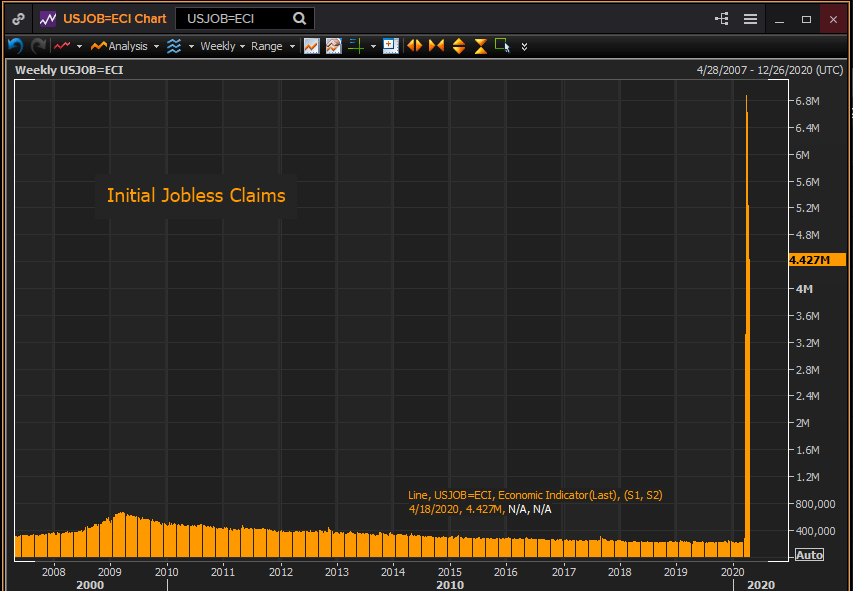
The number of American filing for unemployment benefits is expected to decline for the fourth week in a row but the improvement is relative, as the number will still be more than five times greater than any period prior to last month.
Initial jobless claims are projected to be 3.5 million in the week of April 24 bringing the total from March 20 to 29.953 million.
Continuing claims for the six month benefits period is also to forecast to rise by the same amount to 19.476 million.

Claims will have dropped 50% in a month from their peak in the second week of the massive layoffs caused by government mandated business closures in the effort to halt the Corona virus pandemic. These unemployment claims, including this week, represent 18.2% of the American labor force of 164.6 million people.
During the financial crisis of a decade ago the largest one week filing was 665,000 on March 28, 2009. The highest total for continuing claims was 6.635 million on May 30, 2009.
Labor market prognosis
The most pressing question for the labor market and the overall economy is how many of these workers will return to their jobs as states begin to lift restrictions on businesses.
In statistics from several states that require employers to state whether the layoff is considered temporary or permanent, the vast majority were thought to be temporary when they occurred. California firms with at least 75 workers said just 7% were considered permanent and of the 23,400 layoffs in Colorado and Washington at the time of the report 75% were considered temporary.
The expectation of most employers and workers that unemployment would be short-lived was based on hope rather than knowledge. In this unique situation the ability of the millions of small businesses that employed most of the furloughed works to reopen is unknown.
Most owners will strive to rebuild but for restaurants, bars and other social venues, customers may return too slowly to rescue these cash-flow dependent businesses.
US GDP
While everyone who has been laid-off can qualify for federal insurance and many will have additional state benefits, the shock to demand of the layoffs and social restrictions has pushed the US economy into contraction in the first quarter.
Growth was estimated at a 2.7% annualized pace in first quarter in January and February by the Atlanta Federal Reserve GDPNow model. The Bureau of Economic Analysis reported -4.8% GDP in its advanced estimate for the complete first quarter, the first of three releases. A rate of -4% had been predicted by economists inthe Reuters survey, with a range of 1% to -15%.
With more than two dozen states planning to at least partially lift business and social restrictions in the next week businesses will soon know if there are enough customers to keep them in from going under.
If these experiments are successful public pressure in the remaining locked-down states will likely force their opening as well.
How many businesses will have survived their near death experience and be able to bring back their employees is unknown. There are no economic models for such an event.
Conclusion: Markets and the dollar
Though the impact of the economic shutdown in the first quarter is limited to March the information will inform how markets will assess the fully involved second quarter.
The greater the decline in January, February and March the more negative will become the outlook for April, May and June. Equities and bonds will respond in a straight forward fashion with higher prices, and for bonds lower yields if the number is no worse than expected and the safety premium will continue to leach from the dollar.
Author

Joseph Trevisani
FXStreet
Joseph Trevisani began his thirty-year career in the financial markets at Credit Suisse in New York and Singapore where he worked for 12 years as an interbank currency trader and trading desk manager.