Recession risk likely to weigh on Sterling in 2026


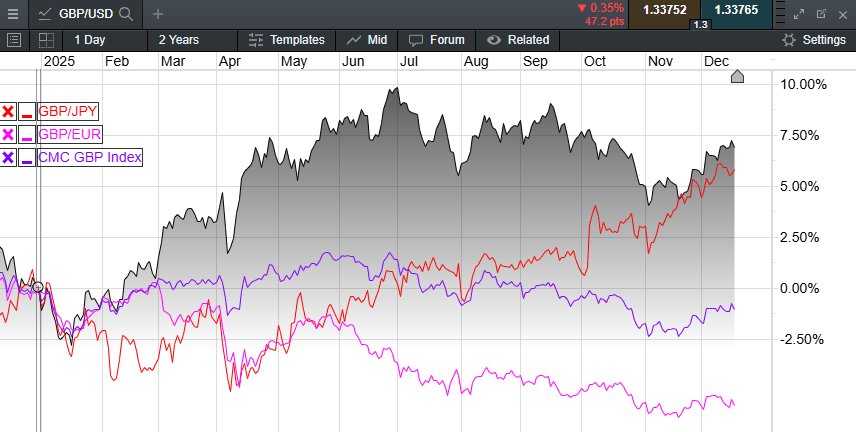
It’s been a somewhat mixed year for the pound with a reasonably strong performance against the US dollar, despite sinking to a low of 1.2100 during January before undergoing a sizeable move to 1.3800 in the first half of the year.
Since those July peaks we’ve seen a modest pull back, with support coming in at the 1.3000 level in October, before a recovery to current levels.
Against the euro, the pound has struggled, sliding from peaks of 0.8240 at the end of February, and undergoing gradual losses on a month-to-month basis, sliding to the 0.8865 area mid-November, before a modest rebound.
While some of that weakness can be attributed to the Bank of England continuing to cut rates after the ECB called a halt in June, the reality is that a lack of confidence in UK governance, as well as the economic outlook appears to have driven a shift out of sterling in a trend that looks set to continue in 2026.
The poor performance of both the US dollar and the Japanese yen have offered the pound some modest relief, with the weak yen a symptom of interest rate differentials, as well as limited expectations about future rate cuts, however these two have been a rare bright spot for the pound in a year that has seen wholesale sterling weakness.
The flight from the US dollar appears to be a mechanical reaction to investors diversifying away from the greenback amidst uncertainty over the effects of US government fiscal, as well as trade policy.
GBP performance YTD 2025
Source: CMC Markets
The performance of the euro has also been reflected in the strong gains that we’ve seen across European equity markets with capital flowing out of the US as investors diversify away from US equities, to cheaper European markets.
This also helps to explain why the FTSE100 has done so well after several years of underperformance as US investors pare down their exposure to US dollar denominated assets.
The big question, as we head into 2026, is whether the pound will see this trend continue in respect of weakness against the euro, and resilience against the US dollar.
For a good while the relationship between the pound, dollar and euro had been driven by interest rate expectations, and to some extent that is still true, however given the fraught political backdrop here in the UK there still remains an element of a “moron premium” when it comes to UK assets, and in particular UK government debt.
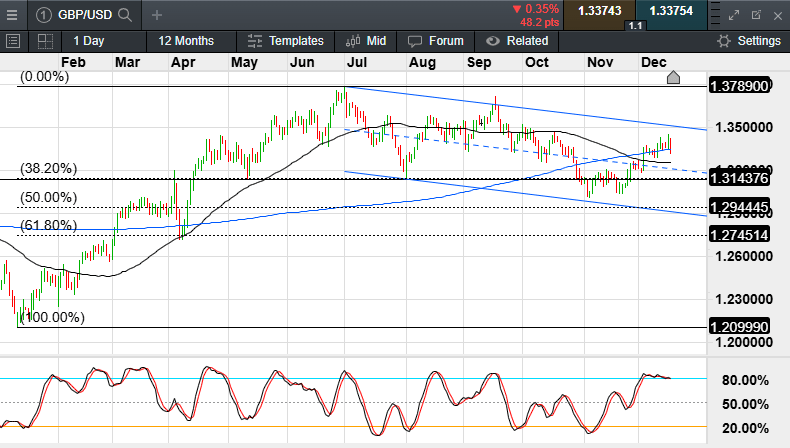
As we can see from the chart below, the pound has been trending lower against the US dollar since the summer.
GBPU/SD daily chart
Source: CMC Markets
We did find some support at the 1.3000 area in mid-October which has since prompted a rebound but we would need to see a strong move through 1.3600 to suggest the recent weakness has run its course.
This barrier is located through the upper trend line from the July peaks which could have the potential to signal a move towards 1.4000. A move below 1.3000 has the potential to target a move back towards the 1.2500 area.
As far as the US dollar is concerned the unpredictability around US fiscal policy and concerns over an AI bubble could mean that the pound could benefit in the form of continued flows into UK companies, which by and large continue to be well run, despite rising costs and pressures on margins.
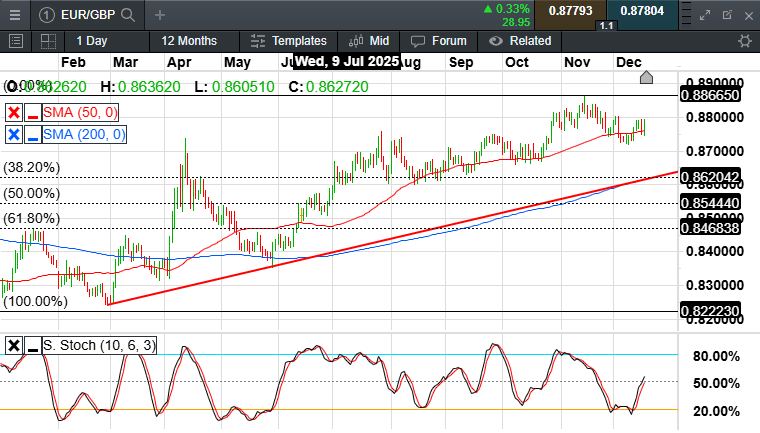
Against the euro the picture is more mixed with the pound caught in a steady decline that shows little sign of running out of steam, with current strength likely to be limited to a move towards the 0.8620 area on the chart below.
EUR/GBP performance year to date 2025
Source: CMC Markets
How many more rate cuts in 2026?
The main question we had heading into this year was based around how many more rate cuts were likely to come down the line, and whether any central bank might start to lean towards raising rates.
With the exception of the Bank of Japan we don’t, as yet, have any central banks leaning towards rate hikes, although we also haven’t had nearly as many rate cuts as we thought we would during 2025.
The ECB called a halt to rate cuts in the summer, while splits at the Bank of England and the Federal Reserve have complicated the picture when it comes to the size and speed of further rate reductions this year.
This doesn’t look set to change in 2026, although if we cast our minds back to 12 months ago, the Bank of England was predicting a base rate of 3% by the end of this year. This seemed a stretch to most sensible people at the time, and so it has proved with the base rate at 4% at the start of December, and only just reduced to 3.75% in the last few days.
This stickiness in prices could well remain a theme as we head into 2026, with continued elevated wage growth, along with headline inflation might see a repeat that came in the aftermath of the 2024 budget, although few people expect inflation to go higher in the same way it did a year ago.
As things stand, there is a chance we may see further rate cuts heading into the start of next year, not because inflation is slowing but because unemployment continues to head higher, and the UK economy slips into recession.
Here in the UK, the primary worry is that inflation may not come down as quickly as the government or the Bank of England would like, resulting in the MPC keeping rates higher for longer.
The reasons for this stickiness are easy to spot and lie in Westminster, where a mind numbingly economically illiterate approach to the nation’s finances from the government, has prompted an even larger moron premium on UK gilts, as well as a failure to learn the lessons of the October 2024 budget.
This failure to learn from 2024 thus repeated the same mistakes this year, sucking the life out of business, as well as consumer confidence, and then going on to simultaneously raise taxes on both.
This indifference to the private sector and business in general, appears to show a government completely out of tune with how to inspire confidence, as well as understand incentives, and could in time prompt a sharp sell off in gilts as the markets lose further confidence in the UK’s current economic model.
For 2026, the central bank will not only need to keep its focus on prices, but will also have to contend with a slowing economy at a time when wage inflation could stay sticky for longer.
There is also the increasing risk that job losses are likely to continue to head towards the levels we saw in the immediate aftermath of Covid when the unemployment rate hit 5.3%, especially since we already aren’t far off that level at 5.1%.
While wages growth does appear to be starting to slow in the private sector, it is still well above the central bank’s inflation target in the public sector, and while weak hiring trends could suck some demand out of the economy, for those in work pay growth still remains high, which could mean that headline inflation could stay elevated for longer.
With that in mind we could well see a continuation of the trends that we saw in 2025, with the pound continuing to weaken against the euro, potentially heading through the 0.9000 area, while continuing to hold its own against the US dollar, albeit with a downward bias.
As for the Fed, the market is pricing for one more cut between now and the middle of next year, while the ECB appears to be done.
Author
Michael Hewson MSTA CFTe
Independent Analyst
Award winning technical analyst, trader and market commentator. In my many years in the business I’ve been passionate about delivering education to retail traders, as well as other financial professionals. Visit my Substack here.