US Initial Jobless Claims Preview: Optimism doesn't come naturally
- Jobless claims forecast to rise to 617,000 from 576,000.
- Continuing Claims expected to drop to 3.667 million from 3.731 million.
- American economy created 1.617 million jobs in the first quarter.
- The economic changes wrought and intensified by the pandemic continue to plague labor markets.
- Markets have stopped looking to claims for economic direction.

Help-wanted signs are everywhere in the US. The pandemic grip on the labor market is loosening fast as companies prepare for growth that the Fed expects to be 6.5% this year.
Yet even as GDP expansion accelerates to what could be the best year in a generation, layoffs continue at rates reminiscent of the financial crisis.
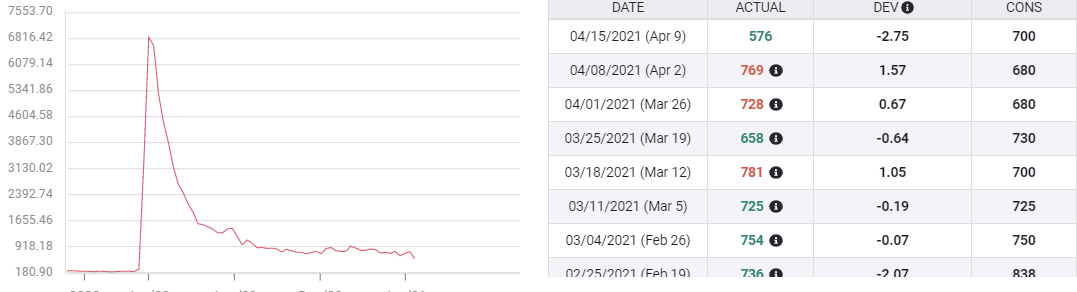
Initial Jobless are forecast to rise to 617,000 in the April 16 week. The previous 574,000 was the lowest of the pandemic era.
Continuing Claims are expected to fall to 3.667 million in the week of April 9 from 3.731 million and 3.727 million prior, both the smallest totals since March 20 2020.
Nonfarm Payrolls
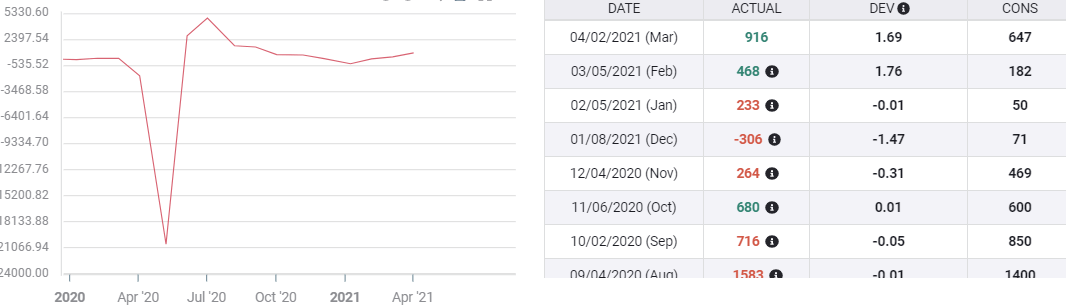
Job creation had an excellent first quarter. Hiring almost quadrupled from January’s 233,000 to 916,000 in March and was two-and-a-half times the 638,000 in the lockdown marred third quarter. American firms have rehired 62% of the 22.362 million workers fired in the March and April panic last year, leaving 8.4 million still unemployed.
At the first quarter rate of hiring it would take until the first week of September to completely reconstitute the US labor market.
FXStreet
Initial Claims
The long-term economic damage of the lockdown approach to the pandemic is evident in the claims figures. More than a year after the initial closures businesses continue to fail and eliminate jobs at rates comparable to the year following the financial crash of 2008.
Claims peaked on February 21, 2009 at 667,000. A year later claims were 469,000, nearly back to the level of the three months before the fourth quarter 2008 collapse.
On March 13, 2020 the last statistic before the lockdown impact, the four week moving average was 232,500. It was 683,000 in the April 9, 2021 week.
Initial Jobless Claims
Market response
Markets have stopped watching the Initial Jobless Claims figures for economic direction. Layoffs are retrograde. They are the fallout of last year’s preventative economic measures. They have little to say about growth and hiring in the next three quarters.
Conclusion
The pandemic did more than shut the economy for several months and in some industries for much longer. It intensified economic changes already underway but below the general radar.
Working from home is no longer a part-time indulgence for many workers and companies but a new paradigm.
The ramifications of some of those changes, on urban economies and real estate and tax values for example, will take years to reach full impact.
Others, in the retail and travel businesses for instance, are already permanent and evident in the failures of old business models.
That destruction will keep layoffs high even as different businesses charge into the new economy.
Author

Joseph Trevisani
FXStreet
Joseph Trevisani began his thirty-year career in the financial markets at Credit Suisse in New York and Singapore where he worked for 12 years as an interbank currency trader and trading desk manager.
















