US Fourth Quarter GDP Preview: Old news
- Annualized economic growth expected to be unchanged in the fourth quarter.
- Consumer sentiment was strong in the final three months.
- Downward revision to retail sales for November and December risk lower expansion.

The Bureau of Economic Analysis, a division of the Commerce Department will release its second estimate for the annualized gross domestic product (GDP) for the fourth quarter on Thursday, February 27th at 13:30 GMT, 8:30 EDT.
Forecast
Annualized GDP is expected to be unchanged at 2.1% in its second estimate. It was 2.1% in the third quarter, 2.0% in the second and 3.1% in the first. The third and final estimate will be released on March 26th.
US economy in the fourth quarter
The basic components of the economy in the fourth quarter have been reported over the past two months and the few revisions not included in the January 30th initial estimate—called ‘advanced’ by the BEA, are not likely to be of a character to alter the GDP estimate substantially.
National account procedures followed by the BEA include four categories of economic activity for GDP: consumption, business spending, government expenditures and net international trade.
Economists often use the retail sales control group category to approximate consumption or consumer spending. The October figure of 0.3% was unrevised and November’s first estimate was adjusted down to -0.1% from 0.1% on January 16th, both were included in the January 30th GDP release. The revision to December’s estimate from to 0.2% from 0.5% released on February 14th was not incorporated in the January 30th GDP.
Retail Sales Control

Business investment is tracked by the durable goods category non-defense capital goods orders ex-aircraft. The revisions to fourth quarter results for October to 1.1% from 1.2% and November unchanged at 0.1% were available to the BEA for the January GDP estimate. The potential revision to December’s 0.9% figure will be released on February 27th concurrent with the new GDP estimate.
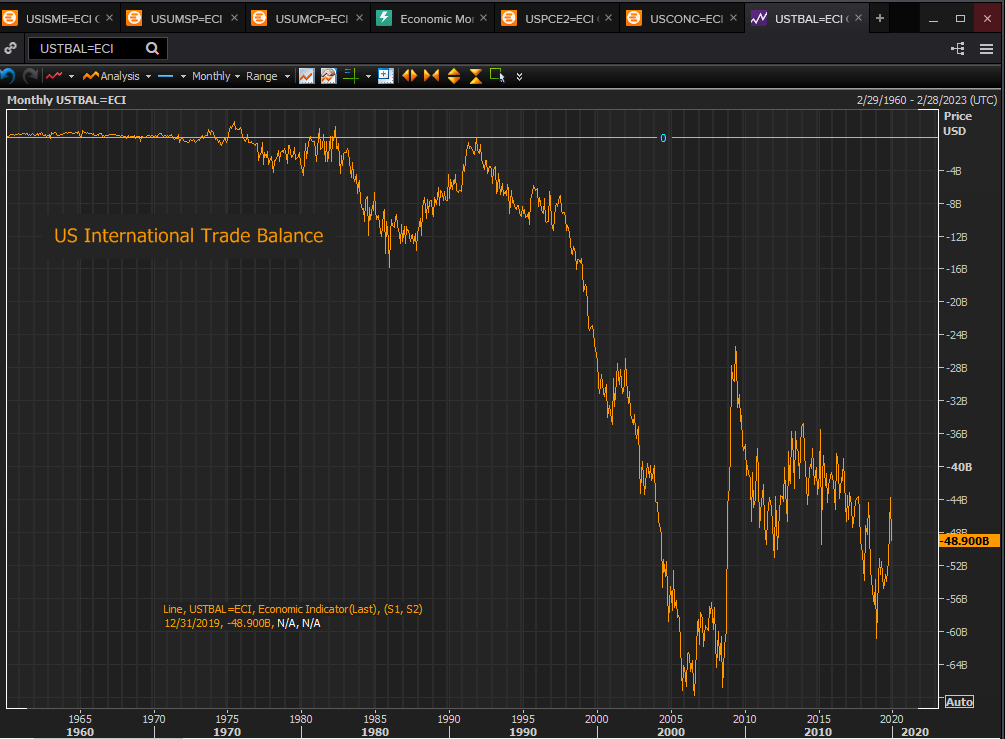
Government accounting uses the net international trade balance as a contributor or detractor from gross domestic product. A positive trade balance, which the US has not had for close to 40 years, adds to GDP, a negative balance subtracts.
Reuters
The October trade balance was revised to -$46.9 billion from -$47.2 billion and included in the January GDP estimate. November's adjustment to -$43.7 billion from -$43.1 billion, released on February 5th, will be incorporated in this GDP release and the December trade balance revision on the initial -$48.9 billion which will not be issued until March 6th will be incorporated into the GDP figure until the third estimate on March 26th.
In general government procurement and spending is budgeted a year in advance and rarely produces an outcome different that appropriated it the enabling legislation.
Conclusion
Of the four BEA categories of GDP accounting, consumption, business spending, government expenditures and net international trade, two, consumption and international trade, have new information in the GDP second estimate. The retail sales control group result for December, which was adjusted to 0.2% from 0.5% on January 16th between the first and second GDP estimates ane November's net trade was revised to -$43.7 billion from -$43.1 billion.
Pending revisions to non-defense capital goods for December, the business spending proxy, and the trade balance for the same month will not be released in time for the second GDP estimate on February 27th. Any changes will have to wait for the final GDP release on March 26th.
The small downward adjustments to the December retail spending component and the prior month's trade balance are not likely to produce a change in the GDP estimate, though their existence tilts the risk to the negative. Either way the dollar will not be affected, currency traders having more timely concerns.
With the events of the past month and the potential threat to US and global GDP from the Coronavirus, the size of the fourth quarter expansion is truly old news.
Author

Joseph Trevisani
FXStreet
Joseph Trevisani began his thirty-year career in the financial markets at Credit Suisse in New York and Singapore where he worked for 12 years as an interbank currency trader and trading desk manager.