US Dollar Weekly Forecast: Attention shifts to the Fed
- The US Dollar surrendered its yearly gains in an unexpected U-turn.
- The Greenland factor, US-EU trade, and Trump all weighed on the buck.
- The Fed is largely anticipated to leave its interest rates unchanged.

The week that was
It was a rough week for the US Dollar (USD). Indeed, the US Dollar Index (DXY) not only gave back all its gains for the year but also slid all the way down to four-week lows below the 98.00 mark.
During this process, the US Dollar Index fell below its crucial 200-day Simple Moving Average (SMA), a technical reversal that often causes traders to become uneasy and potentially leads to further weakness if follow-through selling occurs.
In rates, the picture was more mixed. The move against the Greenback came alongside a steady rebound in US 2-year yields, suggesting front-end rate expectations remain relatively firm. Further out along the curve, however, yields drifted lower, with both the belly and the long end easing through the week, a reminder that growth and inflation concerns are still very much part of the broader macro conversation.
The Fed, in January: “We’ve cut a lot… now we wait”
After delivering 75 basis points of cuts in 2025, policymakers have been sounding like a committee that’s hit pause. In plain English, they’ve been telling markets they want to sit with the data for a bit before deciding whether the next move is another cut or a longer hold.
What’s striking is the split inside the Fed: One camp is basically saying, “Careful, inflation isn’t licked yet, and extra easing could undo progress.” The other camp is more open to the idea that, if inflation keeps behaving, rates should come down further to protect jobs and keep the economy on track.
The “no rush to cut” voices are pretty loud
Neel Kashkari (Minneapolis, voter) has been giving off the clearest “not in January” vibe. He indicated he didn’t see a reason to cut at the January meeting, suggesting the bar for near-term easing is high.
Alberto Musalem (St Louis, non-voter) struck a similar tone, saying he saw little reason for further easing in the near term.
Jeff Schmid (Kansas City, non-voter) went further and framed the risk as asymmetric. He suggested that cutting rates now could do more damage to inflation than it would help employment, implying he’s not convinced the labour market needs rate relief.
Raphael Bostic (Atlanta, non-voter) sounded firmly in the inflation-first camp. He warned that inflation was still too high and signalled the Fed needed to stay laser-focused on getting it under control, a reminder that some officials still see the inflation job as unfinished.
The “keep an eye on jobs, but don’t get ahead of ourselves” centre
Mary Daly’s (San Francisco, non-voter) message landed in the careful-middle bucket. She implied the Fed would need to move deliberately as it calibrates policy to achieve both price stability and full employment.
John Williams (New York, permanent voter) also sounded like he thought policy was in a good place right now. He indicated rates were well positioned to support labour-market stabilisation while inflation returns to 2%, essentially arguing the current stance can do the job without immediate tweaks.
Austan Goolsbee (Chicago, non-voter) gave the market a simple condition: he suggested they would need convincing evidence that inflation was truly on a path back to 2%. That’s not a promise to cut, more like a reminder that the Fed wants proof, not hope.
The “we could cut more this year” camp is there, but it’s not the majority tone
Stephen Miran (FOMC Governor, voter) sounded the most dovish, as widely anticipated. He indicated he was looking for roughly 150 basis points of cuts this year, and he framed that view as driven by inflation, suggesting he believes inflation will cool enough to allow significant easing, not that he’s ignoring it.
Leadership is trying to keep the message tidy: “data-dependent, flexible, no drama”
Two senior voices, Philip Jefferson (FOMC Governor, voter) and Michelle Bowman (FOMC Governor, voter), both leaned hard into a “keep options open” posture.
Jefferson suggested the current stance left the Fed well positioned to decide the timing and extent of further adjustments based on incoming data, the outlook, and risks.
Bowman, meanwhile, implied that unless there was a clear and sustained improvement in labour-market conditions, the Fed should be ready to adjust policy toward neutral.
All in all, the message from the Fed this month is one of patience after action. Having already delivered substantial rate cuts last year, policymakers now want to pause and see how the economy responds, rather than rushing into another move.
The internal debate is clear. Some worry that cutting too soon could reignite inflation, while others fear that holding policy too tight for too long could eventually hurt the labour market. For now, neither side has won the argument.
What unites them is caution: Until there is clear evidence that inflation is firmly on track back to 2%, the Fed’s instinct is to hold steady, keep its options open, and let the data, not the calendar, dictate the next step.
Markets see cuts; the Fed sees unfinished business
The latest US inflation data showed both the headline Consumer Price Index (CPI) and the core print advancing by 2.7% and 2.6%, respectively, in the year to December, with both prints matching their previous month’s advance.
Investors saw this set of data releases as a confirmation of further interest rate cuts in the upcoming months, despite the impact of US tariffs on the cost of living of Americans still remaining far from clear, and several Fed officials still warning that inflation does remain elevated and quite above the bank’s 2% goal.
Dollar softens as politics, not data, drive sentiment
More broadly, this week’s mood has been shaped by a shifting geopolitical backdrop that left investors uneasy. Markets reacted to headlines suggesting President Trump had secured US access to Greenland through a NATO-linked arrangement, a development that came alongside a softening in rhetoric toward Europe.
Trump appeared to step back from renewed tariff threats and played down any notion of taking Denmark’s autonomous territory by force, moves that helped cool one source of tension, even as they opened up another set of questions.
In the FX galaxy, the US Dollar ended up absorbing most of that uncertainty. US assets were hit hard early in the week as geopolitical nerves flared, reviving talk of the so-called “Sell America” trade, as investors once again questioned whether political risk could start to weigh more persistently on US markets and the buck alike.
What’s in store for the US Dollar
The spotlight next week shifts firmly to the FOMC meeting on January 28 and any follow-up commentary from rate setters once the decision is out of the way.
On the domestic front, weekly Initial Jobless Claims are likely to attract their usual share of attention.
Technical landscape
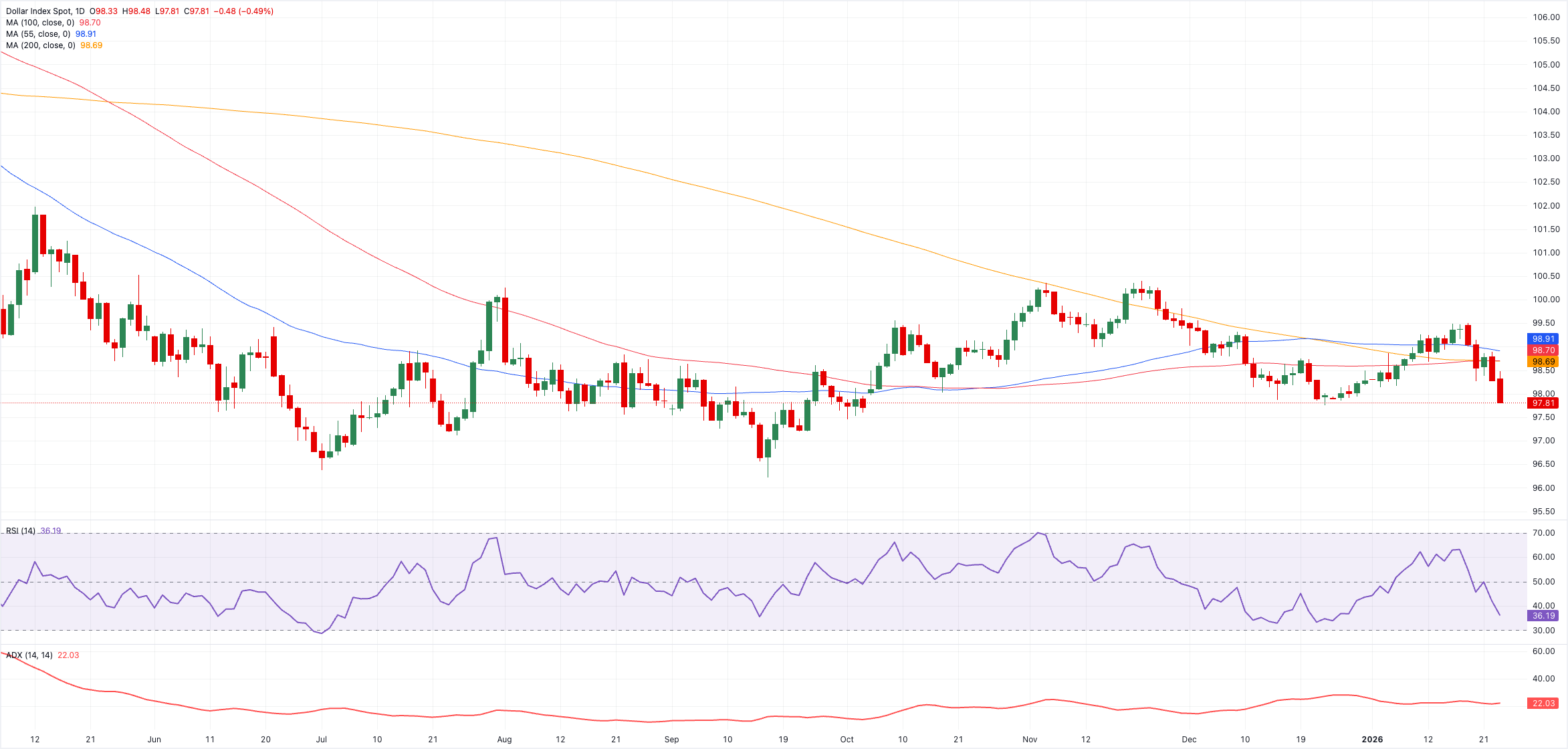
After climbing to the area of yearly highs around 99.50 earlier in the month, the US Dollar Index (DXY) has come under fresh and quite persistent selling pressure. Against that, the index returned to the area below the contention zone at 98.00 towards the end of the week.
In doing so, DXY broke below its critical 200-day SMA at 98.70, exposing the continuation of the downward trend, at least in the very short term. Down from here, the next support sits at the December low of 97.74. A deeper pullback could put the 2025 bottom at 96.21 (September 17) back into focus, ahead of the February 2022 valley at 95.13, and the 2022 bottom at 94.62 (January 14).
A bullish U-turn, in contrast, should need to surpass the 200-day SMA once again, thus opening the door to a probable test of the interim 55-day SMA at 98.96, prior to the 2026 ceiling at 99.16 (January 16). North of here emerges the November 2025 high at 100.39 ahead of the May 2025 peak at 101.97.
Additionally, momentum indicators appear to favour further pullbacks on the short-term horizon. That said, the Relative Strength Index (RSI) eases toward the 40 mark, while the Average Directional Index (ADX) just over the 19 level suggests the trend still looks firm.
Bottom line
Over the past few sessions, the US Dollar has retreated, as the near-term momentum clearly shifted against it. Much of that softness looks political in nature, with markets increasingly focused on headlines and uncertainty around President Trump rather than on the data.
The labour market continues to be the central focus for the Fed. Policymakers are watching closely for any meaningful signs of weakness, but inflation is still very much part of the story. Price pressures remain uncomfortably high, and if progress on disinflation starts to stall, hopes for early or aggressive rate cuts could quickly be scaled back.
In that scenario, the Fed would likely stick with a more cautious stance and, in time, argue for a firmer US Dollar, political noise notwithstanding.
Fed FAQs
Monetary policy in the US is shaped by the Federal Reserve (Fed). The Fed has two mandates: to achieve price stability and foster full employment. Its primary tool to achieve these goals is by adjusting interest rates. When prices are rising too quickly and inflation is above the Fed’s 2% target, it raises interest rates, increasing borrowing costs throughout the economy. This results in a stronger US Dollar (USD) as it makes the US a more attractive place for international investors to park their money. When inflation falls below 2% or the Unemployment Rate is too high, the Fed may lower interest rates to encourage borrowing, which weighs on the Greenback.
The Federal Reserve (Fed) holds eight policy meetings a year, where the Federal Open Market Committee (FOMC) assesses economic conditions and makes monetary policy decisions. The FOMC is attended by twelve Fed officials – the seven members of the Board of Governors, the president of the Federal Reserve Bank of New York, and four of the remaining eleven regional Reserve Bank presidents, who serve one-year terms on a rotating basis.
In extreme situations, the Federal Reserve may resort to a policy named Quantitative Easing (QE). QE is the process by which the Fed substantially increases the flow of credit in a stuck financial system. It is a non-standard policy measure used during crises or when inflation is extremely low. It was the Fed’s weapon of choice during the Great Financial Crisis in 2008. It involves the Fed printing more Dollars and using them to buy high grade bonds from financial institutions. QE usually weakens the US Dollar.
Quantitative tightening (QT) is the reverse process of QE, whereby the Federal Reserve stops buying bonds from financial institutions and does not reinvest the principal from the bonds it holds maturing, to purchase new bonds. It is usually positive for the value of the US Dollar.
Author

Pablo Piovano
FXStreet
Born and bred in Argentina, Pablo has been carrying on with his passion for FX markets and trading since his first college years.