GBP/USD Weekly Forecast: Pound Sterling on a firm note against US Dollar ahead of Fed decision
- Pound Sterling looks set to end the week with a firm tone against the US Dollar.
- US-EU tensions kept the US Dollar on the backfoot, while strong UK Retail Sales and flash PMI readings boosted the Pound Sterling’s appeal.
- Focus shift to the Fed’s monetary policy outcome and expectations for the BoE’s February policy meeting.

GBP/USD started the week on a firm footing and continued to trade strongly as disputes between the United States (US) and the European Union (EU) over the purchase of Greenland battered the US Dollar (USD) significantly.
A week, in which the pair was expected to be majorly driven by the United Kingdom (UK) employment and Consumer Price Index (CPI) data, was broadly steered by the Greenland crisis.
The Cable attracted significant bids near 1.3344 at the start of the week after a slight negative opening due to US-EU disputes, revisited the previous week’s high near 1.3500 on Tuesday, and extended its advance above this threshold on Friday, following strong UK Retail Sales and preliminary S&P Global Purchasing Managers’ Index (PMI) data.
US-EU tussle over Greenland’s entitlement weighed on US Dollar
The US Dollar corrected sharply at the start of the week, with the US Dollar Index (DXY) retracing from the seven-week high of 99.49 posted on January 15. The appeal of the US Dollar and US assets dampened after US President Donald Trump imposed 10% tariffs on several EU members, and the UK, for opposing Washington’s plans to make the “complete and total purchase” of Greenland, and kept the option of forceful acquisition on the table.
In response, EU members, UK Prime Minister (PM) Keir Starmer, and officials around the world criticized US President Trump severely for invoking the tariff tool. Speaking at the World Economic Forum (WEF) in Davos on Tuesday, French President Emmanuel Macron strongly condemned Trump’s use of tariffs to blackmail the continent into stopping its opposition to Washington’s purchase of Greenland. “Endless accumulation of new tariffs was unacceptable, particularly when used as leverage against territorial sovereignty,” Macron said, The New York Times (NYT) reported.
Geopolitical and trade tensions between two of the world’s largest economies pushed DXY further lower to 98.25 on Tuesday. However, it regained ground after President Trump rolled back increased import duties and ruled out military action on Greenland, while speaking at the WEF on Wednesday. The DXY rebounded to near 98.87 as signs of easing US-EU tensions recovered the appeal of the Greenback and US assets. Trump also announced that both Washington and the North Atlantic Treaty Organization (NATO) reached a framework of a “future deal with respect to Greenland, and in fact, the entire Arctic Region” after meeting with NATO Secretary General, Mark Rutte.
The US Dollar’s recovery proved short-lived as financial market participants started weighing concerns over Washington’s long-term relations with its trading partners, forcing the Greenback to extend its decline to near 98.25 by the end of the week. “While a Greenland deal solves the immediate problem of tariffs and invasion, it doesn’t solve the core issue of the seeming alienation of allies from one another. And that’s not a good place to be if you want to preserve the USD’s reserve-currency status," analysts at Macquarie Group said.
A recap of UK data-packed week
The UK’s economic calendar was data-packed this week, starting with employment figures for the three months ending in November, released on Tuesday. The Office for National Statistics (ONS) reported that the ILO Unemployment Rate remained steady at 5.1% and the economy added 82K fresh workers. In three months ending in October, employers fired 17K workers.
Average Earnings Excluding Bonuses, a key measure of wage growth, grew at an annualized pace of 4.5%, as expected, slower than the prior reading of 4.6%.
On Wednesday, the UK Consumer Price Index (CPI) report for December showed that headline inflation accelerated after two months of slowdown. The headline CPI rose at an annualized pace of 3.4%, faster than 3.3% estimates and the November release of 3.2%. The core CPI – which excludes volatile components such as food, energy, alcohol, and tobacco – rose at a steady pace of 3.2% year-on-year (YoY), as expected.
Higher UK inflation data failed to weigh on BoE dovish expectations as last year’s rises in utility costs and other government-controlled tariffs fell out of the annual comparison, Reuters reported.
On Friday, the UK Retail Sales and the preliminary S&P Global PMI data came in stronger-than-expected. Retail sales, a key measure of consumer spending, returned to growth in December after contracting in the last two months. The ONS reported that Retail Sales data rose by 0.4% month-on-month (MoM), while it was expected to decline steadily by 0.1%.
Meanwhile, the PMI report showed that the overall business output grew strongly due to a sharp increase in both manufacturing and the services sector activity. The Composite PMI jumped to 53.9 in January from 51.4 in December, also beating estimates of 51.7.
Fed decision, BoE prospects key triggers for GBP/USD
Next week’s UK economic calendar will be light. Meanwhile, the Federal Reserve’s (Fed) monetary policy outcome on Wednesday, market sentiment, and expectations for the Bank of England’s (BoE) February policy meeting will be key triggers for the pair.
According to the CME FedWatch tool, the Fed will leave interest rates unchanged in the range of 3.50%-3.75% at its January policy meeting. This will be the first central bank’s pause after reducing borrowing rates by 75 basis points (bps) in the last three meetings.
The Fed is seen holding key rates steady as policymakers have yet to assess the impact of recent cuts on the economy.
In the last week of January, the White House is expected to announce the name of the new Fed Chairman, a move that is likely to trigger significant volatility in global markets. President Donald Trump said in December that he would announce Chair Jerome Powell’s successor sometime in January. On Thursday, Trump reiterated that he has made his decision and will soon unveil the name of the Fed’s new Chairman.
Technical Analysis: GBP/USD aims to extend its advance towards 1.3625
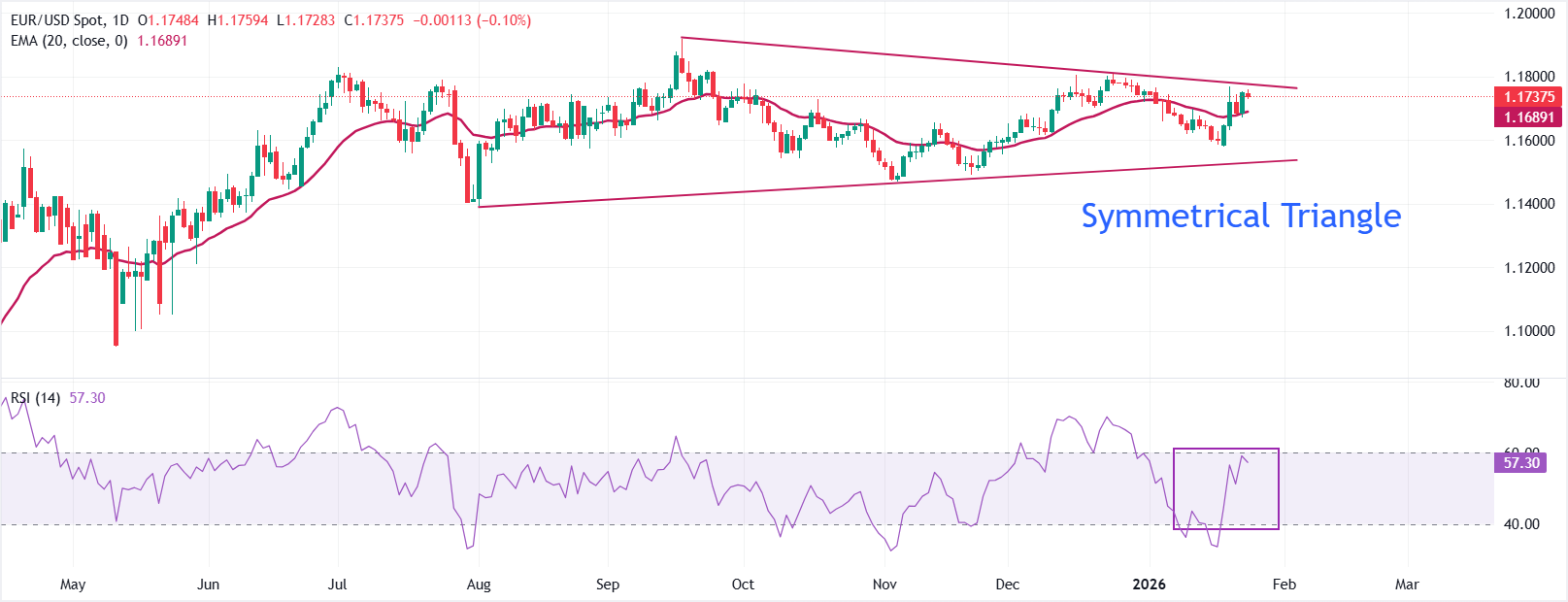
GBP/USD posts a fresh two-week high near 1.3535 at the time of writing on Friday. The 20-day Exponential Moving Average (EMA) at 1.3443 edges higher, and price holds above it, maintaining a topside bias.
The 14-day Relative Strength Index (RSI) at 61 sits above the 50 midline, confirming firm bullish momentum without overbought conditions.
Measured from the 1.3793 high in July to the 1.3009 low in November, the price trades above the 61.8% Fibonacci retracement at 1.3494. A daily close above would open a path toward the 78.6% retracement at 1.3625.
The short-term structure remains bullish while the 20-day EMA continues to rise and price trades above it. A pullback slipping below this average would reduce upside traction and shift focus to consolidation.
(The technical analysis of this story was written with the help of an AI tool.)
Fed FAQs
Monetary policy in the US is shaped by the Federal Reserve (Fed). The Fed has two mandates: to achieve price stability and foster full employment. Its primary tool to achieve these goals is by adjusting interest rates. When prices are rising too quickly and inflation is above the Fed’s 2% target, it raises interest rates, increasing borrowing costs throughout the economy. This results in a stronger US Dollar (USD) as it makes the US a more attractive place for international investors to park their money. When inflation falls below 2% or the Unemployment Rate is too high, the Fed may lower interest rates to encourage borrowing, which weighs on the Greenback.
The Federal Reserve (Fed) holds eight policy meetings a year, where the Federal Open Market Committee (FOMC) assesses economic conditions and makes monetary policy decisions. The FOMC is attended by twelve Fed officials – the seven members of the Board of Governors, the president of the Federal Reserve Bank of New York, and four of the remaining eleven regional Reserve Bank presidents, who serve one-year terms on a rotating basis.
In extreme situations, the Federal Reserve may resort to a policy named Quantitative Easing (QE). QE is the process by which the Fed substantially increases the flow of credit in a stuck financial system. It is a non-standard policy measure used during crises or when inflation is extremely low. It was the Fed’s weapon of choice during the Great Financial Crisis in 2008. It involves the Fed printing more Dollars and using them to buy high grade bonds from financial institutions. QE usually weakens the US Dollar.
Quantitative tightening (QT) is the reverse process of QE, whereby the Federal Reserve stops buying bonds from financial institutions and does not reinvest the principal from the bonds it holds maturing, to purchase new bonds. It is usually positive for the value of the US Dollar.
Author

Sagar Dua
FXStreet
Sagar Dua is associated with the financial markets from his college days. Along with pursuing post-graduation in Commerce in 2014, he started his markets training with chart analysis.

















