Gold Weekly Forecast: Geopolitics, Fed policy decision to influence XAU/USD action
- Gold advanced toward $5,000 and set a new record-high.
- The Federal Reserve will conduct the first policy meeting of the year.
- XAU/USD remains technically overbought following the last leg higher.
Gold (XAU/USD) started the week on a strong footing and gathered bullish momentum, reaching a new record-high of $4,967 in the Asian session on Friday. XAU/USD’s volatility is likely to remain high in the short term, with investors keeping a close eye on geopolitics and the Federal Reserve’s (Fed) monetary policy decisions.
Gold ignores easing EU-US tensions, advances toward $5,000
United States (US) President Donald Trump said over the weekend that he will impose a 10% tariff from February 1st, and lift it to 25% by June, on all goods from Denmark, Sweden, France, Germany, the Netherlands, Finland, Britain and Norway, which oppose his plan to acquire Greenland. Citing EU diplomats, Reuters reported that EU ambassadors reached a broad agreement to retaliate with a tariff package on 93 billion Euros of US imports. Growing concerns over a revival of a trade war between the EU and the US caused investors to adopt a cautious stance, allowing Gold to benefit from safe-haven flows early Monday.
Following a long weekend, financial markets opened on Tuesday, and Wall Street’s main indexes suffered heavy losses as investors reacted to escalating EU-US tensions. In turn, Gold extended its rally and gained nearly 2% on Tuesday.
After pushing higher in the first half of the day on Wednesday, Gold erased a portion of its daily gains in the American session as risk flows returned to markets. US President Trump backed away from his tariff threat, explaining in a social media post that he agreed with European leaders on "the framework of a future deal with respect to Greenland" and added that Washington will not be imposing tariffs on eight European nations.
Nevertheless, the selling pressure surrounding the US Dollar (USD) allowed XAU/USD to extend its rally in the second half of the week, despite the improving risk mood. Investors refrained from betting on a persistent USD recovery ahead of the upcoming Fed meeting and the uncertainty surrounding the nomination of the next Fed chair.
Early Friday, Gold advanced to a new record-high of $4,967 as markets reacted to a potential military conflict between the US and Iran. US President Trump said late Thursday that the US has an "armada" heading toward Iran, but added that hopefully he will not have to use it. Reuters reported that USS Abraham Lincoln and several guided-missile destroyers were expected to arrive in the Middle East in the coming days. Profit-taking and broad USD resilience capped Gold's upside and the precious metal erased some of its daily gains before settling above $4,900.
Gold traders to focus on Fed, geopolitics
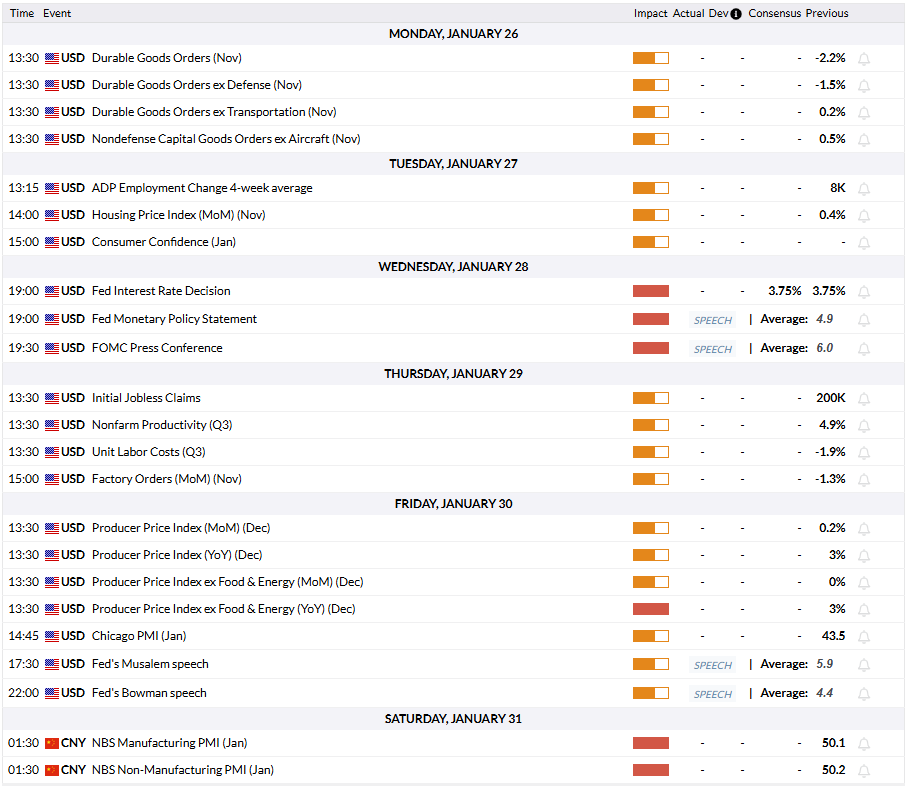
The economic calendar will offer some mid-tier data releases in the first half of the week, including the US November Durable Goods Orders and January Consumer Confidence Index. However, investors are likely to ignore these figures and stay on the sidelines until the Fed announces its monetary policy decision in the American session on Wednesday.
The US central bank is widely anticipated to leave the policy rate unchanged at the range of 3.5%-3.75%. Hence, investors will scrutinize comments from Fed Chair Jerome Powell in the post-meeting press conference.
According to the CME FedWatch Tool, markets are currently pricing in about a 15% probability of a 25-basis-points (bps) rate cut at the next meeting in March. In case Powell adopts an optimistic tone about the inflation outlook and notes that they will need to support the labor market, investors could see this as a dovish sign and trigger another leg lower in the USD, helping XAU/USD push higher. Conversely, Gold could edge down if Powell notes that the central bank is not as concerned about the labor market as it was at the end of 2025, and that there are still upside risks to inflation. Investors could remain convinced of another policy hold in March, which would open the door for a steady recovery in the USD.
In the meantime, a further escalation of tensions in the Middle East, with the US military taking action against Iran, could allow Gold to continue to benefit from safe-haven flows.
Investors will also pay close attention to headlines over the nomination of the next Fed chair. US Treasury Secretary Scott Bessent said recently that Trump could reach a decision by the end of the month. The US president also told CNBC that he would prefer to keep White House economic adviser Kevin Hassett in his current position. BlackRock's chief bond investment manager, Rick Rieder, Fed Governor Christopher Waller and former Fed Governor Kevin Warsh are reportedly among the potential candidates. Powell’s term as head of the American central bank ends in May, but his term on the Fed runs through 2028. He is likely to be asked whether he intends to finish out his term. It’s difficult to foresee a potential market reaction on this, but if Powell suggests his retirement will be sooner rather than later, and Trump names either Waller or Warsh as the next Fed chair, markets could lean toward a more dovish policy outlook, hurting the USD.
On the other hand, Rieder is widely seen as someone who would be less influenced by politics. Although that doesn’t mean he wouldn’t embrace a dovish stance, he is a market person after all, and his pick could at least ease market concerns over the Fed losing its independence. In this scenario, the USD could stage a rebound in the near term.
Gold technical analysis
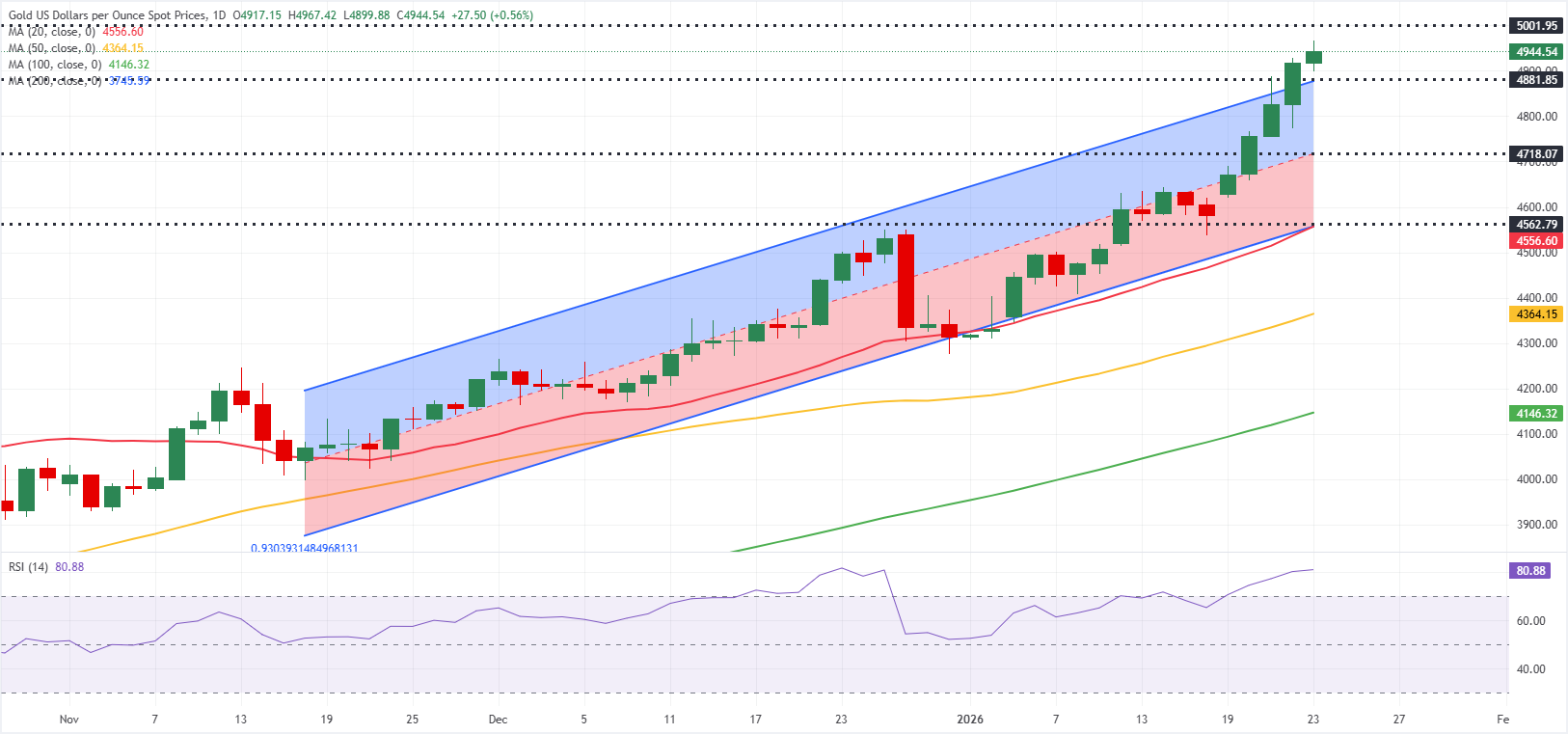
The Relative Strength Index (RSI) indicator on the daily chart climbed to 80 and Gold broke above the upper limit of the two-month-old ascending regression channel, pointing to extremely overbought conditions.
Hence, there could be a technical correction before the uptrend continues. On the downside, $4,880 (upper limit of the ascending channel) aligns as the first support level before $4,800 (round level) and $4,720 (mid-point of the ascending channel).
On the upside, $4,967 (record-high) could be seen as an interim resistance level before $5,000 (round level). If Gold breaks above this latter hurdle, investors could see round levels, such as $5,100, $5,200 and $5,300 as profit-taking targets.
Gold FAQs
Gold has played a key role in human’s history as it has been widely used as a store of value and medium of exchange. Currently, apart from its shine and usage for jewelry, the precious metal is widely seen as a safe-haven asset, meaning that it is considered a good investment during turbulent times. Gold is also widely seen as a hedge against inflation and against depreciating currencies as it doesn’t rely on any specific issuer or government.
Central banks are the biggest Gold holders. In their aim to support their currencies in turbulent times, central banks tend to diversify their reserves and buy Gold to improve the perceived strength of the economy and the currency. High Gold reserves can be a source of trust for a country’s solvency. Central banks added 1,136 tonnes of Gold worth around $70 billion to their reserves in 2022, according to data from the World Gold Council. This is the highest yearly purchase since records began. Central banks from emerging economies such as China, India and Turkey are quickly increasing their Gold reserves.
Gold has an inverse correlation with the US Dollar and US Treasuries, which are both major reserve and safe-haven assets. When the Dollar depreciates, Gold tends to rise, enabling investors and central banks to diversify their assets in turbulent times. Gold is also inversely correlated with risk assets. A rally in the stock market tends to weaken Gold price, while sell-offs in riskier markets tend to favor the precious metal.
The price can move due to a wide range of factors. Geopolitical instability or fears of a deep recession can quickly make Gold price escalate due to its safe-haven status. As a yield-less asset, Gold tends to rise with lower interest rates, while higher cost of money usually weighs down on the yellow metal. Still, most moves depend on how the US Dollar (USD) behaves as the asset is priced in dollars (XAU/USD). A strong Dollar tends to keep the price of Gold controlled, whereas a weaker Dollar is likely to push Gold prices up.
Author

Eren Sengezer
FXStreet
As an economist at heart, Eren Sengezer specializes in the assessment of the short-term and long-term impacts of macroeconomic data, central bank policies and political developments on financial assets.