US Dollar Weekly Forecast: Rally faces next test as inflation retakes centre stage
- The US Dollar further extended its ongoing bull run this week.
- Hawkish Fedspeak and geopolitics propped up the Greenback.
- Next on tap on the domestic calendar are the FOMC Minutes.

The week that was
The US Dollar’s (USD) rally remained everything but abated, climbing for the third consecutive week and reaching levels last seen in April 2025. The move higher came on the back of a mixed performance in US Treasury yields, extending their rally in the belly and long end of the curve while losing some momentum at the short end.
Geopolitics also had its say after the resurgence of tensions in the US-Iran-Hormuz conflict. This situation, coupled with the inaction of the White House and the apparent utter lack of willingness from every party involved to put this crisis to an end, seems to have reignited fresh demand for the safe haven universe, eventually adding extra legs to the buck’s move.
Meanwhile, there was no change in the bias from Federal Reserve (Fed) officials, as almost all of them advocated for a tighter monetary policy stance, in contrast to the “patience” favoured by New York Fed’s John Williams. That patience would desperately need the Middle East effervescence to finish, and it remains to be seen whether the lagged effects of recent hikes will deliver on consumer prices and expectations in a timely manner. Patience, in my humble opinion, remains a luxury most can't afford.
Against this backdrop, the US Dollar Index (DXY) has managed to surpass the 102.00 barrier to hit new 17-month peaks, gaining more than 3% in September.
Jobs keep simmering on the back burner
The strong upside impulse in the US Dollar appears to have been dented by disheartening prints from the latest Nonfarm Payrolls, showing that the economy added a meagre 29K jobs last month, while the previous print was revised down to 133K (from 162K). Of note, however, was the uptick in the jobless rate to 4.2% (from 4.1%).
No one was pencilling in another rate hike at the Fed’s October meeting before the jobs data release, and no one is thinking otherwise following NFP. Meanwhile, it is still widely anticipated the Fed will hike by a quarter percentage point in December, a move coincident with investors’ expectations of 27 basis points of tightening by year-end.
Once again, the move is based not on the labour market but exclusively on inflation.
Fed officials keep the tightening bias alive
Fed officials used the week after September’s rate hike to reinforce the case for further policy adjustment. Inflation remains too high and is showing signs of broadening, while energy prices, Middle East tensions, tariffs and AI-related demand continue to create upside risks.
Christopher Waller (Board of Governors) said another hike was likely if the economy performed as expected, while his peer Michael Barr said further adjustments would probably be needed. Lorie Logan (Dallas) went further, arguing that rates may need to rise by an additional 50 basis points or more because policy is not yet sufficiently restrictive.
The message was not entirely uniform on timing. John Williams (New York) saw no need for urgency and said more data were needed, although he still considered one further increase this year likely. Neel Kashkari (Minneapolis) has pencilled in another hike in 2026 and one more in 2027 but questioned whether the neutral rate is higher than previously thought. Vice Chair Philip Jefferson (Board of Governors) also favoured taking more time before the next move, while stressing that the Fed must prevent inflation from becoming entrenched. Alberto Musalem’s (St. Louis) preference was for earlier, incremental tightening rather than waiting and risking larger increases later.
The common ground is that the economy remains resilient, demand is firm and the labour market is broadly healthy, giving the Fed room to focus on price stability. AI is adding both inflationary demand and potential future productivity gains, while officials remain alert to the risk that repeated supply shocks could lift expectations.
Overall, the tone was hawkish, but the likely path remains gradual and data-dependent: further hikes are increasingly probable, though higher bond yields and a possible rise in the neutral rate could influence how much additional tightening is ultimately required.
Dollar longs continue to fade
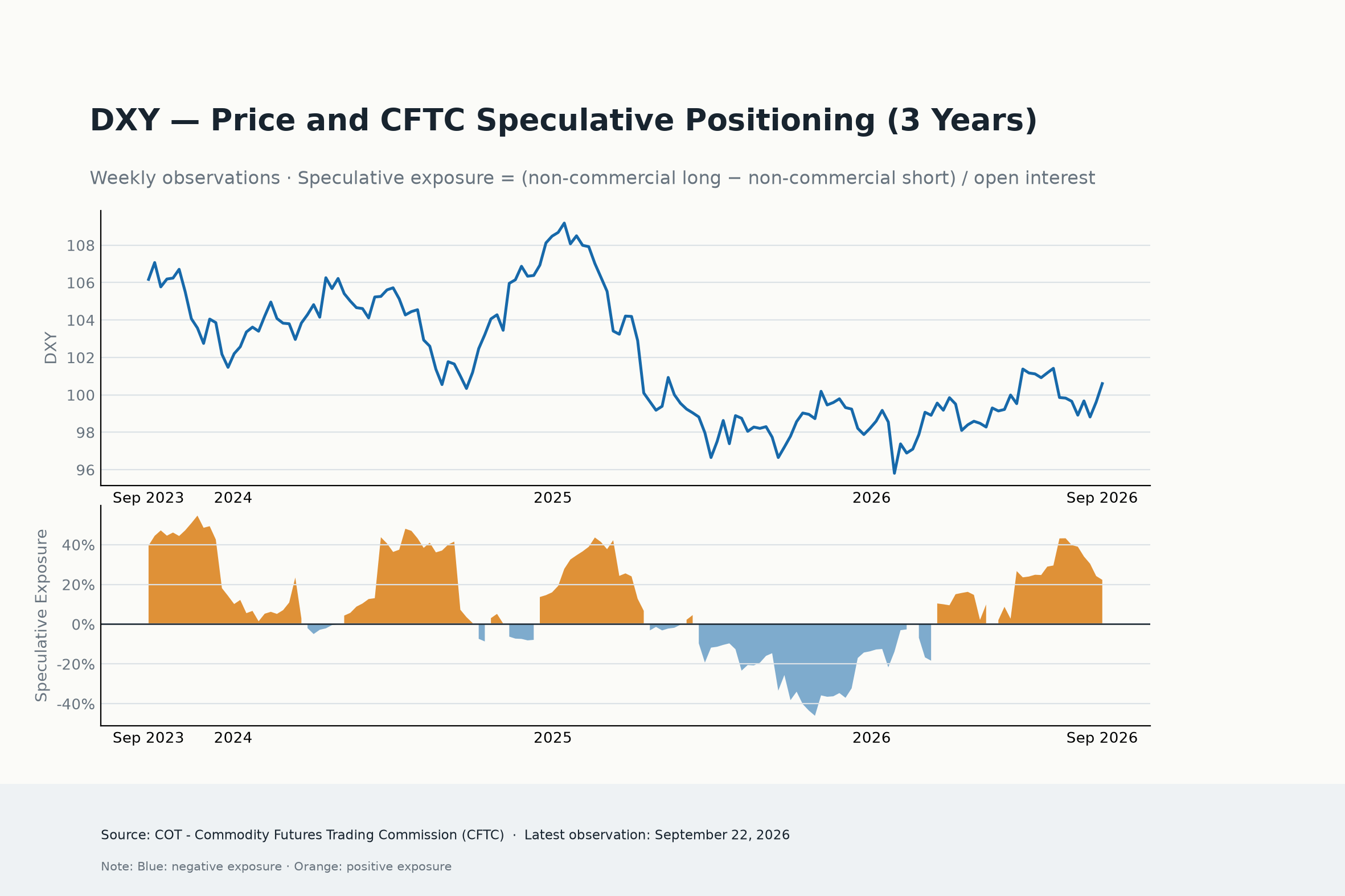
Commodity Futures Trading Commission (CFTC) data released this week suggest speculative positioning in the US Dollar has been broadly stable, with investors making only marginal adjustments after several weeks of trimming bullish exposure. The latest report suggests that rather than a change in sentiment, the market is waiting for fresh macro catalysts after the major central bank decisions in September.
That said, non-commercial players were largely absent in the latest reporting period following a steady reduction of bullish bets over the course of several weeks, with net long positioning slipping marginally to around 10.3K contracts.
The small tweak indicates investors are no longer rushing to unwind Dollar longs but are instead adopting a more neutral position as markets digest the latest developments from the Fed and other key central banks.
Bullish bias continues to fade
Although speculative positioning remains positive, it has become noticeably less constructive over the past month.
Speculative exposure edged down to 22.3%, extending its gradual decline from recent highs. The Speculative Exposure Percentile is 42.9, and the Net Position Percentile is 44.8, showing that current Dollar positioning is not especially bullish or bearish from a historical perspective.
This represents a sharp contrast to earlier in the year, when investors held considerably stronger bullish convictions toward the buck.
Macro narrative remains balanced
The positioning data fit well with the broader macro backdrop.
Both the Fed and the Bank of Japan (BoJ) raised interest rates by 25 basis points during the reporting week, while US economic data continued to highlight the resilience of the domestic economy. At the same time, Treasury yields paused their recent advance, and oil prices retreated as hopes for a diplomatic solution to the Middle East conflict eased concerns over another inflation shock.
Those crosscurrents gave investors little reason to aggressively rebuild Dollar longs or significantly increase bearish bets, leaving speculative positioning little changed.
Momentum still points lower
While this week's report showed little change, the broader trend continues to point toward a gradual reduction in Dollar optimism.
The 4-week change continues to suggest that speculators have trimmed their long Dollar exposure over the past month. Although the pace of selling has slowed considerably, positioning has yet to show signs of a sustained recovery.
Overall
The latest CFTC report suggests that speculative traders have paused their reassessment of the US Dollar rather than reversed it.
Positioning remained remarkably stable despite a busy week for central banks, with both speculative exposure and historical percentiles pointing to a largely neutral market.
For now, traders appear content to wait for the next major catalyst, whether it comes from incoming US inflation and labour market data, shifts in Treasury yields, or further guidance from the Fed, before taking a stronger directional view on the USD.
What’s next for the US Dollar
Next week won't be significant data-wise, although it will be interesting to closely follow the behind-the-scenes of the Fed meeting in September with the release of the FOMC Minutes. In addition, the ISM Services PMI and the advanced U-Mich Consumer Sentiment data should get some attention.
As usual, comments from Fed officials will be worth monitoring.
Bottom line
The US Dollar enters the new week in a position of strength, supported by a still-hawkish Fed, elevated geopolitical uncertainty and resilient Treasury yields.
However, speculative positioning is broadly neutral, and the labour market is showing tentative signs of cooling, making it unlikely that the next leg higher will come from positioning alone.
Instead, inflation data and any evidence that price pressures remain stubborn enough to justify another Fed hike in December will probably determine whether the US Dollar can extend its rally beyond current multi-month highs or whether the recent rally starts to lose momentum.
Ultimately, the Dollar's outlook is no longer being shaped primarily by employment data but by the evolution of inflation. As long as price pressures remain inconsistent with the Fed's 2% objective, policymakers are likely to keep the door open to additional tightening, preserving the Greenback's relative advantage even if the labour market continues to cool gradually.
Employment FAQs
Labor market conditions are a key element to assess the health of an economy and thus a key driver for currency valuation. High employment, or low unemployment, has positive implications for consumer spending and thus economic growth, boosting the value of the local currency. Moreover, a very tight labor market – a situation in which there is a shortage of workers to fill open positions – can also have implications on inflation levels and thus monetary policy as low labor supply and high demand leads to higher wages.
The pace at which salaries are growing in an economy is key for policymakers. High wage growth means that households have more money to spend, usually leading to price increases in consumer goods. In contrast to more volatile sources of inflation such as energy prices, wage growth is seen as a key component of underlying and persisting inflation as salary increases are unlikely to be undone. Central banks around the world pay close attention to wage growth data when deciding on monetary policy.
The weight that each central bank assigns to labor market conditions depends on its objectives. Some central banks explicitly have mandates related to the labor market beyond controlling inflation levels. The US Federal Reserve (Fed), for example, has the dual mandate of promoting maximum employment and stable prices. Meanwhile, the European Central Bank’s (ECB) sole mandate is to keep inflation under control. Still, and despite whatever mandates they have, labor market conditions are an important factor for policymakers given its significance as a gauge of the health of the economy and their direct relationship to inflation.
Author

Pablo Piovano
FXStreet
Born and bred in Argentina, Pablo has been carrying on with his passion for FX markets and trading since his first college years.

















