The Euro is near a one-year low: Inflation could trigger its rebound, not its fall

EUR/USD has fallen to its lowest level since May 2025, but a fresh inflation shock in the Eurozone could give the Euro (EUR) an unexpected lifeline. The pair hit 1.1312 on Wednesday and trades well below the January peak of 1.2082. The decline reflects a powerful combination of US Dollar (USD) strength, geopolitical uncertainty and renewed concerns about Europe's exposure to higher energy prices.
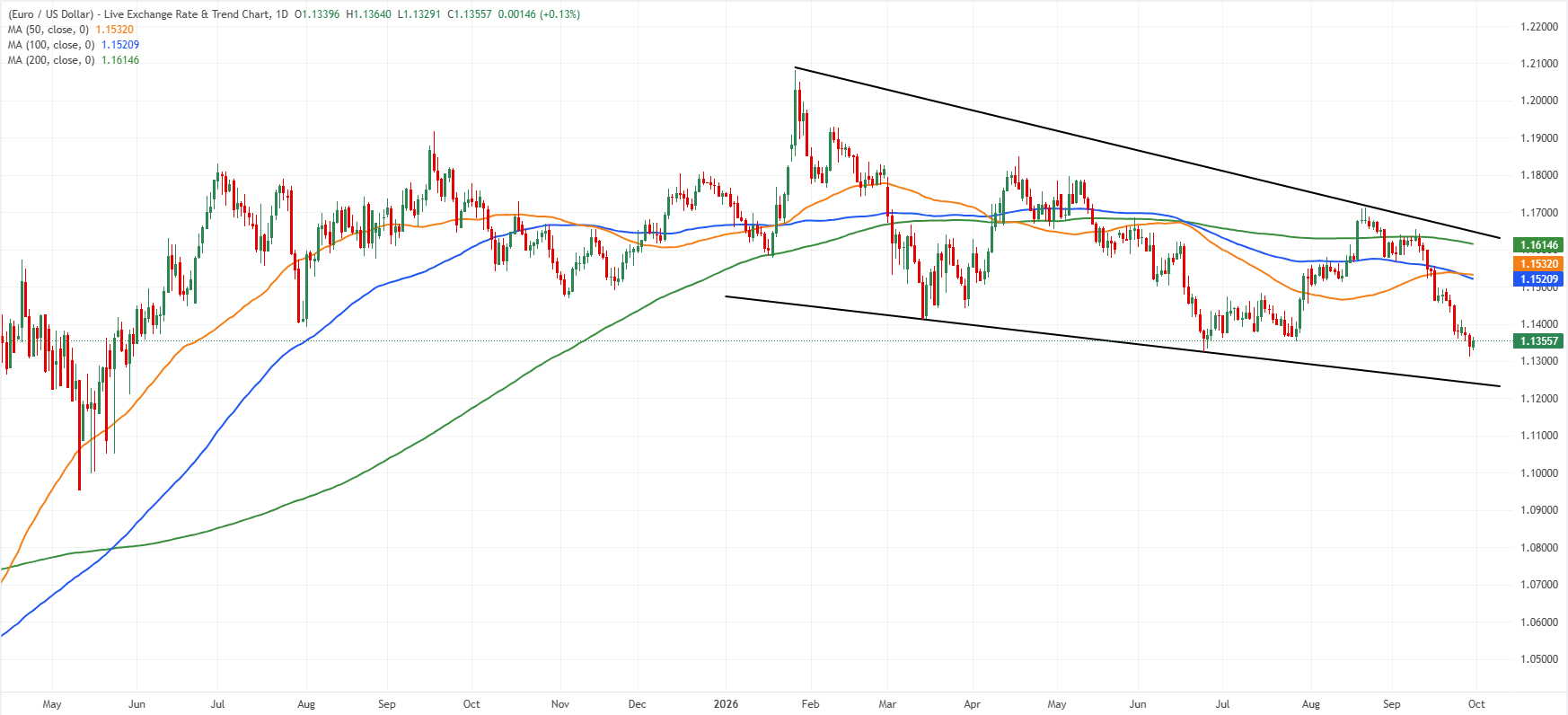
But one of the biggest threats facing the European economy could paradoxically support its currency. Inflation is accelerating again across the Eurozone. Preliminary September data from Spain, France, Italy and Germany have broadly surprised to the upside, strengthening evidence that price pressures are accelerating again across the Eurozone. If Friday's Eurozone figures confirm that trend, investors may have to reconsider how far the European Central Bank (ECB) is prepared to go in its fight against inflation.
After raising its Deposit Facility Rate by 25 basis points in June and another 25 basis points in September, taking it to 2.50%, the ECB faces an uncomfortable choice: tolerate another inflation surge or tighten monetary policy further despite an already fragile economy.
For the Euro (EUR), that choice could prove crucial.
European inflation is becoming a serious problem again
The latest national inflation figures point in the same direction. Spain's preliminary Harmonized Index of Consumer Prices (HICP) inflation rose to 5% YoY in September from 4.6% in August. France's HICP inflation accelerated much more sharply than expected, rising to 3.4% from 2.6%, versus expectations of 3%. Italy's inflation rate climbed to 4.1% from 3.2%, also exceeding the 3.8% consensus. In Germany, preliminary HICP rose to 3.3% from 2.9%, exceeding market expectations of 3.1%.
The next major test comes with Friday's Eurozone inflation report. Headline HICP inflation is expected to rise to 3.6% in September from 3.2% in August, while core inflation is forecast to edge up to 2.5% from 2.4%. That would leave inflation moving further away from the ECB's 2% target.
JPMorgan economist Mariana Monteiro, cited by Reuters, noted that energy inflation has surprised to the upside across the countries that have already published September data, while food inflation has also been modestly stronger than expected.
The problem is that the energy shock may not disappear quickly. The war involving Iran and the continuing Russia-Ukraine conflict have increased uncertainty surrounding global energy supplies, while Europe remains particularly exposed to fluctuations in Oil and Natural Gas prices.
ECB President Christine Lagarde has acknowledged that the energy shock could prove more persistent than initially expected, with continued volatility putting upward pressure on prices while simultaneously weighing on economic growth.
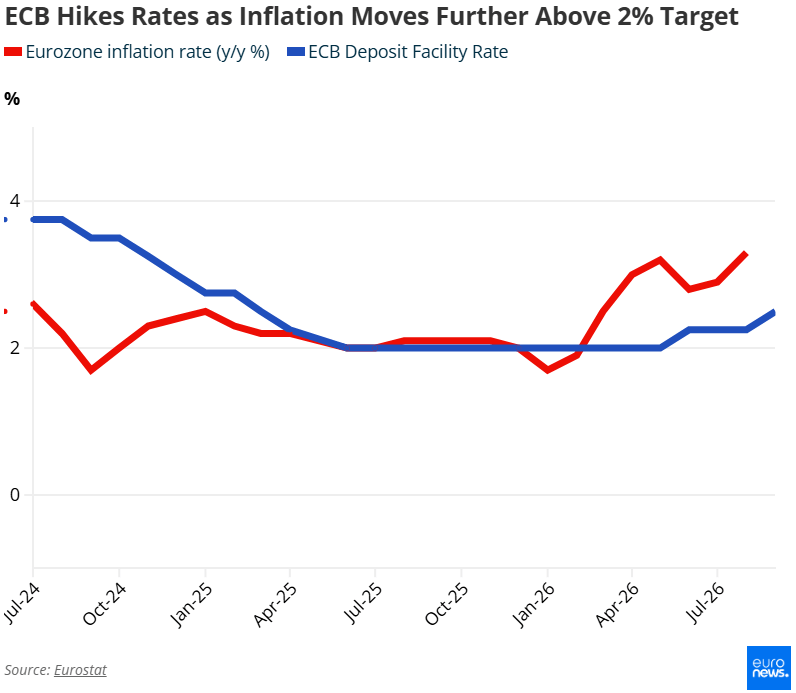
October or December: How far is the ECB prepared to go?
The debate is no longer simply about whether inflation is above target. It is about whether the ECB needs to raise rates again to prevent the latest energy shock from spreading through the broader economy. Markets still lean toward patience.
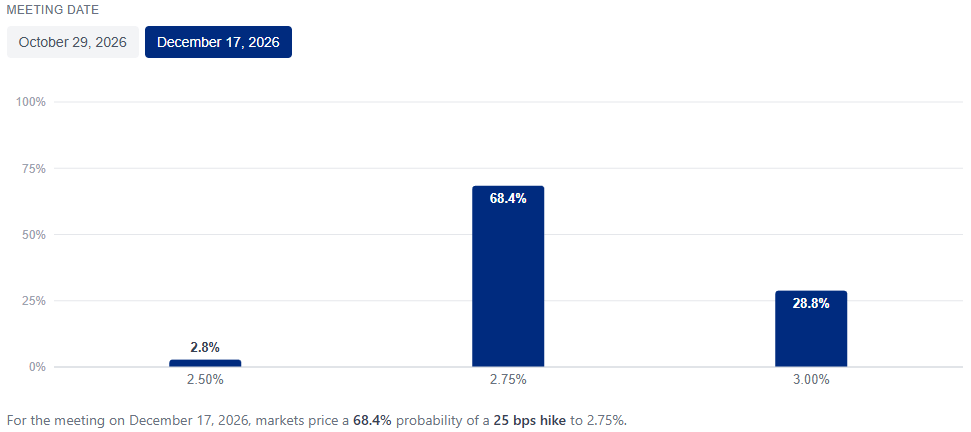
The ECB Watch tool currently assigns a 70% chance that policymakers will leave rates unchanged at the October 29 meeting, implying around a 30% chance of another hike. By the December 17 meeting, however, markets price a 68.4% chance of a 25-basis-point increase that would take the Deposit Facility Rate to 2.75%.
Recent comments from ECB officials explain why that probability is rising. ECB policymaker Alexander DeMarco said stronger core inflation could provide grounds for further action and did not exclude an October hike. Bundesbank President and ECB Governing Council member Joachim Nagel said it is too early to speculate about the next meeting but acknowledged that rates may eventually need to move into mildly restrictive territory depending on how energy prices evolve.
National Bank of Slovakia Governor and ECB Governing Council member Peter Kazimir was more explicit, warning that rising gas and electricity prices are becoming increasingly concerning and arguing that another rate increase may ultimately be unavoidable.
ECB Executive Board member Isabel Schnabel has also described energy-price developments as “quite concerning,” highlighting not only Oil but also diesel prices and refining-capacity constraints.
The more cautious argument comes from Lagarde herself. “We see higher inflation ahead but no signs yet that it is becoming embedded,” Lagarde said, emphasizing that the ECB has not yet observed convincing evidence of higher energy prices feeding into wages.
That distinction is critical. An energy shock alone does not necessarily justify aggressive monetary tightening. But if higher energy costs begin affecting wages, services and broader price-setting behavior, the ECB's response could become significantly more forceful.
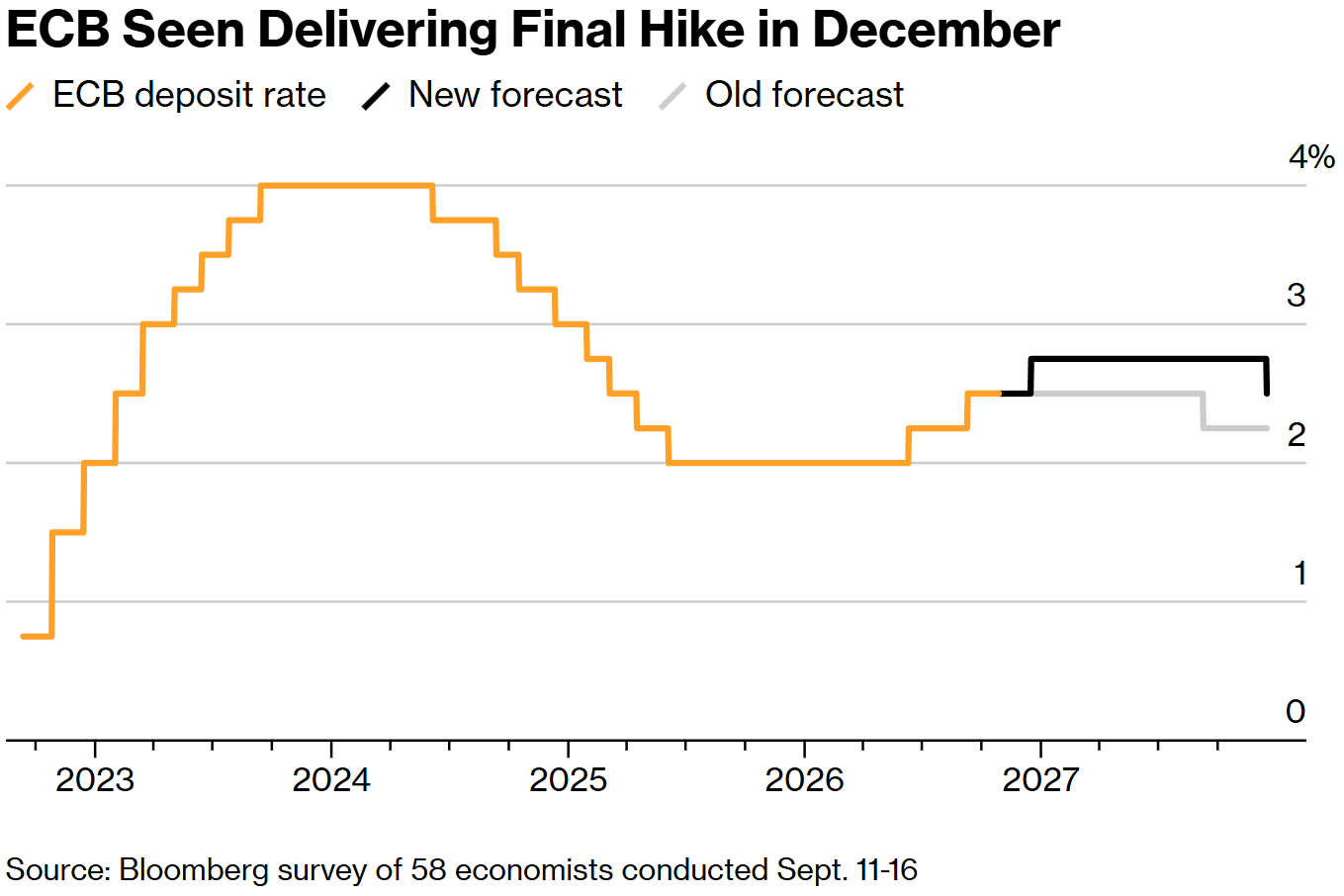
Recent market analysis points to a similar split. A Bloomberg survey of 58 economists conducted between September 11 and September 16 points toward a pause in October followed by a final 25-basis-point increase in December.
The problem: The ECB is fighting a supply shock with a fragile economy
The ECB's dilemma is particularly difficult because today's inflation is not being driven primarily by booming domestic demand. Energy is at the center of the shock. Higher Oil and Natural Gas prices increase production, transportation and electricity costs throughout the economy. Monetary policy cannot produce more energy or resolve geopolitical supply disruptions. Higher interest rates can only limit the risk that the initial price shock spreads into wages and other prices. That comes at a cost.
Germany remains highly sensitive to energy prices because of the importance of its industrial and manufacturing sectors. Higher input costs threaten margins, investment and competitiveness just as the economy is trying to regain momentum.
France faces a different vulnerability. Elevated borrowing costs and fiscal uncertainty have pushed long-term sovereign yields higher, tightening financial conditions independently of the ECB. The Bank of France has warned that the country cannot rely on the central bank to resolve its public-debt challenges. Lagarde has also stressed that higher long-term yields already slow economic activity and tighten financial conditions across the Eurozone. This is why the ECB cannot simply respond to every increase in headline inflation with higher rates.
Goldman Sachs expects Eurozone headline inflation to peak around 3.8% in the fourth quarter, while core inflation could reach roughly 2.7% in early 2027. At the same time, the bank expects only moderate economic growth, reinforcing the tension between inflation control and economic resilience.
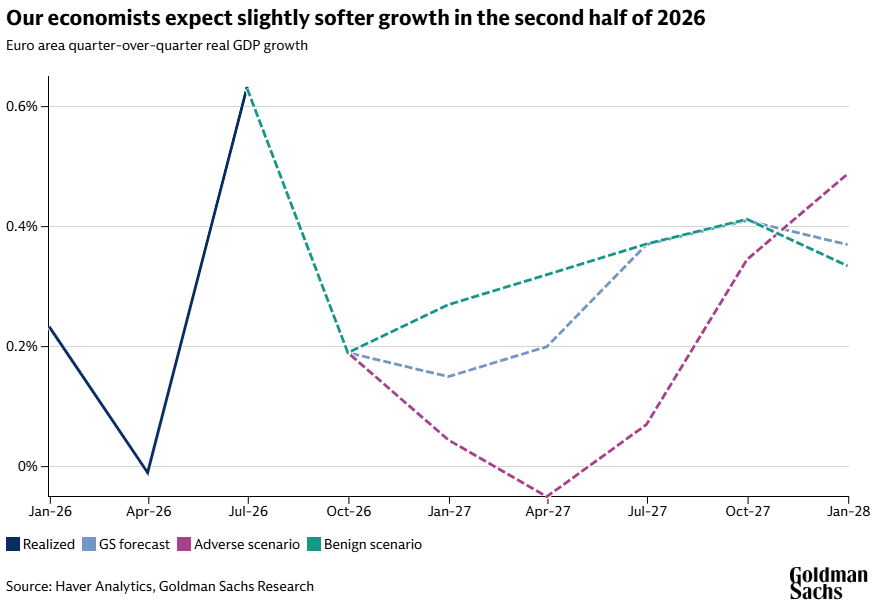
Why stronger inflation could eventually help the Euro
For households and companies, higher inflation is clearly not positive. For the currency market, however, the transmission mechanism is different. Currencies respond strongly to relative interest-rate expectations.
If investors become convinced that the ECB needs to raise rates again, or keep them higher for longer, Eurozone short-term yields can rise relative to their US counterparts. That makes Euro-denominated assets comparatively more attractive and can provide support to the single currency.
This mechanism is already visible in market pricing. Scotiabank notes that increasingly hawkish ECB commentary is intensifying alongside higher energy prices. MUFG argues that stronger expectations for ECB tightening have already offset part of the hawkish repricing surrounding the US Federal Reserve (Fed). ING strategist Francesco Pesole also describes the ECB's recent rhetoric as broadly hawkish, noting that the dovish camp currently appears relatively weak.
In other words, the same inflation shock that damages European growth could eventually make it harder for EUR/USD to continue falling if it forces investors to price a more restrictive ECB path. But there is an important limitation: markets already expect additional tightening.
Commerzbank strategist Michael Pfister argues that a substantial amount of further ECB tightening is already priced in. If policymakers fail to deliver what investors expect, the Euro could struggle to benefit even if inflation remains elevated.
That makes the difference between October and December particularly important. An October hike would represent a stronger-than-currently-expected policy response. A December move, by contrast, is already much closer to the market's base case.
The US Dollar remains the other half of the EUR/USD equation
Even a more hawkish ECB cannot determine EUR/USD alone. The US Dollar has strengthened as investors seek safety amid geopolitical uncertainty, while the Federal Reserve remains relatively hawkish.
ING argues that the latest EUR/USD decline appears largely Dollar-driven. The bank warns that stronger US economic data combined with expectations for an October Fed hike could expose the pair to additional downside, potentially toward 1.10.
Deutsche Bank takes a more cautious view on chasing the US Dollar higher. With EUR/USD near the bottom of its broad 1.13-1.20 yearly range, the bank argues that Fed terminal-rate expectations and much of the geopolitical energy premium are already reflected in market pricing. The bank maintains a year-end EUR/USD forecast of 1.17.
Societe Generale strategist Kit Juckes highlights the central contradiction, arguing that relative interest-rate differentials continue to favor the US Dollar, but the market must also determine whether the Eurozone economy is strong enough to justify the amount of ECB tightening currently priced.
Inflation could put a floor under the Euro, but it cannot guarantee a rebound yet
EUR/USD around 1.1350 leaves the Euro close to its lowest level in 16 months, but the forces behind the decline are becoming increasingly complex. Higher energy prices hurt European growth, worsen the region's external position and increase uncertainty. Those are negative forces for the Euro.
At the same time, persistent inflation reduces the ECB's ability to support the economy through easier monetary policy. If September's Eurozone inflation data exceed expectations and evidence of second-round effects begins to emerge, the probability of another rate hike in October could rise sharply.
That would make the inflation shock a potential source of support for the Euro rather than simply another reason to sell it. For now, however, the ECB appears to favor a measured response. Lagarde continues to emphasize the absence of clear second-round effects, while economists and markets generally see December as a more likely window for another rate increase than October.
The next phase for EUR/USD may therefore depend on which force moves faster: Europe's inflation problem becoming serious enough to force the ECB into more aggressive tightening, or the combination of US Dollar strength, elevated energy prices and weak European growth continuing to dominate the currency pair.
For Euro traders, bad inflation news may no longer be entirely bad news.
Euro FAQs
The Euro is the currency for the 20 European Union countries that belong to the Eurozone. It is the second most heavily traded currency in the world behind the US Dollar. In 2022, it accounted for 31% of all foreign exchange transactions, with an average daily turnover of over $2.2 trillion a day. EUR/USD is the most heavily traded currency pair in the world, accounting for an estimated 30% off all transactions, followed by EUR/JPY (4%), EUR/GBP (3%) and EUR/AUD (2%).
The European Central Bank (ECB) in Frankfurt, Germany, is the reserve bank for the Eurozone. The ECB sets interest rates and manages monetary policy. The ECB’s primary mandate is to maintain price stability, which means either controlling inflation or stimulating growth. Its primary tool is the raising or lowering of interest rates. Relatively high interest rates – or the expectation of higher rates – will usually benefit the Euro and vice versa. The ECB Governing Council makes monetary policy decisions at meetings held eight times a year. Decisions are made by heads of the Eurozone national banks and six permanent members, including the President of the ECB, Christine Lagarde.
Eurozone inflation data, measured by the Harmonized Index of Consumer Prices (HICP), is an important econometric for the Euro. If inflation rises more than expected, especially if above the ECB’s 2% target, it obliges the ECB to raise interest rates to bring it back under control. Relatively high interest rates compared to its counterparts will usually benefit the Euro, as it makes the region more attractive as a place for global investors to park their money.
Data releases gauge the health of the economy and can impact on the Euro. Indicators such as GDP, Manufacturing and Services PMIs, employment, and consumer sentiment surveys can all influence the direction of the single currency. A strong economy is good for the Euro. Not only does it attract more foreign investment but it may encourage the ECB to put up interest rates, which will directly strengthen the Euro. Otherwise, if economic data is weak, the Euro is likely to fall. Economic data for the four largest economies in the euro area (Germany, France, Italy and Spain) are especially significant, as they account for 75% of the Eurozone’s economy.
Another significant data release for the Euro is the Trade Balance. This indicator measures the difference between what a country earns from its exports and what it spends on imports over a given period. If a country produces highly sought after exports then its currency will gain in value purely from the extra demand created from foreign buyers seeking to purchase these goods. Therefore, a positive net Trade Balance strengthens a currency and vice versa for a negative balance.
Author

Ghiles Guezout
FXStreet
Ghiles Guezout is a Market Analyst with a strong background in stock market investments, trading, and cryptocurrencies. He combines fundamental and technical analysis skills to identify market opportunities.















