The 29K jobs number isn't the real story. The downward revisions show the labor market turned months ago

The September jobs report added 29K jobs against a 90K forecast, and the more useful numbers in it are the revisions. Read with the revisions before them, they show the pace of hiring slowing in May, five months before September's headline.
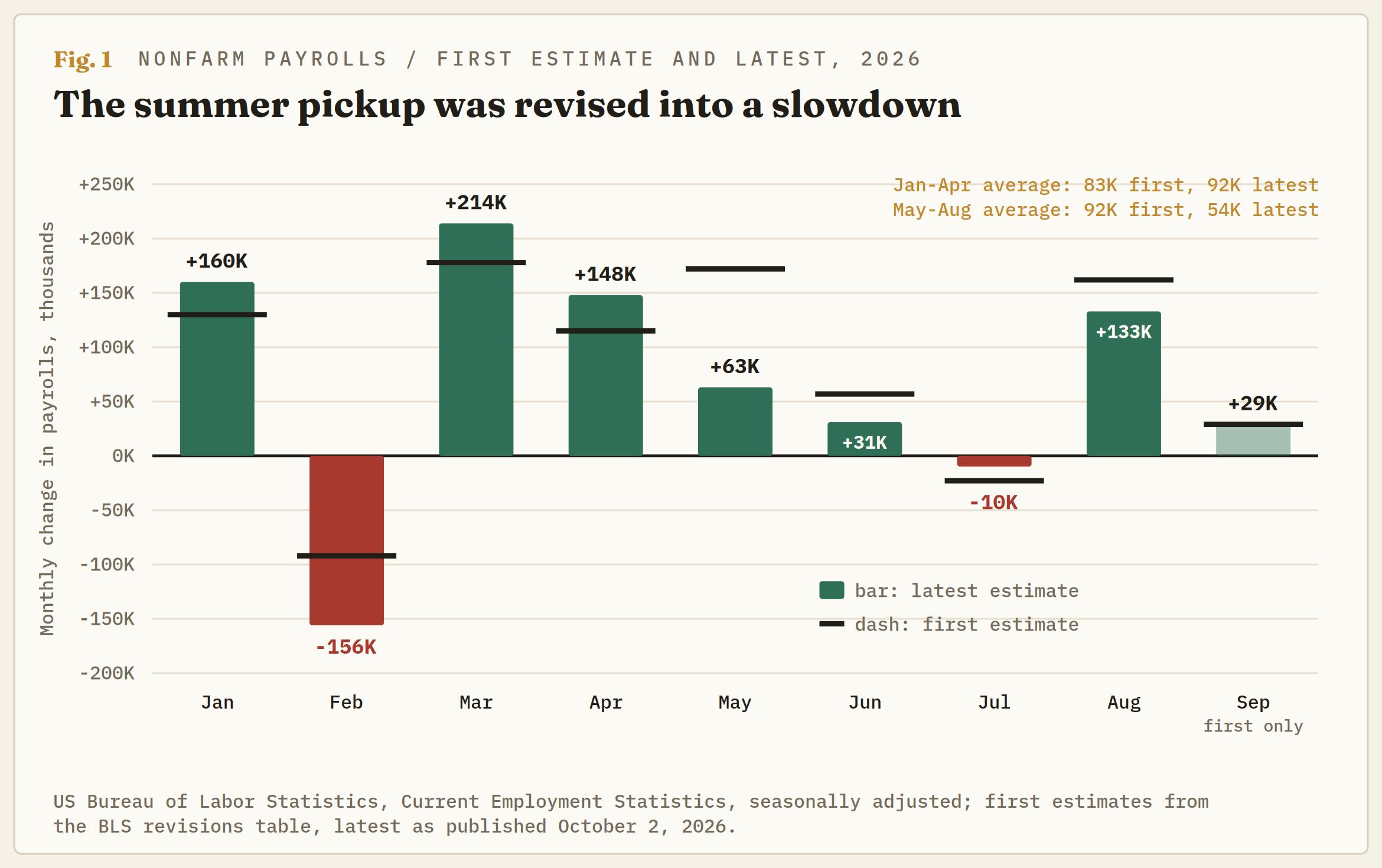
As first reported, Nonfarm Payrolls (NFP) grew by an average of 83K a month from January to April and 92K from May to August. On the current figures, the same stretches show 92K and 54K, so the summer that looked like a pickup was a slowdown. Markets trade the first estimate, and the trend is built from the revisions. Kalshi, an exchange where people bet on numbers like this one, pays out on the figure in the release's first sentence.
May's first estimate missed the turn by 109K
May was first reported as a gain of 172K and now stands at 63K, after two revisions removed 109K. June went from 57K to 31K. The October 2 release cut another 60K from July and August, leaving August at 133K and July at a loss of 10K.
The revisions haven't all pointed down. January, March and April were revised up by a combined 99K. The months from May to August were revised down by a net 151K, which pushed the spring up and the summer down. July is the only summer month revised up, and it went from a loss to a smaller loss.
Revisions that all point down can't date a turn
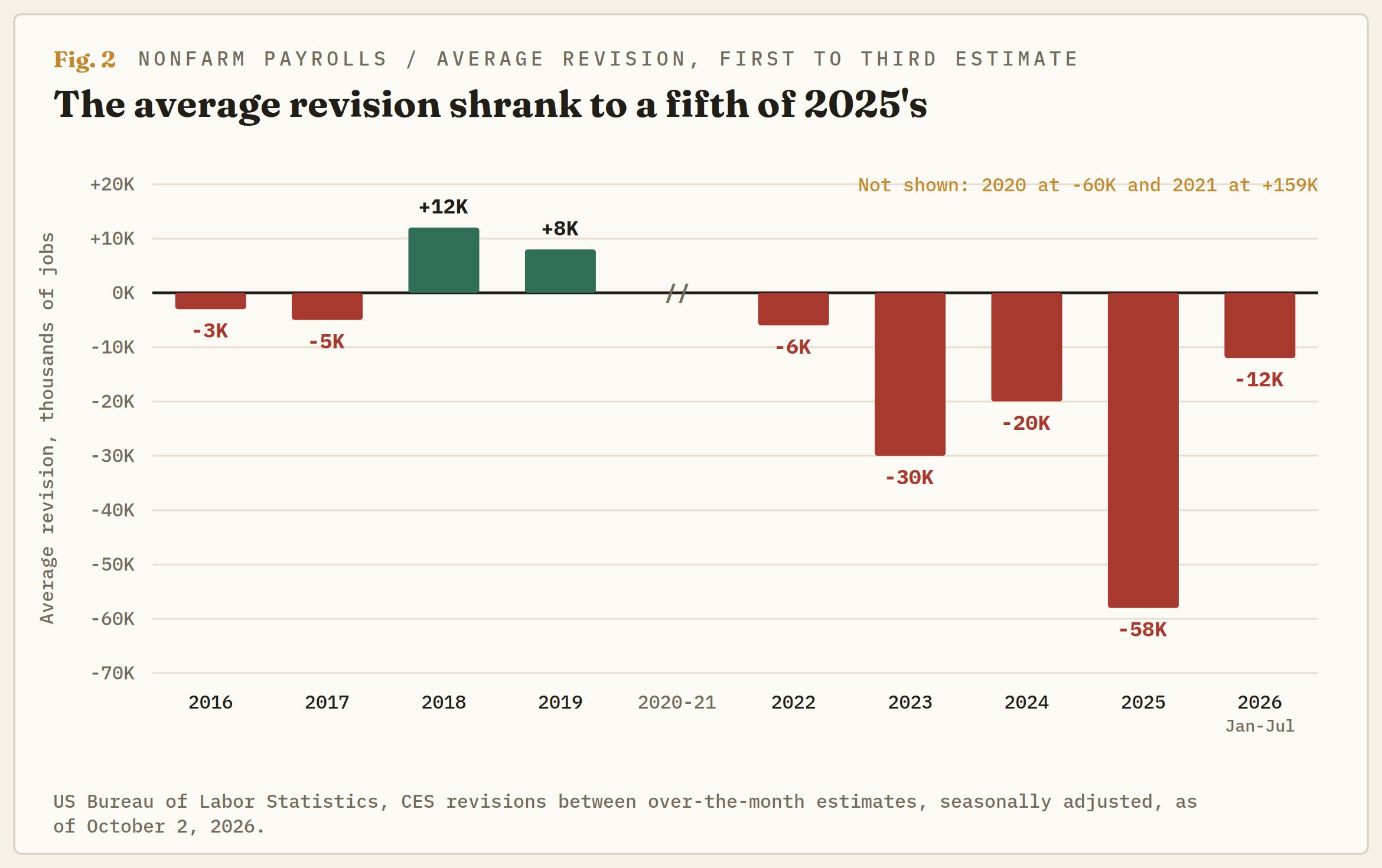
In 2025, every month that got all three estimates was revised down by 58K on average, and the annual benchmark then cut March 2025 employment by 898K. Revisions that all point the same way say the first estimates run high, and nothing about when hiring changed.
Starting with the January estimates, the Bureau of Labor Statistics (BLS) changed the model it uses for jobs at businesses that have just opened or shut down. The model now draws on the latest survey responses as well as past patterns. Since then, the average revision has been -12K, and its direction has depended on the month, which is what lets the revisions date the turn.
The preliminary benchmark for March 2026, published on August 28, came in at -79K, less than a tenth of the year before. Retail was overstated by 155K, and transportation and warehousing were understated by 135K. The total came out nearly right because the industries were wrong in both directions at once. The BLS will apply it in February 2027, spread across the 12 months to March at about 7K a month, which is too little to move the turn.
The 29K is the thinnest estimate of the year
For September, the BLS had 53.1% of the employers that report to it each month in hand, the lowest share of 2026 and the fourth lowest since 2016. The survey counts jobs in the pay period that includes the 12th, and the report came out 20 days after September 12, the shortest gap on the 2026 calendar. June shares that gap and has the second-lowest share, at 54.4%. Both were on the release calendar months before anyone answered the survey.
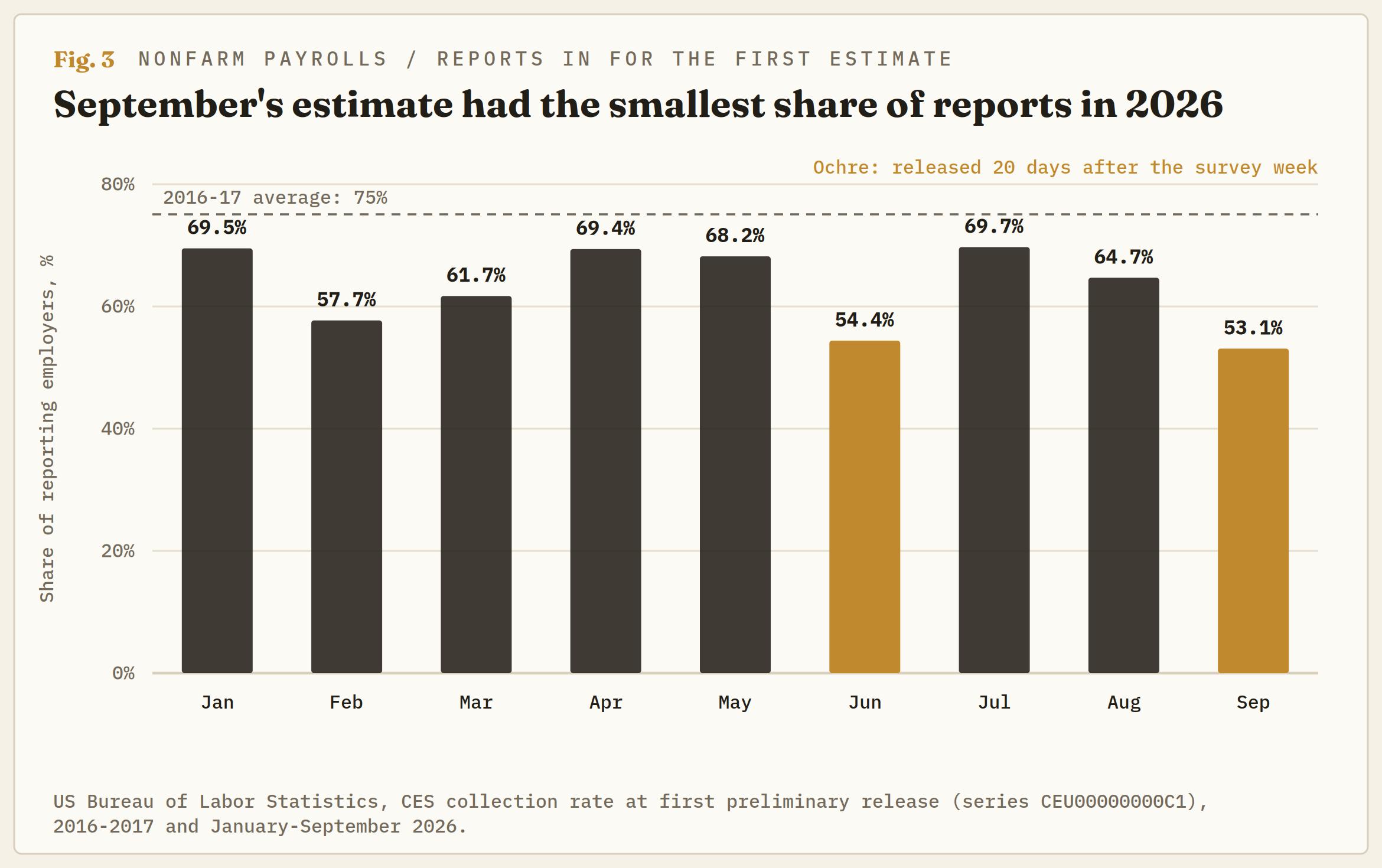
In 2016 and 2017, the first estimate typically had three-quarters of the reports, and in 2026 it has averaged 63%. Since 2016, leaving out 2020 and 2021, months with less than 60% of reports in for the first estimate were revised by 54K on average. Months above 70% were revised by 31K. September's 29K is smaller than the average revision for a month that thin.
One month is now smaller than its own error
In 2019, the average month added about 180K jobs by its third estimate, and the first estimate missed by 34K, about a fifth of the month. In 2026, the miss has averaged 44K, and payrolls grew by 45K a month in the 12 months to August. No single first estimate can settle whether a month added jobs.
The turn doesn't depend on September. A revision of 54K either way would leave May to September averaging between 38K and 60K, against 92K for January to April. At this pace of hiring, the jobs report is a three-month statistic that happens to be published every month.
Undoing the turn would take more than 200K of upward revisions
September will be revised in the November 6 report and again on December 4, when it will rest on roughly nine in ten reports instead of half. August gets its last revision on November 6, and the February 2027 report applies the final benchmark.
The case for a higher September is the calendar. Labor Day fell on September 7, as late as it can, and economists have pointed to a late Labor Day as a drag on the first estimate. Weekly jobless claims are near their lowest since the late 1960s, and ADP, the payroll processor, counted 90K private jobs in September against the BLS's 46K.
The case for a lower one is the record. Since 2016, 13 of the 17 months below 60% at the first estimate were revised down. Most of those came in the years when every revision pointed down, but both of 2026's thin months, February and June, were revised down too.
Neither case brings back the spring's pace. Lifting May to September back to the average of the first four months would take more than 200K of upward revisions.
A second estimate for September above 29K on November 6 would say the slowdown is levelling off, and one below it would say it's deepening. The record for thin months points to the second. Anyone who traded the 29K traded the version with 53.1% of the reports in.
Author

Joshua Gibson
FXStreet
Joshua joins the FXStreet team as an Economics and Finance double major from Vancouver Island University with twelve years' experience as an independent trader focusing on technical analysis.

















