The October Fed hike just died. Here's what the 29K jobs report really means for rates

A week before the September jobs report, futures priced in about a 70% chance of a Federal Reserve (Fed) rate hike in October. After that, CME FedWatch, which turns futures prices into the odds of a Fed move, puts October at 21.59% and still prices in a December hike. The chance it gives a December hold is 0.00%.
Payroll reports have moved the Fed's hikes from meeting to meeting all summer, and they've had little to do with how high rates are expected to go. Inflation, which Fed officials project at 3.7% for 2026 on their preferred measure, sets where rates end up. The only labour number that can change that is the unemployment rate, and it has stayed between 4.1% and 4.3% since March.
The first hike's date followed the jobs reports
The June 5 report put May's Nonfarm Payrolls (NFP) gain at 172K, and futures priced a hike by December with about a 60% chance of one by October. The August 7 report revised July to a net loss of 23K jobs, and FedWatch's odds of a September hold rose to 60%, from 45% the day before.
The September 4 report put August at 162K, and the odds of a September hike rose to 58.4% from 49.4%. The Fed raised its rate to 3.75%-4.00% on September 16, by 12 votes to none. The May figure that started the move has since been revised to 63K, and the hike went ahead anyway.
Fed Chair Kevin Warsh said on September 16 that the hike was due to inflation, because the committee wasn't confident underlying inflation was moving toward 2% clearly and fast enough. He described the labour side of the Fed's mandate as being in good shape. For FedWatch, that left the jobs reports setting the date of a hike that inflation had already justified.
The second hike's date moved the same way, with help. New York Fed President Williams said on September 29 that there was no urgency to raise rates again. The Fed's preferred inflation measure came in below forecasts on September 30. The jobs report came last, after most of the 70% had already gone.
Jobs reports added little to the two-year yield's climb
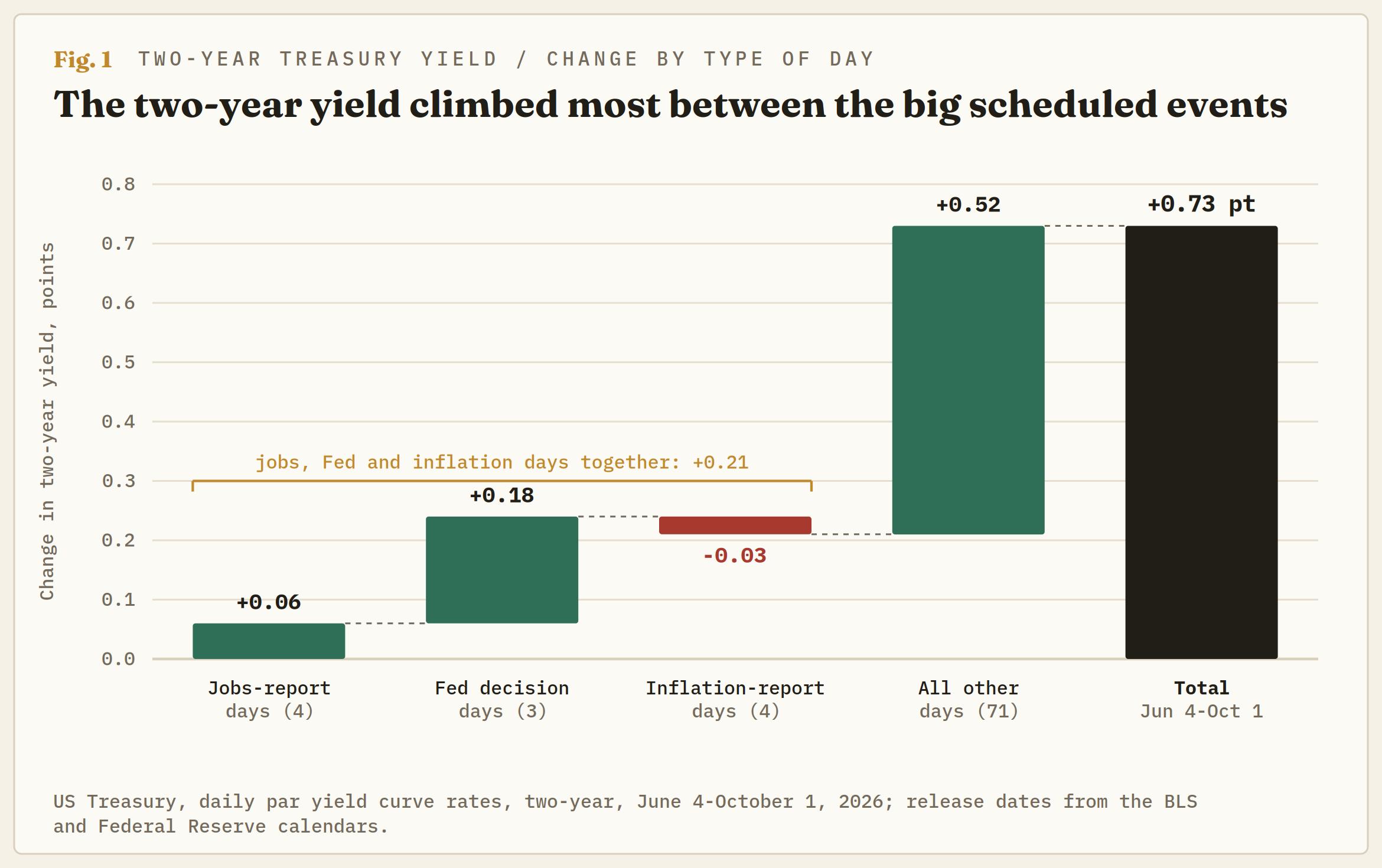
The two-year Treasury yield, the interest rate on two-year government debt, moves with expectations for the Fed's rate. It rose 0.73 of a percentage point between June 4 and October 1. The four jobs-report days in that stretch added a net 0.06 on the Treasury's daily figures, because the moves on those days ran in both directions.
The three Fed decision days added 0.18 and the four inflation reports came to -0.03, which leaves 0.52 for the days in between. Days with no jobs report, inflation report or Fed decision added more than twice as much as all of those events together. The yield fell again after the September report.
Keeping pace with a workforce that has nearly stopped growing
The September 16 FOMC statement said job gains have kept pace with the workforce and the unemployment rate has changed little. Dallas Fed President Logan said on Thursday, the day before the report, that 4.1% is close to the lowest unemployment rate the economy can sustain. Neither describes a labour market that would stop a hike.
Keeping pace is easy when the workforce barely grows. Fed Board staff research found the pool of available workers could grow by fewer than 10K a month in 2026 after a fall in immigration. Dallas Fed economists put the job growth needed to hold unemployment steady near zero since mid-2025. On that arithmetic, a jobs count near zero gives the futures market no reason to drop the December hike.
Reuters' surveys of economists put the same number at 0-50K on September 4 and 50K-80K on October 2. It's possible the economy needs 80K jobs a month, though in early September the same survey allowed for none at all. A 90K forecast sat above every one of those estimates, so September's 29K could miss it and still keep pace with the workforce on the Fed's own staff estimates. That is why FedWatch still has December at 100%.
The rate with the veto rose by three hundredths of a point
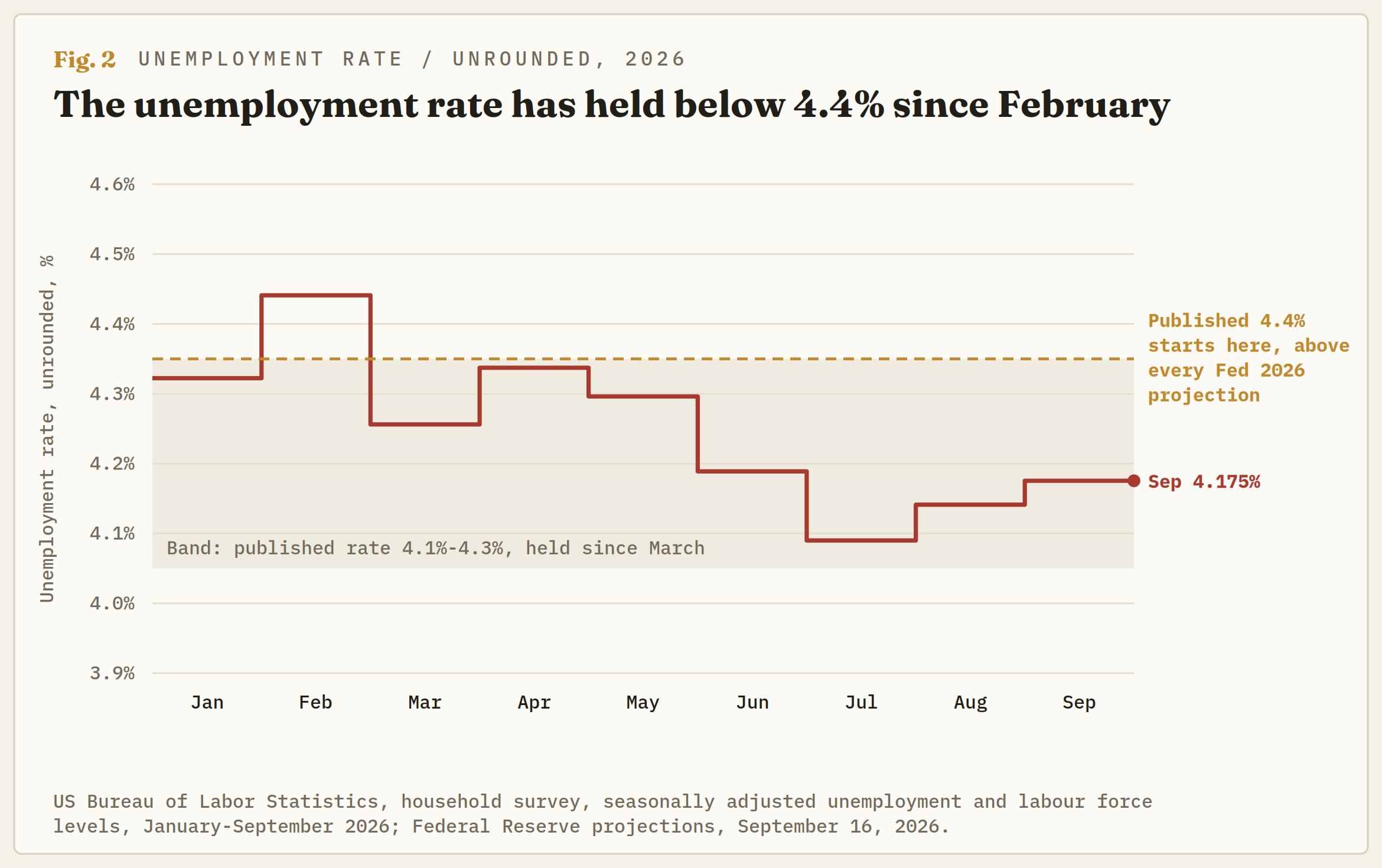
The unemployment rate rose to 4.2% from 4.1% in the September report. On the unrounded figures, it went from 4.141% to 4.175%, and the published rate has now been 4.1%-4.3% for seven months in a row.
The Fed's September projections leave little room for unemployment to rise. In June, seven of the 18 officials who submitted projections saw the risk to unemployment tilted higher, and in September none did. The highest projection for unemployment at the end of 2026 is 4.3%.
That makes 4.4% the reading that matters for FedWatch. It would be above every official's projection for the end of the year and outside the range the rate has held since March. It's the jobs-report number that can move December's 100%.
On inflation, the projections lean the other way, with 17 of the 18 seeing the risk tilted higher. The statement that announced the hike said it supports both of the Fed's goals, and the risk tallies show which one the officials are worried about.
Futures already price more hikes than any official projects
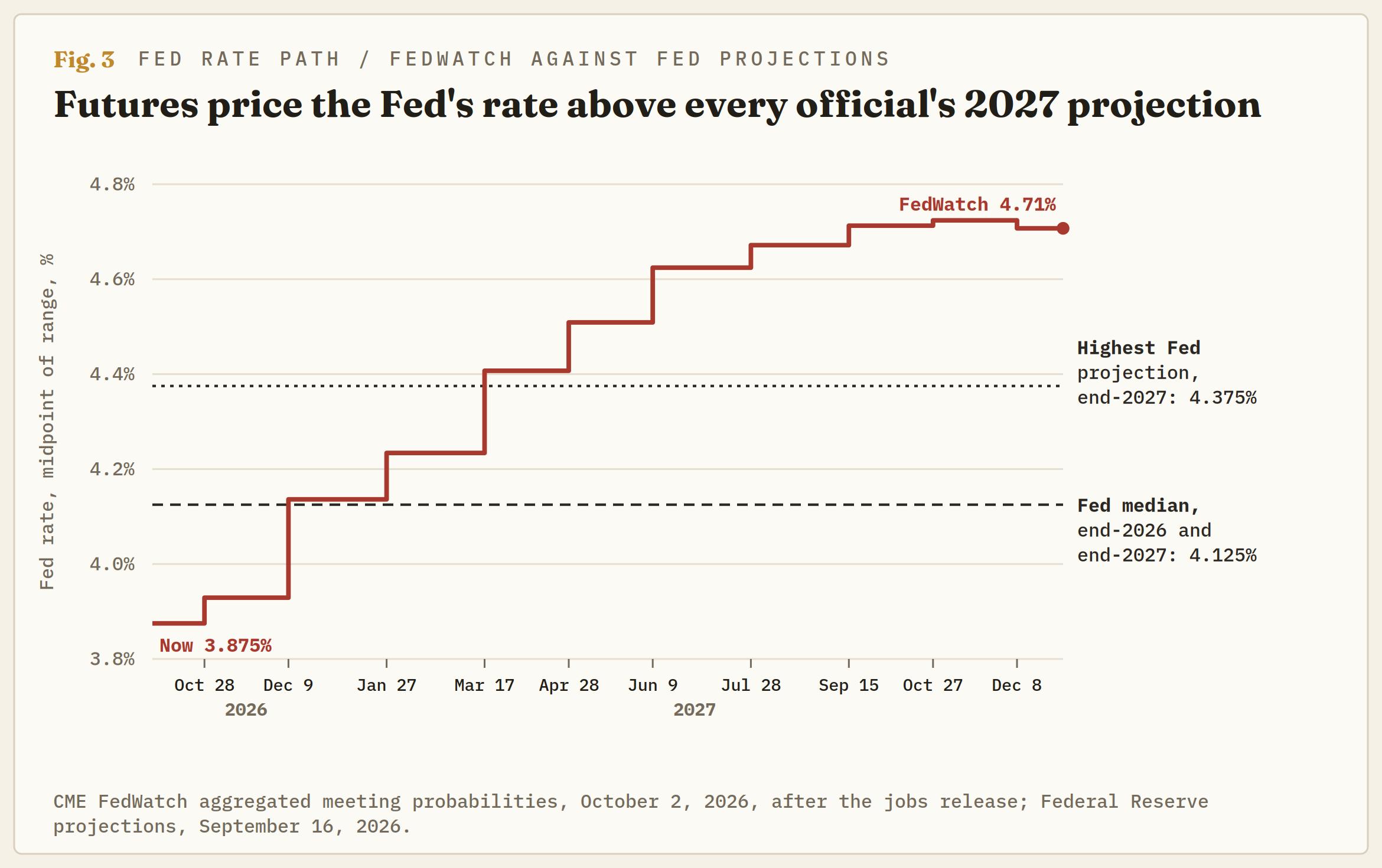
FedWatch prices three more hikes by June 2027, which would take the Fed's rate to 4.50%-4.75%, and shows no chance of anything lower at the end of 2027. The highest of the 18 official projections for the end of 2027 is 4.375%, the middle of 4.25%-4.50%. President Logan said on Thursday that rates need to rise another half a percentage point or more.
The next jobs report arrives after the October decision has been announced. The December 4 report lands five days before the December 9 decision.
FedWatch prices a second hike at 43.59% for January 27 and fully by March 17. With unemployment at 4.3% or lower, a payroll miss pushes that hike toward March and a payroll beat pulls it toward January. Unemployment at 4.4% or higher on either report is the condition that can move December, because it would break the range and the Fed's own projections at once.
Before either jobs report, the minutes of the September meeting arrive on October 7 and the September Consumer Price Index (CPI) on October 14. The lean is that the December hike holds, and that any drop in its odds on a payroll miss reverses while unemployment stays in range. The call is wrong if December's odds fall below 50% after a payroll miss with unemployment at 4.3% or lower. That would mean the jobs count itself had become a reason to stop.
Author

Joshua Gibson
FXStreet
Joshua joins the FXStreet team as an Economics and Finance double major from Vancouver Island University with twelve years' experience as an independent trader focusing on technical analysis.

















