UK Elections Preview: Five scenarios for the vote and potentially wild GBP/USD reactions
- The December 12 UK elections are critical for GBP/USD.
- A victory for PM Johnson is likely, but the scale is critical for sterling's gains.
- A hung parliament also has different variants, that may not necessarily plunge the pound.

"Nightmare on Downing Street on Friday the 13" – is how Prime Minister Boris Johnson has described a victory for Labour leader Jeremy Corbyn in the December 12 poll.
Investors may nod in agreement with Johnson's approach, as they would prefer him to stay. It is now his elections to lose. However, for cable traders, it is not a straightforward binary choice between these politicians – both highly unpopular – but also the composition of parliament. That is why five scenarios await GBP/USD.
Where we are and how we got here
Brits are called to vote in a national survey for the fourth time in as many years. The outgoing parliament lasted for only two and a half years – half the usual parliamentary term. Voter fatigue and the unusual timing of the elections – close to the shortest days of the year – adds to the uncertainty.
The House of Commons rejected the PM's predecessor Theresa May's Brexit deal three times and then forced Johnson to ask for an extension to Article 50 – delaying Brexit until January 31, 2020. While Johnson's accord passed the first hurdle, parliament rejected the PM's tight schedule for approval, and he began pushing for new elections.
The Liberal Democrats and the Scottish National Party concluded that they would be unable to force a second referendum and agreed to dissolve the House. Labour, lagging in the polls, eventually jumped on the bandwagon.
At the time of writing, opinion polls are showing Conservatives leading by around ten points over Labour. The Tories have gained from the Nigel Farage's Brexit Party losing most of its support. Labour has gradually advanced as support for the Liberal Democrats has eroded.
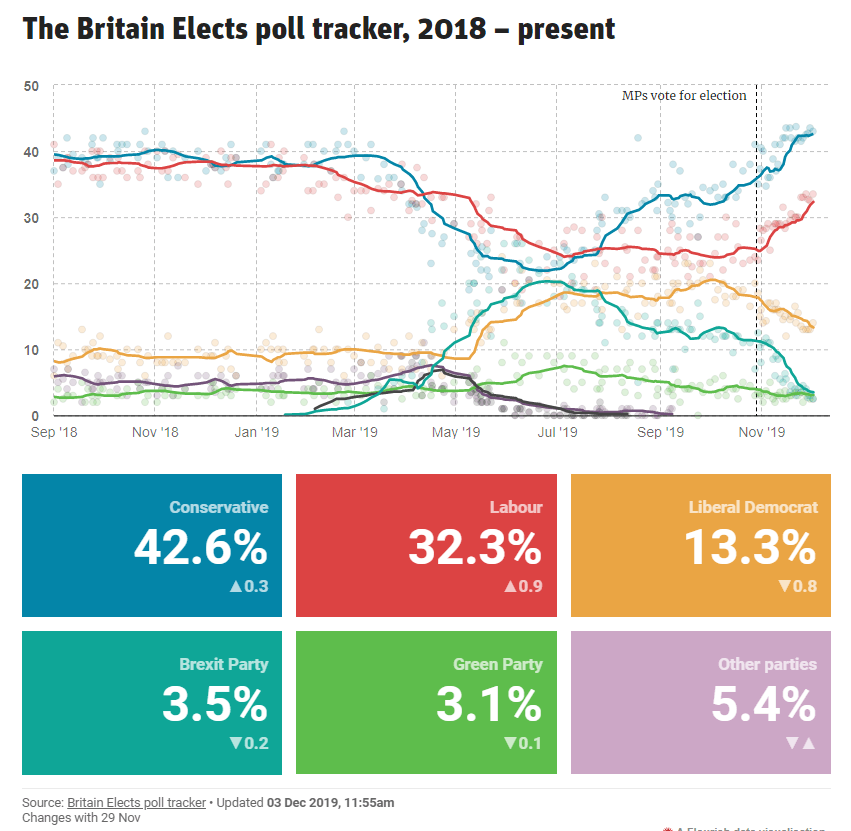
While Labour has been narrowing the gap, its advance only faintly resembled the party's comeback in 2017. The Conservatives' campaign is more disciplined in 2019, and Corbyn's unpopularity is weighing more heavily.
History often rhymes, but rarely repeats itself in full.
YouGov's broad Mutl-Regression Post-stratification (MRP) poll – an extensive statistical exercise – has shown a landslide majority of 68 for Johnson's party – but with many constituencies potentially won by small margins.
Nevertheless, with Britain's first-past-the-post system and the inaccuracy of polls in previous votes, nothing is guaranteed.
What markets want and why
Investors undoubtedly prefer the PM's Conservatives to win a landslide victory. That would enable Johnson to finally ratify his Brexit Withdrawal Bill and leave the EU in early 2020. And while the Tories have pledged more spending, their expenditure plans are modest in comparison to other parties – to investors' liking.
Johnson's version of Brexit may be detrimental to the economy. Moreover, he aims to end the transition period at the end of 2020 – and that may lead to leaving the bloc on World Trade Organization terms – another headwind. Perhaps markets see him pushing back that deadline – similar to missing the October 31 Brexit date. His morbid statements about preferring to "die in a ditch" or "do or die" luckily ended with no harm done.
In any case, businesses would rather have a dose of certainty than Corbyn's more complex Brexit approach. The Labour leader has pledged to renegotiate a softer exit from the EU and hold a referendum – with Remain on the ballot. While markets may prefer these options, the opposition's approach prolongs the uncertainty that has already hurt investment.
Moreover, investors fear the hard-left leader's radical manifesto, which includes massive spending and nationalization. Also, the chances of a Labour majority are virtually non-existent. And Corbyn would have to collaborate with the SNP, potentially leading to a second independence referendum in Scotland.
Rough timetable
The critical thing to remember is that in the UK elections, counting is slow, but governments can be formed quickly. Therefore, expect a long night between Thursday and Friday, but then a flurry of activity – with substantial news due before markets close.
7:00 GMT: Voting begins, and reports about turnout are published during the day – potentially moving the pound ahead of the results. Elevated turnout usually means high participation by the young, who tend to oppose Brexit and vote Labour or LibDem, and that may weigh on sterling. Low turnout means older voters – who lean toward Brexit and the Conservatives – may have the upper hand, thus pushing GBP/USD higher.
22:00 GMT: The BBC publishes exit polls, which will rock markets. However, trading may be choppy if the results are not clear enough.
Around 23:10 South Sunderland tends to be the first constituency to report real results and it is often seen as a barometer for the whole country.
From 00:00 on Friday and up to around 6:00 Results pour in and the picture becomes more evident. Every one of Britain's 650 constituencies has the potential to rock markets.
Around 8:00: Potential statements from leaders and a fuller market reaction as European traders join in.
During Friday: Further statements, potential resignations, and potentially the formation of a new government.
How to play GBP/USD – Five scenarios
GBP/USD has already advanced ahead of the elections, enjoying a Golden Cross pattern:
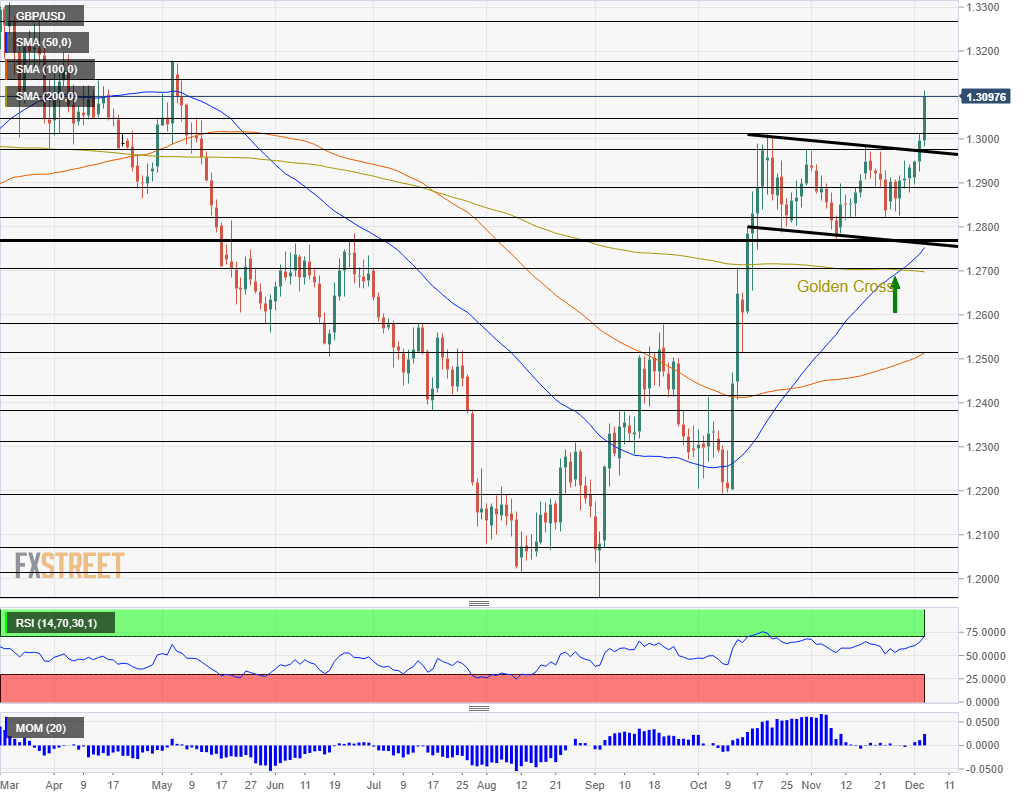
Here are five scenarios for election night and Friday the 13:
1) A landslide Conservative win – GBP/USD surges
If the Conservatives win a landslide majority of 68 votes that YouGov projected in its MRP poll – or any majority of around 30 seats or more, it would be an optimal outcome that would send sterling surging higher. The probability is medium-high.
Johnson would receive a personal mandate and broad room for shaping policy – Brexit or otherwise.
2) A small majority – GBP/USD up, then down
Markets would cheer a Tory victory, but sterling's advance may be ephemeral due to two reasons. The main reason is that the pound's recent surge mostly prices in such an outcome. The market reaction may eventually be a "buy the rumor, sell the fact" one. The probability is high.
Secondly, while Johnson would have succeeded in securing a majority – better than Theresa May – he may still find internal opposition towards the end of the transition period.
3) Hung parliament – GBP/USD down, then up
History may fully repeat itself with the Tories falling just short of a majority. That would likely send the pound plunging. Johnson might begin scrambling to make a deal with the Northern Irish Democratic Unionist Party (DUP). The probability is medium.
This time, the small faction will probably demand more as they feel betrayed by the PM's Brexit deal that creates a customs border on the Irish Sea.
However, if a government is formed, sterling could rise after an initial drop as it would keep Corbyn away from Downing Street.
4) Hung parliament, Corbyn steps aside – GBP/USD down, then up
In this scenario, the elections result in a hung parliament, and that initially weighs heavily on the pound.
Labour could form a coalition or a minority government, but perhaps by sacrificing the leader. If LibDem leader Jo Swinson is a position to condition her support on having a different PM instead of Corbyn, the initial downfall of the pound could be followed by a surge.
A Remain coalition led by a centrist Labour MP could turn into the best-case scenario. However, the probability is low for such an outcome or for Corbyn to step down.
5) Jeremy Corbyn, PM – GBP/USD crashes
In this option, Corbyn enters Downing Street. In this case, sterling may stumble significantly as such a scenario would be a shocker. The probability is very low.
For this scenario to occur, Labour's would need to win many constituencies, and get close to the number of seats won by the Conservatives. A late surge or "break" toward the opposition party would have to occur at the last moment. The SNP would join him on the condition of an IndyRef in 2020, and the Liberal Democrats would go along.
Conclusion
The December 12 elections are critical for the UK and the pound. Markets prefer and are cautiously pricing in a victory for the Conservatives, but nothing is guaranteed, and different scenarios may move sterling.
More Three UK Election Projections, Raw Numbers and Seat by Seat
Author

Yohay Elam
FXStreet
Yohay is in Forex since 2008 when he founded Forex Crunch, a blog crafted in his free time that turned into a fully-fledged currency website later sold to Finixio.
















