Trump flexes tariff muscle once again, as investors continue to buy the dip

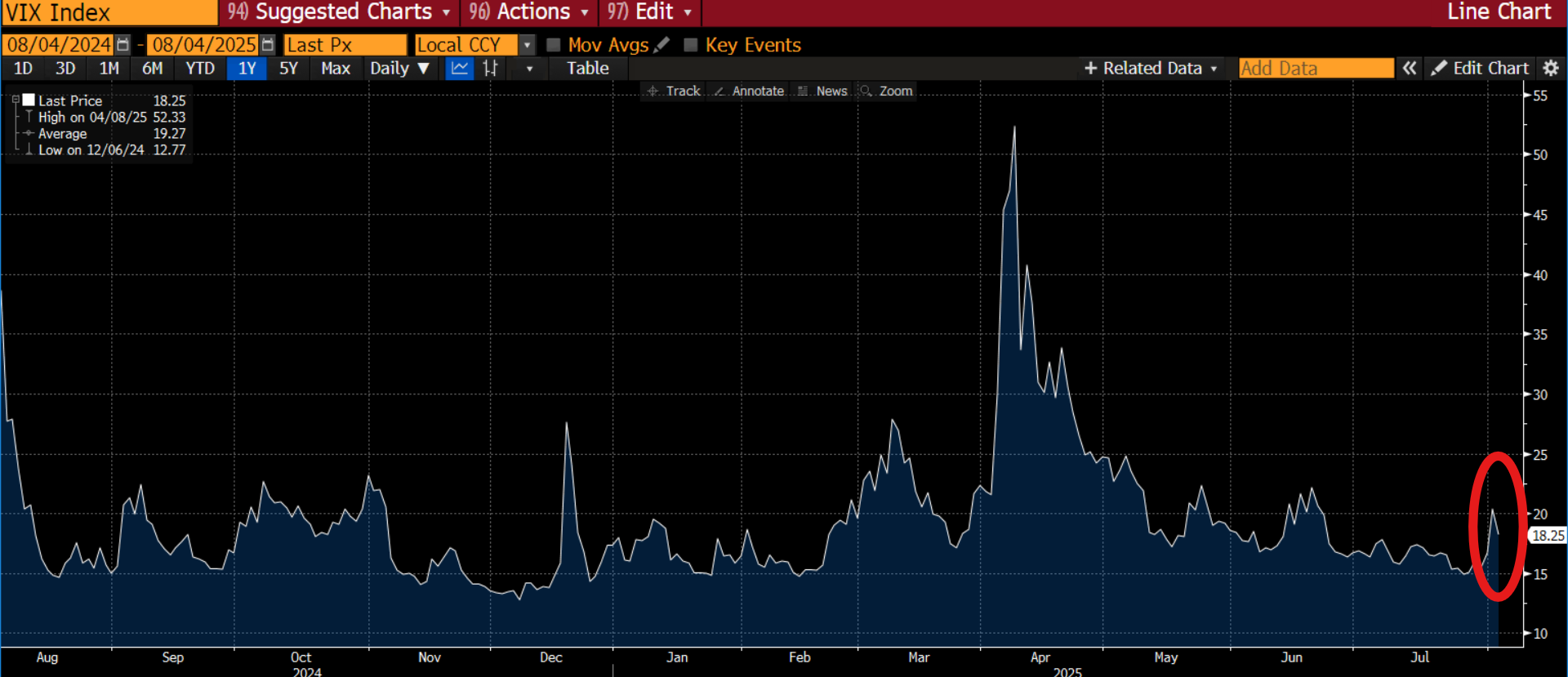
Volatility tends to spike at the start of August, and that has certainly been the case in 2025. After selling off sharply on Friday, global stock markets are recouping some of their losses on Monday. Stock indices are a sea of green, and US indices are higher by more than 1%. European stocks are also sharply higher, although the FTSE 100 is underperforming as it gets weighed down by its energy sector, which has been impacted by the latest production increase from Opec +.
Chart 1: Vix volatility index for the S&P 500
India gets tariff threat from US
The tariff drama continues, which could keep the Vix elevated this week. On Monday afternoon, Donald Trump said that he would increase the tariff rate on India due to the country’s purchases of Russian oil. The President did not say by how much he would raise tariffs, which currently stand at a hefty 25%, but it suggests that Donald Trump will continue to use tariffs as a means to reach his political aims, this time in foreign policy.
Swiss stocks gain as trade negotiations re start
This news is not having much impact on risk sentiment, and US stocks continue to extend gains on Monday. This could be because negative tariff headlines are balanced out by good ones. For example, the latest headlines suggest that the Swiss authorities are willing to make a better trade offer to Donald Trump in return for a lower trade levy. This has helped the Swiss index to recoup earlier losses. Overall, the S wiss stock market has underperformed other European indices in the aftermath of the April sell off. However, the impact from the 39% tariff rate imposed by Donald Trump has not had a devastating impact on Swiss stocks in recent days. This is a sign that investors are optimistic about the prospect of a lower levy being negotiated in the coming days.
The dollar remains weak on Monday, but it has picked up from its lows, as Treasury yields have risen after Friday’s sharp drop. The dollar is less loved than stocks right now, as it faces a political risk premium that stocks can avoid.
Strong earnings fuels ‘buy the dip’ mentality
Part of the upward bias for US stocks and the ‘buy the dip mentality’ is earnings season. It has been a strong earnings season for the US so far, led by positive results from the tech sector. Of the two thirds of S&P 500 companies that have reported results so far, more than 80% have reported better than expected results, and companies are reporting earnings that are on average 8% better than expected. The blended earnings growth rate is now above 10% for Q2, which is the third consecutive quarter of double-digit growth rates for the S&P 500. Considering expectations were for a weak earnings report coming into the Q2 reporting season, this is something to cheer about.
Can stocks continue to rise as tariff reality bites?
Thus, if we are in the most volatile period of the year, in this environment it is reasonable to expect volatility to be short lived, as investors continue to buy the dip. Th bias is higher for stocks right now, and a strong set of earnings supports this view. Of course, Q2 earnings do not include the latest tariff rates imposed by Donald Trump, which are higher than the 10% base rate that was implemented after ‘Liberation Day’ in April. Thus, we shall have to see if the S&P 500, and the tech and finance sectors, can keep it up later this year.
Author

Kathleen Brooks
XTB UK
Kathleen has nearly 15 years’ experience working with some of the leading retail trading and investment companies in the City of London.