Trade reversal leads to sharp widening in November trade balance

Summary
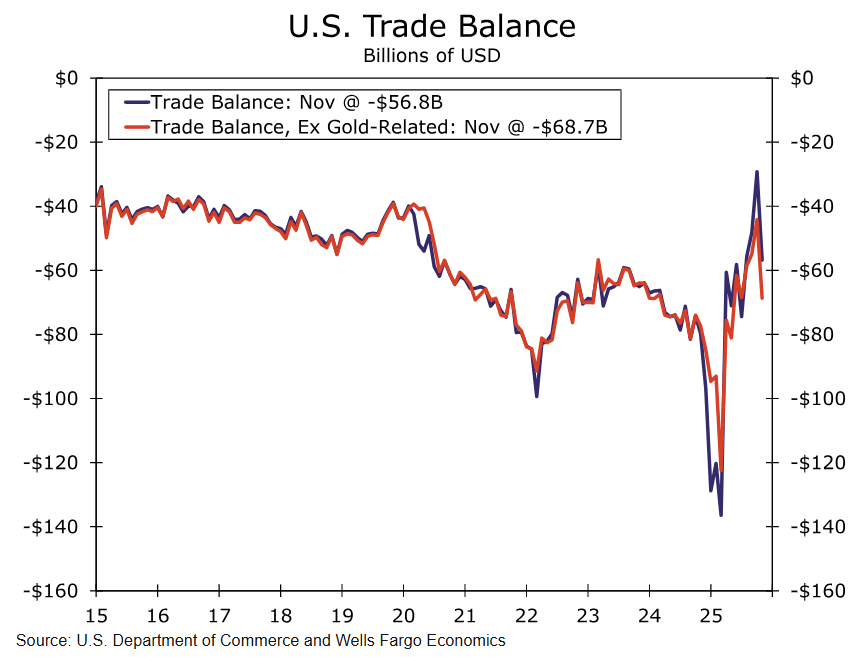
The US trade deficit widened by nearly $30 billion in November, reversing the prior two months of narrowing amid some payback in gold-related exports and large moves in pharmaceuticals. Cutting through month-to-month volatility and high-tech related demand, underlying imports are tracking to be down last year.
Reverse, reverse
It's been a long time since we've gotten a clean read from the U.S. international trade data. November remained murky. The trade deficit sharply widened to $56.8 billion in November, mostly reflecting payback in specific categories.
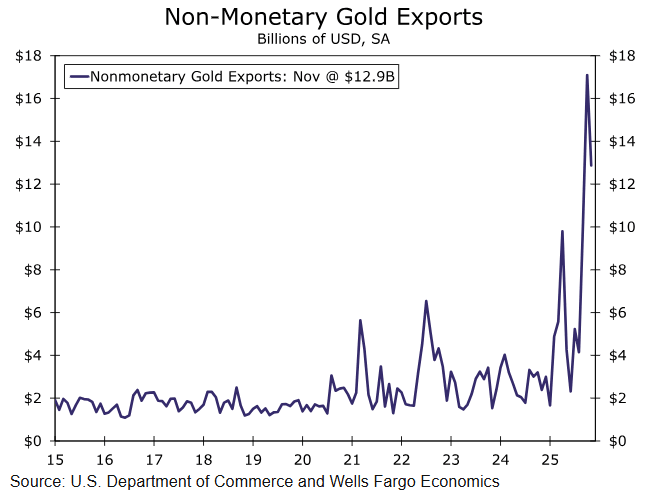
Gold is driving a lot of the headline change. Non-monetary gold exports fell $4.2 billion in November, but at $12.9 billion total gold exports are still running at an elevated level (chart). The price of gold has surged, surpassing $5,000 per ounce, but the jump in recent flows looks to be due to increased volume of gold flowing out of the country. Since most of this transfer is for investment purposes, the Bureau of Economic Analysis excludes the effect from the trade data in the GDP accounts. As seen by the nearby chart, making similar adjustments reveals a wider trade balance in November.
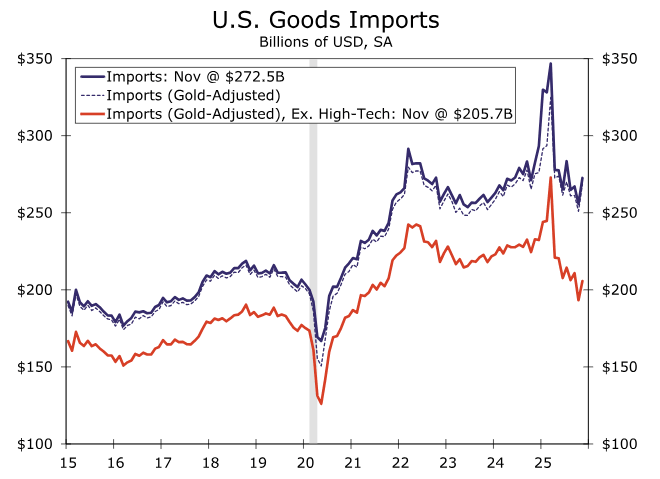
Trade in pharmaceuticals also had an out-sized effect on November flows. We saw a decent-size drop in pharmaceutical exports, which slipped $2.9 billion in November, contributing to the overall 3.6% pullback in exports. Pharmaceutical imports, however, jumped $6.7 billion following a drop more than two-times the size the month prior. This along with a jump in high-tech related categories of imports like computers (+$6.6 billion) and semiconductors (+$2.0 billion) were responsible for the 5% rebound in import growth in November, contributing to the widening in the overall deficit.
Pealing back this onion a bit, import growth was weak in 2025. Overall goods imports are up 5.6% on a year-to-date basis compared to last year, but in adjusting for gold investment, that gain is cut in half. Further, most of the strength in import growth last year was in categories of goods at the center of the high-tech transition. Excluding high-tech related imports (like computers, telecommunications equipment, semiconductors) underlying import growth was negative, slipping 2.6% through November (chart).
The rapid change to trade policy left many importers paralyzed. Changes to tariff rates over the course of the year caused confusion on what rate they would ultimately be exposed to over the medium term. It remains to be seen where imports settle after seeing some pull-forward earlier in the year ahead of tariffs and then some payback since. There has been little indication yet of a large onshoring of manufacturing operations in the wake of tariffs, which suggests import growth will likely recover somewhat this year as businesses rebuild some inventory to meet demand. Underlying domestic demand has held up reasonably well, but consumer spending and capex investment outside of high-tech related categories have slowed allowing firms to run leaner inventories in the wake of tariffs thus far.
Author
Wells Fargo Research Team
Wells Fargo