Australian Dollar Price Forecast: Did the correction just kicked in?
- AUD/USD could not sustain an early move toward fresh highs near 0.7100.
- The US Dollar picks up extra pace investors assess the latest Fed meeting.
- The RBA is seen hiking its OCR by 25 bps to 3.85% at its February 3 event.

AUD/USD is still very much in the big picture of going up, even though the pair is taking a break after its last rise. The bigger picture is still supported by a better risk environment and rising confidence that the Reserve Bank of Australia (RBA) could raise rates as early as next week.
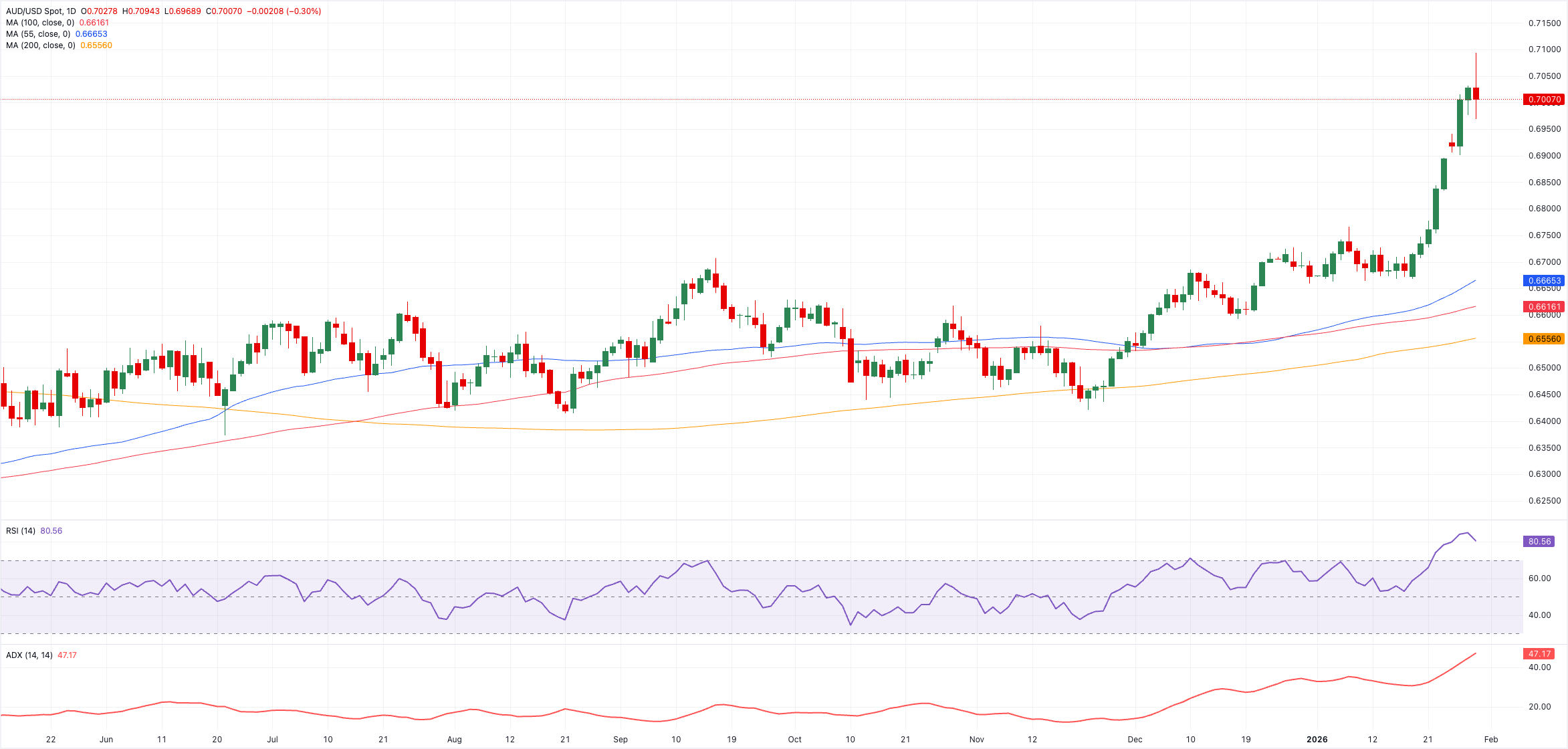
That being said, the Australian Dollar (AUD) did lose some ground on Thursday. AUD/USD briefly rose to new highs near 0.7100, its highest level since February 2023. However, heavy selling brought the pair back down below 0.7000.
The pullback shows that people are once again buying the US Dollar (USD) as the markets continue to process the Federal Reserve's decision on Wednesday to keep rates the same. Also, a new flare-up of tensions in the Middle East has taken some of the shine off the broader risk rally.
Australia: slowing gently, not stalling
Recent Australian data may not have set pulses racing, but they still paint a picture of an economy cooling gradually rather than rolling over. Growth momentum has eased, yet the soft-landing narrative remains very much alive.
January’s Purchasing Managers’ Index (PMI) surveys back that up. Both Manufacturing and Services activity improved and stayed comfortably in expansion territory, with readings of 52.4 and 56.0, respectively. Retail Sales continue to hold up reasonably well, and while the trade surplus narrowed to A$2.936 billion in November, it remains firmly in positive territory.
Economic growth is clearly moderating, but only at a measured pace. Gross Domestic Product (GDP) expanded by 0.4% QoQ in Q3, easing from 0.7% previously. On an annual basis, growth held steady at 2.1%, exactly in line with RBA projections.
The labour market remains a standout. Employment surged by 65.2K in December, while the Unemployment Rate unexpectedly slipped to 4.1% from 4.3%.
Inflation, however, continues to complicate the picture. December’s Consumer Price Index (CPI) surprised to the upside, with headline inflation jumping to 3.8% YoY from 3.4%. The policy-relevant trimmed mean rose 3.3% from a year earlier, matching consensus and edging above November’s 3.2%, but, crucially, overshooting the RBA’s own 3.2% December projection. On a quarterly basis, trimmed mean inflation climbed to 3.4% YoY in Q4, its highest since Q3 2024. That combination keeps the case for a 25 basis points hike at the February 3 meeting firmly in play.
China: support is there, but it’s muted
China continues to provide a supportive backdrop for the AUD, though without the kind of momentum that tends to ignite sustained rallies.
The economy expanded at an annualised pace of 4.5% in the October–December quarter, with quarterly growth running at 1.2%. Retail Sales rose at an annualised 0.9% in December. Solid numbers, but hardly blockbuster.
More recent indicators point to stabilisation rather than acceleration. Both the official Manufacturing PMI and the Caixin index edged back into expansion at 50.1 in December. Services activity also improved, with the Non-Manufacturing PMI at 50.2 and the Caixin Services PMI holding at a healthy 52.0.
Trade was one of the clearer bright spots. The surplus widened sharply to $114.1 billion in December, helped by a near-7% jump in exports alongside a solid 5.7% rise in imports.
Inflation, however, remains mixed. Consumer price inflation was unchanged at 0.8% in the year to December, while producer prices stayed firmly negative at -1.9%, a reminder that deflationary pressures have yet to fully disappear.
For now, the People’s Bank of China (PBoC) is sticking with a cautious approach. Loan Prime Rates (LPR) were left unchanged earlier in January at 3.00% for the one-year and 3.50% for the five-year, reinforcing expectations that any policy support will be gradual rather than forceful.
RBA: firm footing, flexibility intact
The RBA struck a firm tone at its December meeting, leaving the Official Cash Rate (OCR) unchanged at 3.60% and signalling little urgency to adjust policy.
Governor Michele Bullock pushed back against expectations for rate cuts in the near future, making it clear that the Board is okay with keeping rates higher for longer and is ready to raise them even more if inflation doesn't cooperate.
The December meeting Minutes added some nuance, revealing internal debate around whether financial conditions are restrictive enough. That discussion keeps rate cuts firmly in the “not guaranteed” camp.
Following the latest inflation data, markets are now pricing roughly a 70% chance of a rate hike at next week’s meeting, with close to 54 basis points of tightening priced in by year-end.
Positioning: pressure is easing, but conviction is still low
Positioning data show that the worst of the negative mood around the AUD may be behind us, even though confidence is still shaky. According to the Commodity Futures Trading Commission (CFTC), speculators cut their net short positions to about 14K contracts by the end of the week ending January 20. This is the least negative positioning since late September 2024.
Open interest has also gone up to about 230.6K contracts, which means that people are getting involved again. Right now, though, this feels more like a tentative toe-dip than a full-blown shift towards being very bullish.
What could change things next
Near term: US data releases, headlines about tariffs, and more geopolitical noise are likely to affect the US Dollar side of the story. Next week's RBA rate decision will be very important for the AUD at home. It will determine whether the currency can keep going up.
Risks: The AUD is still very sensitive to changes in global risk sentiment. Any sudden drop in risk, new concerns about China, or a stronger-than-expected rebound in the US Dollar could quickly stop any further gains.
Technical landscape
AUD/USD now faces its initial resistance at the 2026 ceiling at 0.7093 (January 29). However, the pair’s still overbought condition keeps pointing to a probable “technical correction” in the short-term horizon.
In the meantime, once the recent tops are cleared, spot could attempt a move toward the 2023 peak at 0.7157 (February 2).
On the other hand, immediate contention comes at the 2026 bottom at 0.6663 (January 9), ahead of the transitory 55-day and 100-day SMAs at 0.6658 and 0.6614, respectively. South from here lies the important 200-day SMA at 0.6551, seconded by the November base at 0.6421 (November 21).
Looking at the broader picture, the pair’s positive stance should remain in place above its 200-day SMA.
Additionally, momentum indicators underpin the positive momentum, although not without caution: the Relative Strength Index (RSI) remains well in the overbought zone near the 77 mark, while the Average Directional Index (ADX) near 46 is indicative of a very robust trend.
Bottom line
AUD/USD remains closely tied to global risk sentiment and China’s economic trajectory. A sustained break above 0.7000 would be needed to deliver a clearer bullish signal.
For now, a softer USD, steady, if unspectacular, domestic data, an RBA leaning towards renewed tightening, and modest support from China keep the bias tilted towards further gains rather than a deeper reversal.
Australian Dollar FAQs
One of the most significant factors for the Australian Dollar (AUD) is the level of interest rates set by the Reserve Bank of Australia (RBA). Because Australia is a resource-rich country another key driver is the price of its biggest export, Iron Ore. The health of the Chinese economy, its largest trading partner, is a factor, as well as inflation in Australia, its growth rate and Trade Balance. Market sentiment – whether investors are taking on more risky assets (risk-on) or seeking safe-havens (risk-off) – is also a factor, with risk-on positive for AUD.
The Reserve Bank of Australia (RBA) influences the Australian Dollar (AUD) by setting the level of interest rates that Australian banks can lend to each other. This influences the level of interest rates in the economy as a whole. The main goal of the RBA is to maintain a stable inflation rate of 2-3% by adjusting interest rates up or down. Relatively high interest rates compared to other major central banks support the AUD, and the opposite for relatively low. The RBA can also use quantitative easing and tightening to influence credit conditions, with the former AUD-negative and the latter AUD-positive.
China is Australia’s largest trading partner so the health of the Chinese economy is a major influence on the value of the Australian Dollar (AUD). When the Chinese economy is doing well it purchases more raw materials, goods and services from Australia, lifting demand for the AUD, and pushing up its value. The opposite is the case when the Chinese economy is not growing as fast as expected. Positive or negative surprises in Chinese growth data, therefore, often have a direct impact on the Australian Dollar and its pairs.
Iron Ore is Australia’s largest export, accounting for $118 billion a year according to data from 2021, with China as its primary destination. The price of Iron Ore, therefore, can be a driver of the Australian Dollar. Generally, if the price of Iron Ore rises, AUD also goes up, as aggregate demand for the currency increases. The opposite is the case if the price of Iron Ore falls. Higher Iron Ore prices also tend to result in a greater likelihood of a positive Trade Balance for Australia, which is also positive of the AUD.
The Trade Balance, which is the difference between what a country earns from its exports versus what it pays for its imports, is another factor that can influence the value of the Australian Dollar. If Australia produces highly sought after exports, then its currency will gain in value purely from the surplus demand created from foreign buyers seeking to purchase its exports versus what it spends to purchase imports. Therefore, a positive net Trade Balance strengthens the AUD, with the opposite effect if the Trade Balance is negative.
Author

Pablo Piovano
FXStreet
Born and bred in Argentina, Pablo has been carrying on with his passion for FX markets and trading since his first college years.

















