The year of hard assets has arrived – Are you ready to capitalize? [Video]
![The year of hard assets has arrived – Are you ready to capitalize? [Video]](https://editorial.fxsstatic.com/images/i/gold-01.jpg)
The opening weeks of 2026 have delivered a decisive verdict: capital is abandoning faith-based finance and rotating aggressively into scarcity. What The Gold & Silver Club identified well ahead of consensus is now unmistakable. A regime shift is under way and hard assets are its primary beneficiaries.
This message is no longer confined. Wall Street is turning. Strategists at Bank of America have gone decisively bullish on Commodities, arguing that “soon, all Commodity charts will look like Gold.” After more than a decade of neglect, Energy, Metals and Real Assets are being repositioned as the defining contrarian trade of 2026 – an assessment now echoed across the world’s most influential investment banks.
Gold has wasted no time asserting leadership. Prices have surged through successive record highs, extending a run that now sees bullion outperform the S&P 500 for six consecutive months – the longest such streak since the Global Financial Crisis in 2008.
According to Lars Hansen, Head of Research at The Gold & Silver Club, “Gold is now the best-performing major asset of the 2020s – outpacing Equities, Real Estate and Bonds on an annualised basis.”
Silver, however, is where the move becomes explosive.
The Gold-to-Silver ratio has collapsed toward 50 – its lowest level in roughly 14 years – after plunging from above 100 in 2025. The implications are profound. Gold has exploded through $4,690 an ounce, rising more than 78% in just 13 months from its January 2025 opening price of $2,624. The move now rivals the early stages of the 1970s Gold Supercycle.
Silver’s ascent has been even more dramatic. Prices have rocketed above $94 an ounce – up more than 32% year-to-date and an astonishing 235% in just over a year. As Hansen notes, “Silver’s market capitalization has now crossed $5 trillion – overtaking the entire U.S bond market and eclipsing Germany’s equity market.”
The structural underpinnings are impossible to ignore. For the first time in nearly three decades, global central banks now hold more Gold than U.S Treasuries as a share of reserves. Nations from China and India to Poland and Singapore are systematically exchanging paper claims for physical metal – reflecting mounting concern over sovereign debt sustainability and geopolitical fracture.
As Hansen puts it bluntly: “Gold is no longer a hedge. It is a vote of no confidence in the existing monetary order.”
This is not a one-metal story. Uranium has surged to its highest level since mid-2024. Copper, Nickel, Zinc, Aluminium, Platinum, Palladium and Tin have all broken to multi-year, decade-high or all-time record highs – marking the broadest synchronised Commodity breakout since the post-crisis renaissance of 2009 and in several cases, a stronger one.
Across 47 listed Commodities, 38 are positive year-to-date, with more than two dozen now within striking distance of fresh all-time highs.
Since early 2025, The Gold & Silver Club has warned that relentless fiscal expansion, weaponized trade policy and tightening supply would collide – forcing a violent repricing of physical assets. That forecast is no longer theoretical. It is visible, measurable and accelerating.
Bank of America’s assertion that “all Commodity charts will look like Gold” is already materializing. The visual resemblance across the complex is becoming unmistakable.
Hansen frames the moment clearly:
“Liquidity is rising, purchasing power is eroding and scarcity is being repriced in real time. Under these conditions, Gold at $5,000 and Silver at $100 in Q1 2026 are not stretch targets – they are checkpoints on a longer road.”
The lesson of 2025 was that the trend was undeniable. The lesson of 2026 may be that it becomes unstoppable.
Traders waiting for comfort may discover that comfort only arrives when the opportunity is gone. As Hansen concludes: “Markets reward accumulation, not hesitation. Being structurally underweight Metals may prove to be the most expensive strategic error of the next decade.”
The Year of Hard Assets is no longer a thesis. It is the operating environment. Those still on the sidelines risk watching one of the greatest generational wealth transfers of our lifetime unfold without them.
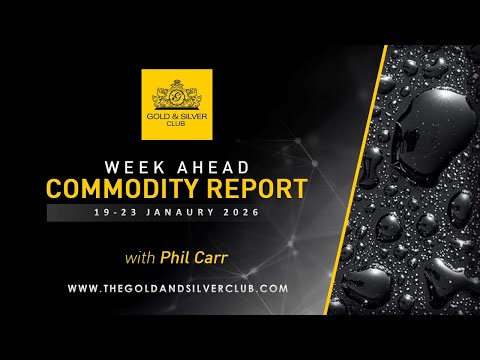
Where are prices heading next? Watch The Commodity Report now, for my latest price forecasts and predictions:
Author

Phil Carr
The Gold & Silver Club
Phil is the co-founder and Head of Trading at The Gold & Silver Club, an international Commodities Trading Firm specializing in Metals, Energies and Soft Commodities.