$4,000 or $4,500? The Fed may decide Gold’s next big move

Gold bottomed at $4,023 early in June, its lowest since last November. Ever since then, the bright metal has recovered roughly $300, but could the rally continue? Is there a chance for Gold?
The US Dollar (USD) turned south on headlines indicating that the United States (US) and Iran had reached an agreement, which is, anyway, far from ending the war: the agreement aims to extend the truce for 60 days to allow additional negotiations. It also partially restored traffic through the Strait of Hormuz, although a full reopening has not yet been confirmed. The headlines have been enough to take Oil prices sharply down, but not enough to put the Greenback on sell-off mode.
Gearing up for the Federal Reserve
In part, the limited USD reaction is due to the upcoming Federal Reserve (Fed) monetary policy announcement. The Federal Open Market Committee (FOMC) is undergoing its two-day meeting, the first one led by Chair Kevin Warsh, and will announce its monetary policy decision on Wednesday.
Market players are largely expecting the central bank to remain on hold, as Warsh and co. are between a rock and a hard place: the Iran war has triggered inflation to levels that pretty much double the central bank’s 2% goal. At the same time, US President Donald Trump is calling for lower interest rates. Naming Warsh as Jerome Powell’s successor was part of Trump’s agenda on lower rates. But Warsh is just one of twelve voters, and the data is far from supportive of a rate cut. In fact, it’s quite the opposite.
With that in mind, it is likely that the benchmark interest rate will remain unchanged, while Chair Warsh will have to trot out his political savvy. How President Trump will react to the monetary policy announcement is likely to be a bigger market mover than the decision itself.
Generally speaking, the USD should strengthen with a hawkish decision, one that hints that the next rate move will be up. The opposite scenario is also valid: a dovish announcement hinting at holding rates unchanged or even cutting them in the foreseeable future should send the USD nosediving.
The latter scenario seems the most politically correct, but the least likely, given the macroeconomic frame. The best Warsh can do to minimize Trump’s anger is to deliver a neutral speech, leaving the door open for both paths and directly linking it to upcoming data.
And what about Gold trend?
Well, Gold may see some near-term demand on an on-hold decision, and if the Fed leans dovish. The bright metal, however, needs to run a long mile before confirming a newly born bullish trend that could see price approaching record highs.
If the Fed leans hawkish and war-related optimism persists, Gold has a better chance of returning to the $4,000 level than of recovering beyond $4,500, a psychological line in the sand.
XAU/USD technical outlook
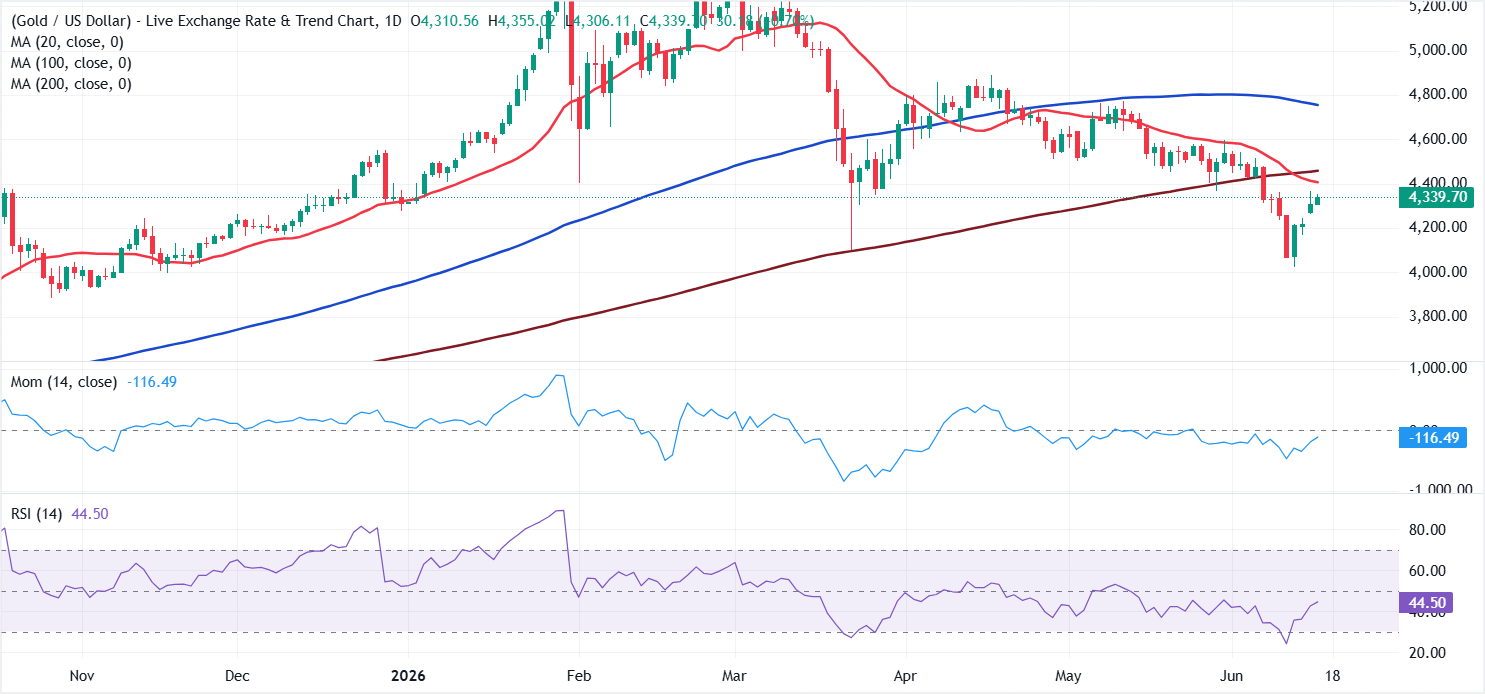
From a technical standpoint, the latest XAU/USD advance seems corrective. The daily chart shows that the pair remains far below all its Simple Moving Averages (SMAs), which offer a bearish alignment, as the bearish 20-day SMA has crossed below the 100- and 200-day SMAs for the first time since September 2023. The 20-day SMA at around $4,400 provides relevant dynamic resistance ahead of the 200-day SMA at around $4,475. Next comes the $4,500 mentioned mark, with steady gains beyond it confirming buyers regained control.
There is an unfilled weekly opening gap at $4,219, with a pullback to that level on the cards, should the USD recover its strength. Further falls are likely to end with sellers aiming to test buyers' determination at around the $4,000 barrier.
Author

Valeria Bednarik
FXStreet
Valeria Bednarik was born and lives in Buenos Aires, Argentina. Her passion for math and numbers pushed her into studying economics in her younger years.